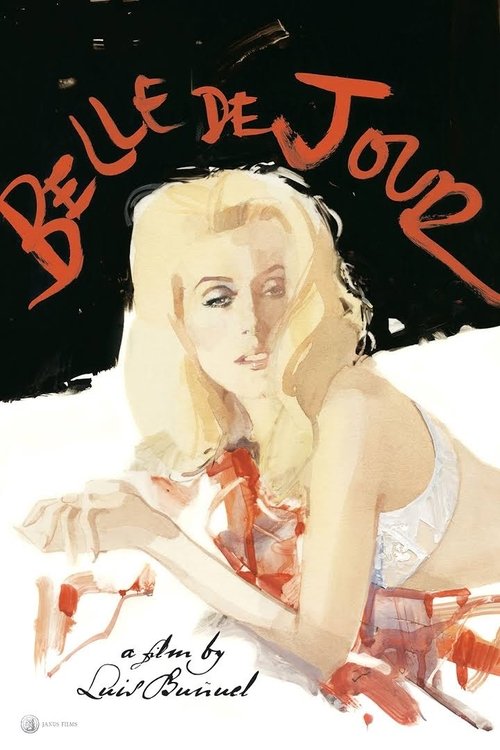
Belle de Jour (1967)
Directed by Luis Buñuel
No — Belle de Jour is not woke, scoring 12 out of 100 on our wokeness meter.
Luis Buñuel took on Joseph Kessel's 1928 novel, which he privately regarded as a soap opera, and turned it into something colder and stranger.
Consciousness Markers
The film centers a woman's sexual interiority and fantasies with unusual seriousness for 1967, granting Séverine an inner life and agency, though it is a surrealist character study rather than a feminist polemic.
Buñuel's characteristic anti-bourgeois satire is present in the portrait of a respectable Parisian household sustained by hypocrisy, but it is a surrealist critique rather than an economic 'eat the rich' thesis.
Buñuel is deliberately ambiguous and surreal rather than didactic; the film resists moralizing or messaging.
The cast is entirely white French actors; no diversity-conscious casting is present or attempted.
No LGBTQ+ characters or themes appear; the eroticism is strictly heterosexual.
No engagement with race or racial politics whatsoever.
No environmental or climate themes.
No body-positivity themes; the film trades on conventional glamour and Deneuve's star image.
No neurodivergence themes; the fantasies are framed as erotic psychology, not neurodivergence.
No historical revisionism; the film is a contemporary-set adaptation of a 1928 novel.
Why it received this score
Luis Buñuel took on Joseph Kessel's 1928 novel, which he privately regarded as a soap opera, and turned it into something colder and stranger. Catherine Deneuve plays Séverine, a beautiful Parisian housewife who cannot sleep with her adoring husband but spends her weekday afternoons in a high-class brothel under the name Belle de Jour. The film treats her fantasies with a straight face, granting a woman an interior life of domination and shame that 1967 cinema rarely permitted. That is a genuine act of attention. It is also a surrealist character study, not a tract, and the sympathy it extends to Séverine has more to do with Buñuel's curiosity about desire than with any program for the liberation of women. The eroticism is entirely heterosexual, the cast entirely white, and no contemporary social markers intrude on the proceedings.
Where the film does draw blood is in its portrait of the bourgeoisie. The Serizy household is immaculate, respectable, and built on a lie. Buñuel's contempt for polite Parisian hypocrisy is unmistakable, though it operates as surrealist mockery instead of an economic argument about wealth. Nobody here is eating the rich. They are merely deceiving one another in well-tailored clothes, which is a different and older complaint.
The film resists moralizing almost entirely. Buñuel declines to tell us what Séverine's double life means, and the final scene refuses to resolve whether we are watching reality or another fantasy. There is no sermon, no lesson, no finger raised from the pulpit. The result is a film that has aged into a kind of chilly glamour, admired more than loved, its provocations now muted by sixty years of familiarity. We are left with Deneuve's blank perfection and a director who found the whole arrangement amusing and said so quietly.
Analysis generated by our Consciousness Algorithm


Synopsis
Beautiful young housewife Séverine Serizy cannot reconcile her masochistic fantasies with her everyday life alongside dutiful husband Pierre. When her lovestruck friend Henri mentions a secretive high-class brothel run by Madame Anais, Séverine begins to work there during the day under the name Belle de Jour. But when one of her clients grows possessive, she must try to go back to her normal life.
Questions about Belle de Jour
Is Belle de Jour woke?
No — Belle de Jour is not woke, scoring 12 out of 100 on our wokeness meter. That earns it a verdict of Ultra Based.
Does Belle de Jour have any woke elements?
Very few. None of the 10 markers reaches 30, the level where a marker counts as present; the highest is Feminist Agenda at 25.
How does Belle de Jour compare to other 1967 movies?
It ranks #4 of the 19 films from 1967 we've scored; their average is 10. The wokest is In the Heat of the Night (60).
How is the Woke Score calculated?
An AI-assisted process researches the film and its reception, scores it 0–100 on ten markers, then combines those into one 0–100 Woke Score. It measures a specific set of 2020s cultural themes, not film quality.