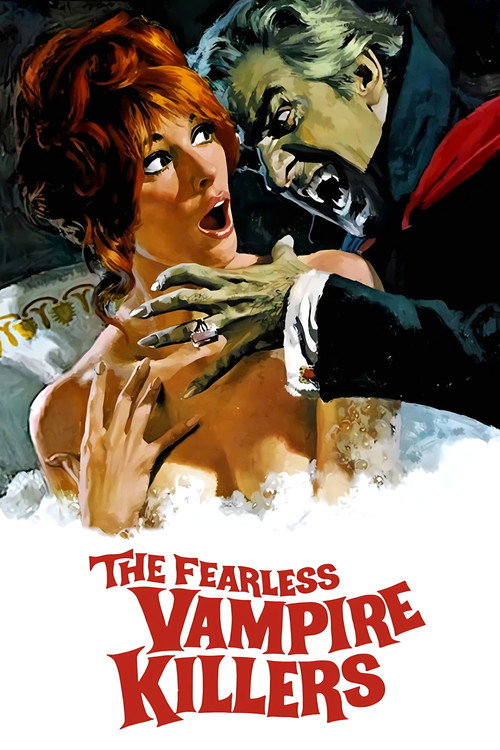
The Fearless Vampire Killers (1967)
Directed by Roman Polanski
No — The Fearless Vampire Killers is not especially woke, scoring 21 out of 100 on our wokeness meter.
Roman Polanski's 1967 gothic spoof arrives from a Central European neverland of wintry forests and crumbling castles, and it carries no modern social baggage whatsoever.
Consciousness Markers
Count von Krolock's son Herbert is explicitly characterized as homosexual and makes repeated comedic advances on Alfred, including an attempted seduction. It is a genuine, if stereotyped and played-for-laughs, gay character.
The cast is entirely white European, with no meaningful representation casting of any kind. This is a 1967 Transylvanian-set gothic spoof with a homogenous ensemble.
Sharon Tate's Sarah is a 'buxom maiden' and damsel in distress, the object of male lust and rescue. The film's gender politics are firmly traditional and leering.
No engagement with race or racial themes whatsoever; the film is a Central European vampire pastiche with an all-white cast.
No environmental or climate themes present.
No economic critique or class-based commentary; the Count's aristocracy is a genre trapping, not a political statement.
No body positivity themes; the film trades in conventional physical comedy and objectification.
No depiction or discussion of neurodivergence.
No historical revisionism; the film is a fantastical period spoof with no real historical claims to revise.
A broad slapstick comedy with no didactic or preachy messaging; it aims to amuse, not instruct.
Why it received this score
Roman Polanski's 1967 gothic spoof arrives from a Central European neverland of wintry forests and crumbling castles, and it carries no modern social baggage whatsoever. The cast is uniformly white. Transylvania here is a stage set for slapstick, and the politics are those of a bawdy folk tale. Sharon Tate's Sarah exists to be ogled, abducted, and rescued. The film's own materials call her a buxom maiden, and the camera agrees with that description at every opportunity. Nobody involved appears to have given the matter a second thought.
Against this backdrop, one element stands apart. Count von Krolock's son Herbert, a foppish aristocrat with a taste for velvet and a wandering eye, is openly homosexual. He pursues Alfred with tireless enthusiasm, corners him for an attempted seduction, and later announces his fondness to his father, who proposes Alfred as a suitable companion for the boy. The portrayal is broad, mincing, and played for nervous laughter. It is also, in 1967, an unmistakably gay character given screen time, dialogue, and a stated desire. We award credit where credit is due, however grudgingly.
That single flourish is the film's entire contribution to the progressive ledger. There is no engagement with race, no environmental sermon, no critique of the Count's aristocratic wealth, no body positivity, no neurodivergence, and no history to revise, since the history on display never happened. The film wants us to laugh at a hunchback and a man stuck in a window. It succeeds often enough. A comedy that sets out to amuse and does so is under no obligation to instruct us, and this one never tries.
Analysis generated by our Consciousness Algorithm


Synopsis
A noted professor and his dim-witted apprentice fall prey to their inquiring vampires, while on the trail of the ominous damsel in distress.
Questions about The Fearless Vampire Killers
Is The Fearless Vampire Killers woke?
No — The Fearless Vampire Killers is not especially woke, scoring 21 out of 100 on our wokeness meter. That earns it a verdict of Based.
Does The Fearless Vampire Killers have any woke elements?
1 of the 10 markers register at 30 or above, led by LGBTQ+ Themes (35). On LGBTQ+ Themes: Count von Krolock's son Herbert is explicitly characterized as homosexual and makes repeated comedic advances on Alfred, including an attempted seduction.
How does The Fearless Vampire Killers compare to other 1967 movies?
It ranks #3 of the 19 films from 1967 we've scored; their average is 10. The wokest is In the Heat of the Night (60).
How is the Woke Score calculated?
An AI-assisted process researches the film and its reception, scores it 0–100 on ten markers, then combines those into one 0–100 Woke Score. It measures a specific set of 2020s cultural themes, not film quality.