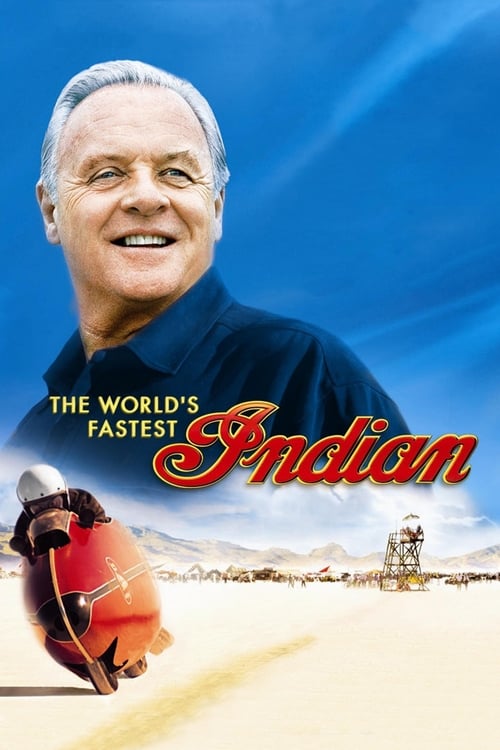
The World's Fastest Indian (2005)
Directed by Roger Donaldson
No — The World's Fastest Indian is not woke, scoring 13 out of 100 on our wokeness meter.
The World's Fastest Indian concerns Burt Munro, an Invercargill eccentric with a modified 1920 Indian Scout, a lemon tree he waters in his own fashion, and a persistent dream of the Bonneville Salt Flats.
Consciousness Markers
Tina Washington, a transgender woman, is a concrete supporting character who helps Burt clear customs and buy a car, and is portrayed with warmth and dignity. This is a notable inclusion for a 2005 mainstream film, though it is a single subplot rather than a thematic focus.
The cast is overwhelmingly white, but the film includes a Native American (Jake, played by Saginaw Grant), a Hispanic car salesman (Fernando), and a transgender motel clerk (Tina Washington) as natural supporting figures in Burt's journey. These are organic to the story rather than box-ticking, so the score is modest.
The film takes dramatic liberties with Munro's history (composite visits, an invented 201 mph record, the lemon-tree detail), but these are conventional biopic embellishments rather than ideologically motivated reinterpretation of history.
Minority characters exist naturally in the story without commentary, and the film makes no argument about race or systemic injustice. No racial consciousness theme is present.
Women appear as lovers and helpers (Ada, Tina) but the film has no feminist thesis; it is a straightforward male-hero quest narrative. No agenda is advanced.
The film is a warm, celebratory, feel-good underdog story that never lectures the audience on social or political matters.
There is no environmental or climate theme whatsoever in this motorcycle land-speed drama.
The film's brushes with bureaucracy (customs, race officials) are obstacles to be charmed away, not a critique of capitalism. No eat-the-rich sentiment.
No body-positivity themes or messaging are present.
No neurodivergence themes or characters are present.
Why it received this score
The World's Fastest Indian concerns Burt Munro, an Invercargill eccentric with a modified 1920 Indian Scout, a lemon tree he waters in his own fashion, and a persistent dream of the Bonneville Salt Flats. Roger Donaldson spent two decades getting this made, and the patience shows in the texture: exploded pistons, a Vauxhall Velox, the flat vowels of Southland. Anthony Hopkins does not attempt a New Zealand accent, a decision the national press noticed at the time, but he inhabits the backyard genius with an ease that suggests the role required very little heavy lifting. The film proceeds as such films do, one kindly stranger at a time, until the salt flats arrive and the officials relent.
On the cultural ledger, the results are modest and mostly incidental. The cast is overwhelmingly white, though a Native American man named Jake, a Hispanic car salesman named Fernando, and a transgender motel clerk named Tina Washington all pass through Burt's journey as helpers rather than exhibits. Tina is the notable one, a warm and dignified presence in a mainstream 2005 release, assisting with customs and the purchase of a used Chevrolet. None of this is argued. It simply happens, which is its own kind of restraint. There is no feminist thesis here, no racial argument, no environmental sermon, no critique of the moneyed men who administer the racing bureaucracy, and no interest whatsoever in the body or the mind as topics of instruction.
History, meanwhile, receives the usual biopic sanding. The Bonneville visit is a composite of several trips. The 201 mph record is invented. The lemon tree is a tribute to the director's own father. These are the ordinary liberties of the form, not a re-education. What the film offers instead is a genial, unpretentious underdog story that trusts warmth over instruction, and asks nothing of us beyond two hours of goodwill.
Analysis generated by our Consciousness Algorithm


Synopsis
The life story of New Zealander Burt Munro, who spent years building a 1920 Indian motorcycle—a bike which helped him set the land-speed world record at Utah's Bonneville Salt Flats in 1967.
Questions about The World's Fastest Indian
Is The World's Fastest Indian woke?
No — The World's Fastest Indian is not woke, scoring 13 out of 100 on our wokeness meter. That earns it a verdict of Ultra Based.
Does The World's Fastest Indian have any woke elements?
2 of the 10 markers register at 30 or above, led by LGBTQ+ Themes (35) and Representation Casting (30). On LGBTQ+ Themes: Tina Washington, a transgender woman, is a concrete supporting character who helps Burt clear customs and buy a car, and is portrayed with warmth and dignity.
How does The World's Fastest Indian compare to other 2005 movies?
It ranks #63 of the 181 films from 2005 we've scored; their average is 13. The wokest is The Constant Gardener (72).
How is the Woke Score calculated?
An AI-assisted process researches the film and its reception, scores it 0–100 on ten markers, then combines those into one 0–100 Woke Score. It measures a specific set of 2020s cultural themes, not film quality.