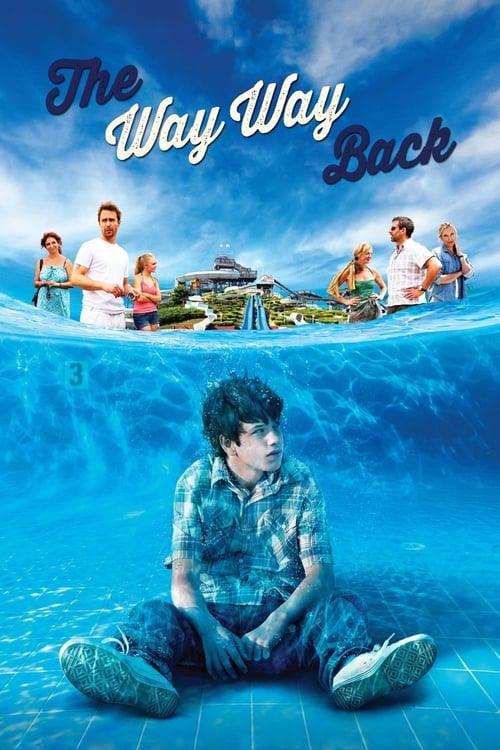
The Way Way Back (2013)
Directed by Jim Rash
No — The Way Way Back is not woke, scoring 6 out of 100 on our wokeness meter.
Nat Faxon and Jim Rash's directorial debut arrives from the summer of 2013 with a beach house, a water park, and a station wagon, and it conducts its business with the tidy demographics of an indie comedy from that era.
Consciousness Markers
The ensemble is overwhelmingly white, with the sole notable exception of a few background water-park employees; casting reflects standard 2013 indie-comedy norms rather than any deliberate inclusivity push.
Pam's late-film decision to stand up to Trent and climb into the back of the wagon offers a faint assertion of self-worth, but the narrative is squarely a boy's coming-of-age story with women largely defined by their relationships to men.
Owen's advice to Duncan to ignore Trent and be himself carries a mild life-lesson message, but it is delivered warmly and personally rather than as preachy sermonizing.
Trent's wealth and condescension are mildly coded as villainous, but the film offers no systemic critique of class or capital; the water park is a small business celebrated, not indicted.
No LGBTQ+ characters, themes, or subtext appear anywhere in the film.
Race is never addressed or thematized; the film's world is uniformly white and treats this as unremarkable.
No environmental themes or climate concerns are present.
No body-positivity themes; Betty's heavy drinking is played for comedy rather than any body-image discourse.
Duncan is shy and introverted, but the film frames this as ordinary adolescent awkwardness, not neurodivergence.
The film is a contemporary fictional story with no historical subject matter to revise.
Why it received this score
Nat Faxon and Jim Rash's directorial debut arrives from the summer of 2013 with a beach house, a water park, and a station wagon, and it conducts its business with the tidy demographics of an indie comedy from that era. The ensemble is white from top to bottom, a fact the film never notices and never asks us to notice. There is no LGBTQ presence, no racial consciousness, no environmental concern, and no engagement with neurodivergence, despite a protagonist whose shyness is the engine of the entire plot. Duncan's awkwardness is treated as ordinary adolescence, which it is, and the film is content to leave it there.
The women in the story orbit the men. Pam drinks, defers, and finally climbs into the back of the wagon in a small act of self-assertion that the film stages as a climax. Betty drinks for laughs. Susanna exists to kiss Duncan at the right moment. Trent's money and his habit of rating a fourteen-year-old on a scale of one to ten mark him as the villain, though the film holds no interest in systems, only in one rude man. Water Wizz, the small business that rescues Duncan, is celebrated without irony.
Owen's counsel to ignore Trent and be himself lands warmly, as a friend's advice instead of a sermon, and that warmth is the film's genuine achievement. It premiered at Sundance, charmed critics, and turned a five million dollar budget into a modest profit. As a document of 2013 progressive sensibilities, it registers as a gentle hum. Nothing here would have alarmed a studio, a test audience, or a grandparent.
Analysis generated by our Consciousness Algorithm


Synopsis
Shy 14-year-old Duncan goes on summer vacation with his mother, her overbearing boyfriend, and her boyfriend's daughter. Having a rough time fitting in, Duncan finds an unexpected friend in Owen, manager of the Water Wizz water park.
Questions about The Way Way Back
Is The Way Way Back woke?
No — The Way Way Back is not woke, scoring 6 out of 100 on our wokeness meter. That earns it a verdict of Ultra Based.
Does The Way Way Back have any woke elements?
Very few. None of the 10 markers reaches 30, the level where a marker counts as present; the highest is Feminist Agenda at 12.
How does The Way Way Back compare to other 2013 movies?
It ranks #181 of the 274 films from 2013 we've scored; their average is 14. The wokest is Belle (76).
How is the Woke Score calculated?
An AI-assisted process researches the film and its reception, scores it 0–100 on ten markers, then combines those into one 0–100 Woke Score. It measures a specific set of 2020s cultural themes, not film quality.