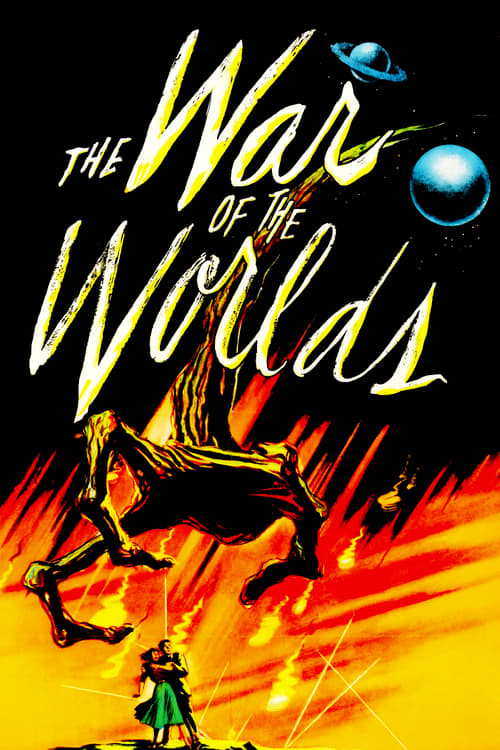
The War of the Worlds (1953)
Directed by Byron Haskin
No — The War of the Worlds is not woke, scoring 2 out of 100 on our wokeness meter.
The War of the Worlds descends from 1953 with the serenity of a picture that has never once questioned its own premises.
Consciousness Markers
The narrated prologue and the closing 'God in His wisdom' moralizing carry a mild sermonizing tone, but it is 1950s Cold War faith, not modern social lecturing.
The cast is entirely white, reflecting 1950s Hollywood norms with no deliberate inclusive casting.
No LGBTQ+ characters or themes appear anywhere in the film.
Sylvia Van Buren functions as a conventional love interest and damsel, with no feminist framing.
The film engages no racial themes; the conflict is purely human-versus-Martian.
Mars is described as a dying world, but this is a plot device for invasion, not an environmentalist message.
No critique of capitalism or wealth; the film is a straightforward Cold War-era invasion thriller.
No body-positivity themes; the Martians are depicted as physically primitive and monstrous.
No neurodivergent characters or themes are present.
While it relocates the novel to 1950s California and adds religious framing, it does not reinterpret historical events through a modern ideological lens.
Why it received this score
The War of the Worlds descends from 1953 with the serenity of a picture that has never once questioned its own premises. Byron Haskin moves H.G. Wells's Martian invasion from Victorian England to the sunlit hills of Southern California, where a vacationing nuclear physicist, a small-town woman named Sylvia, and her doomed pastor watch the sky fill with manta-ray war machines. The cast is white in the manner of the period, and nobody involved appears troubled by the fact. Sylvia exists to be rescued and to supply a scarf for the blood sample. The conflict is human against Martian, universal in the vaguest possible way, and the film never pauses to ask who has been left out of the frame.
The only preaching on offer is theological. A narrator opens the picture with a warning about the terrible weapons of super-science, and the closing line credits the Martians' defeat to the littlest things which God in His wisdom put upon this earth. That is Cold War faith, delivered with a straight face, and it carries a faint sermonizing hum. Wells gave us a cowardly curate to be despised; the film gives us a heroic pastor who dies clutching his bible. The change is a matter of religious sentiment, not of historical reinterpretation. Mars is dying, which prompts an invasion and nothing resembling an environmental argument.
So we have a clean specimen. No critique of wealth, no interest in bodies beyond their capacity to be vaporized, no neurodivergent interiority, no racial reckoning. The film won an Academy Award for its visual effects and now sits in the National Film Registry, which is a fine fate for a picture that asked nothing of its audience but to look up. It remains one of the great science fiction films of its decade, and it remains entirely innocent of contemporary social instruction. Some vintages are simply of their time. This one is of its time and proud of it.
"""
Wait, I need to return valid JSON only. Let me finalize.
{"review": "The War of the Worlds descends from 1953 with the serenity of a picture that has never once questioned its own premises. Byron Haskin moves H.G. Wells's Martian invasion from Victorian England to the sunlit hills of Southern California, where a vacationing nuclear physicist, a small-town woman named Sylvia, and her doomed pastor watch the sky fill with manta-ray war machines. The cast is white in the manner of the period, and nobody involved appears troubled by the fact. Sylvia exists to be rescued and to supply a scarf for the blood sample. The conflict is human against Martian, universal in the vaguest possible way, and the film never pauses to ask who has been left out of the frame.\n\nThe only preaching on offer is theological. A narrator opens the picture with a warning about the terrible weapons of super-science, and the closing line credits the Martians' defeat to the littlest things which God in His wisdom put upon this earth. That is Cold War faith, delivered with a straight face, and it carries a faint sermonizing hum. Wells gave us a cowardly curate to be despised; the film gives us a heroic pastor who dies clutching his bible. The change is a matter of religious sentiment, not of historical reinterpretation. Mars is dying, which prompts an invasion and nothing resembling an environmental argument.\n\nSo we have a clean specimen. No critique of wealth, no interest in bodies beyond their capacity to be vaporized, no neurodivergent interiority, no racial reckoning. The film won an Academy Award for its visual effects and now sits in the National Film Registry, which is a fine fate for a picture that asked nothing of its audience but to look up. It remains one of the great science fiction films of its decade, and it remains entirely innocent of contemporary social instruction. Some vintages are simply of their time. This one is of its time and proud of it.", "thematic_tags": ["oscar_winner", "book_adaptation"]}{
Analysis generated by our Consciousness Algorithm
Part of


Synopsis
The residents of a small town are excited when a flaming meteor lands in the hills, until they discover it is the first of many transport devices from Mars bringing an army of invaders invincible to any man-made weapon, even the atomic bomb.
Questions about The War of the Worlds
Is The War of the Worlds woke?
No — The War of the Worlds is not woke, scoring 2 out of 100 on our wokeness meter. That earns it a verdict of Ultra Based.
Does The War of the Worlds have any woke elements?
Very few. None of the 10 markers reaches 30, the level where a marker counts as present; the highest is Lecture Energy at 10.
How does The War of the Worlds compare to other 1953 movies?
It ranks #11 of the 16 films from 1953 we've scored; their average is 6. The wokest is The Wages of Fear (25).
How is the Woke Score calculated?
An AI-assisted process researches the film and its reception, scores it 0–100 on ten markers, then combines those into one 0–100 Woke Score. It measures a specific set of 2020s cultural themes, not film quality.