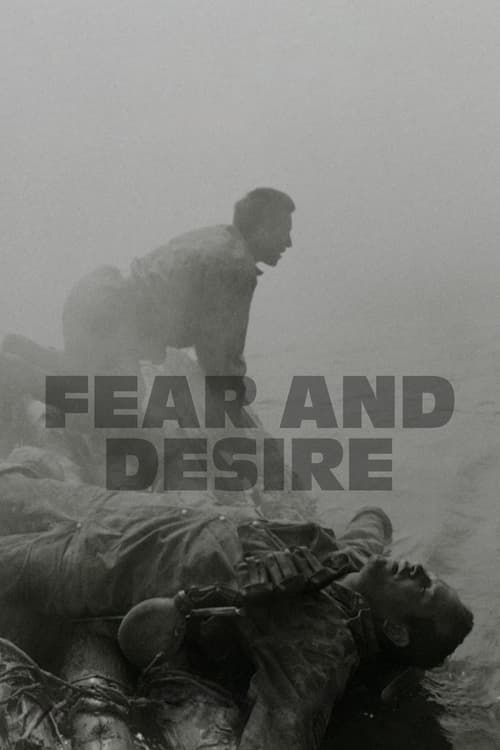
Fear and Desire (1953)
Directed by Stanley Kubrick
No — Fear and Desire is not woke, scoring 6 out of 100 on our wokeness meter.
Stanley Kubrick's first feature arrives like a term paper submitted by a gifted undergraduate who has read the right books and understood none of the assignments.
Consciousness Markers
An opening narration and closing soldiers' philosophizing explicitly spell out the anti-war thesis ('no man is made for it'), giving the film a mild didactic streak, though it is poetic rather than preachy.
Frank Silvera, an Afro-Cuban actor, plays Sgt. Mac in a substantial lead role, which was notably progressive casting for 1953, but the film makes no comment on his race and treats it as unremarkable.
No LGBTQ+ characters, themes, or subtext appear anywhere in the film.
The sole female character is a mute peasant girl who is bound to a tree, dehumanized by the tagline as a 'Strange Half-Animal Girl,' and shot dead; this is the opposite of a feminist agenda.
The film is set in an unnamed, ahistorical war and engages no racial themes or commentary whatsoever.
There is no environmental or climate-related content in this 1953 war film.
The film's critique is of war and human nature, not of capitalism or economic inequality.
No body-positivity themes or messaging are present.
Sidney's descent into madness and the film's PTSD themes are depicted as war-induced psychological breakdown, not as modern neurodivergence-affirming representation.
The film deliberately avoids any specific historical war, presenting an abstract, timeless conflict rather than revising historical narrative.
Why it received this score
Stanley Kubrick's first feature arrives like a term paper submitted by a gifted undergraduate who has read the right books and understood none of the assignments. Four soldiers crash behind enemy lines in a war that belongs to no country and no decade, and the film announces this immediately through narration explaining that the conflict exists "outside history." Kubrick later called the whole thing a bumbling amateur exercise and spent decades trying to bury it. He was being generous to himself, but not entirely wrong.
The film's progressive credentials are thin and mostly accidental. Frank Silvera, an Afro-Cuban actor, plays Sergeant Mac as a full lead, which was unusual casting for 1953 and which the film treats as unremarkable, offering neither comment nor discomfort. That is the extent of its social awareness. Virginia Leith plays a mute peasant girl who is tied to a tree with belts, dehumanized by the studio's own advertising as a strange half-animal girl, and shot dead by a soldier who mistakes his own unraveling for romance. The film frames this as tragedy about men, not about her. Sidney's madness reads as war-induced breakdown, and nobody involved is reaching for a modern vocabulary of trauma or neurodiversity. The anti-war argument gets stated outright, first in the opening voiceover and again when the surviving soldiers sit by the river and conclude that no man is made for war. It is sincere, poetic, and mildly instructive, which is a gentler sin than most.
What we have, then, is a young director with a camera, a borrowed baby carriage for tracking shots, and a thesis about the unchanging shapes of fear and doubt. No economic critique, no environmental conscience, no historical revision, no identity politics to speak of. Just fog made from insecticide and men discovering that killing is unpleasant. The classification is straightforward, and the sommelier may put the bottle back on the shelf.
Analysis generated by our Consciousness Algorithm


Synopsis
After their airplane crashes behind enemy lines, four soldiers must survive and try to find a way back to their battalion. However, when they come across a local peasant girl the horrors of war quickly become apparent.
Questions about Fear and Desire
Is Fear and Desire woke?
No — Fear and Desire is not woke, scoring 6 out of 100 on our wokeness meter. That earns it a verdict of Ultra Based.
Does Fear and Desire have any woke elements?
Very few. None of the 10 markers reaches 30, the level where a marker counts as present; the highest is Lecture Energy at 15.
How does Fear and Desire compare to other 1953 movies?
It ranks #5 of the 16 films from 1953 we've scored; their average is 6. The wokest is The Wages of Fear (25).
How is the Woke Score calculated?
An AI-assisted process researches the film and its reception, scores it 0–100 on ten markers, then combines those into one 0–100 Woke Score. It measures a specific set of 2020s cultural themes, not film quality.