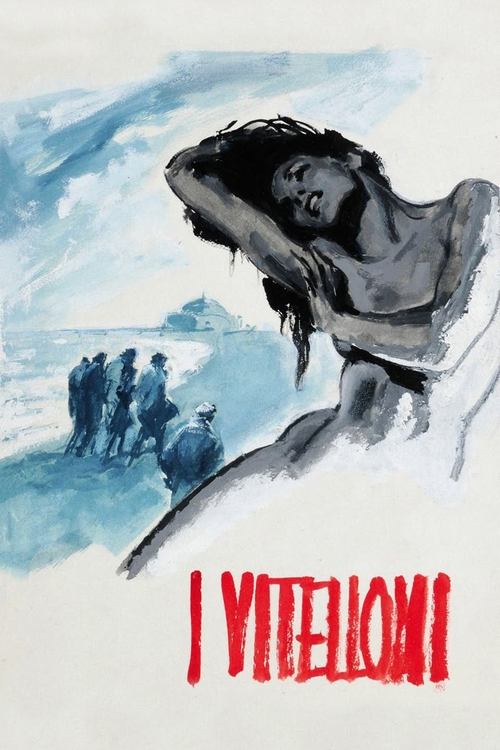
I Vitelloni (1953)
Directed by Federico Fellini
No — I Vitelloni is not woke, scoring 9 out of 100 on our wokeness meter.
Federico Fellini's third feature follows five young men in a provincial Adriatic town who drift from cafe to pool hall to windswept beach, living off their parents and dreaming of escape.
Consciousness Markers
The aging actor Sergio Natali is coded as gay and propositions Leopoldo on the seashore, a subplot Fellini wrote with 'homosexual overtones' that made Vittorio De Sica fear being 'marked as actually gay.' It is a genuine, if minor and unflattering, LGBTQ element.
The film sympathetically depicts Sandra's suffering at the hands of her philandering husband, but this is a moralist critique of immature men rather than a feminist agenda.
Fellini observes and ironizes his characters with a light, ironic touch rather than delivering a sermon; the moral critique is embedded in behavior, not preached.
The film gently satirizes idle middle-class youth who live off their parents, but offers no systemic economic critique or 'eat the rich' framing.
The cast is entirely Italian, which is simply the natural demographic of a 1953 Italian production; there is no deliberate or commented-upon diversity casting.
No racial themes or consciousness appear anywhere in this provincial Italian character study.
No environmental or climate content whatsoever.
No body-positivity themes are present.
No neurodivergence themes are present.
The film is a contemporary, semi-autobiographical portrait of 1950s Italy, not a revisionist reframing of history.
Why it received this score
Federico Fellini's third feature follows five young men in a provincial Adriatic town who drift from cafe to pool hall to windswept beach, living off their parents and dreaming of escape. The film is a comedy drama of small gestures, and its ridicule lands through observation instead of instruction. There is no environmental content here, no racial consciousness, and no impulse to reframe history. The cast is entirely Italian, which for a 1953 Italian production is the demographic on hand and not a statement of any kind.
The most culturally marked passage belongs to Sergio Natali, an aging stage actor who walks Leopoldo along the seashore and propositions him. Fellini wrote the role with acknowledged homosexual overtones, enough that Vittorio De Sica declined it out of fear of being marked as actually gay. The moment is genuine and unflattering, a minor strand in a film with little else to say on the subject. Sandra, the pregnant bride abandoned by her philandering husband, receives real sympathy, but the judgment falls on Fausto's immaturity and not on any social order. That places the film in the register of moral criticism instead of gender politics.
The vitelloni are idle middle-class sons who feed off their families, and Fellini finds them absurd and piteous. He does not extend the joke to any system, which keeps the satire domestic. The moral weight arrives through behavior. A father swings his belt, an angel statue ends up with a peasant who caresses it, and Moraldo boards a train while his friends sleep. Nothing is explained, nothing is preached, and the film trusts us to draw the conclusion. For a work this humane, the cultural temperature is low. It observes, it shrugs, and it moves on.
Analysis generated by our Consciousness Algorithm


Synopsis
Five young men dream of success as they drift lazily through life in a small Italian village. Fausto, the group's leader, is a womanizer; Riccardo craves fame; Alberto is a hopeless dreamer; Moraldo fantasizes about life in the city; and Leopoldo is an aspiring playwright. As Fausto chases a string of women, to the horror of his pregnant wife, the other four blunder their way from one uneventful experience to the next.
Questions about I Vitelloni
Is I Vitelloni woke?
No — I Vitelloni is not woke, scoring 9 out of 100 on our wokeness meter. That earns it a verdict of Ultra Based.
Does I Vitelloni have any woke elements?
Very few. None of the 10 markers reaches 30, the level where a marker counts as present; the highest is LGBTQ+ Themes at 20.
How does I Vitelloni compare to other 1953 movies?
It ranks #3 of the 16 films from 1953 we've scored; their average is 6. The wokest is The Wages of Fear (25).
How is the Woke Score calculated?
An AI-assisted process researches the film and its reception, scores it 0–100 on ten markers, then combines those into one 0–100 Woke Score. It measures a specific set of 2020s cultural themes, not film quality.