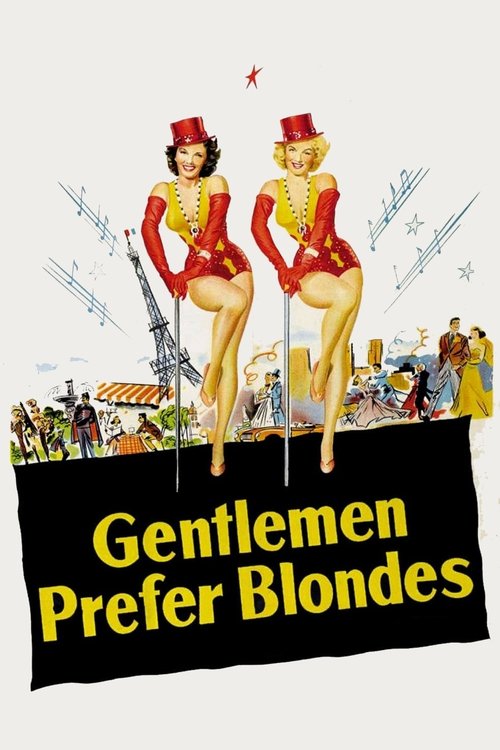
Gentlemen Prefer Blondes (1953)
Directed by Howard Hawks
No — Gentlemen Prefer Blondes is not woke, scoring 18 out of 100 on our wokeness meter.
Gentlemen Prefer Blondes is a 1953 Howard Hawks musical comedy in which Marilyn Monroe and Jane Russell play showgirls navigating a cruise, a detective, a diamond mine owner, and the transactional arithmetic of marriage.
Consciousness Markers
The film centers on two women and their unwavering loyalty to one another, which modern critics have read as a celebration of female solidarity and agency. However, this is a 1953 gold-digger comedy, not a feminist polemic, and its gender politics remain largely of their era.
Lorelei's closing speech rationalizing marriage to a rich man as analogous to a man marrying a pretty woman carries a faint didactic air, but it is played for wit rather than moral instruction.
The cast is entirely white, with no meaningful racial or ethnic diversity in any role. This is a 1953 studio musical with no representation casting ambitions whatsoever.
There are no LGBTQ+ characters, themes, or subtext acknowledged by the film. The romantic pairings are strictly heterosexual.
Race is entirely absent as a subject; the film features no racial consciousness, commentary, or non-white perspectives.
There is no environmental or climate theme anywhere in the film.
The film is a celebration of acquiring wealth, diamonds, and millionaire husbands rather than a critique of capital. It is the opposite of an eat-the-rich narrative.
The film showcases showgirls' bodies as spectacle but contains no body-positivity messaging in the modern sense.
No neurodivergent characters or themes are present or addressed.
The film is a light musical comedy with no historical revisionism or reframing of past events.
Why it received this score
Gentlemen Prefer Blondes is a 1953 Howard Hawks musical comedy in which Marilyn Monroe and Jane Russell play showgirls navigating a cruise, a detective, a diamond mine owner, and the transactional arithmetic of marriage. The film has no interest in racial or ethnic diversity, and its cast is uniformly white. Queer themes do not exist here. The romantic pairings are heterosexual, and the camera treats sexuality as a spectacle for a presumed male viewer. Climate concerns are absent. Class politics are inverted: the story celebrates millionaires, diamonds, and the acquisition of wealthy husbands. Any suggestion that this is an eat-the-rich satire would be a misreading of the most affectionate kind.
What the film does offer is a durable portrait of female friendship. Lorelei and Dorothy defend each other, scheme for each other, and refuse to let a man come between them. Modern critics have read this as agency and solidarity, and that reading is not unreasonable. Still, the gender politics remain those of a 1953 gold-digger comedy. Dorothy's sharp wit and Lorelei's strategic innocence are not a feminist manifesto. Body positivity is not on the agenda either. The film displays showgirls as visual commodities, and it has no interest in self-acceptance, neurodivergence, or revised history. The past is simply the setting, not a site of correction.
The closest thing to a sermon arrives when Lorelei explains to her fiancé's father that a woman marrying a rich man is like a man marrying a pretty woman. The speech is clever, mildly preachy, and played for laughs. It argues for common sense, not social transformation. The film remains a well-polished vehicle for two stars, a handful of iconic numbers, and a pink dress that has outlived most of its contemporaries. As a cultural artifact, it is charming, efficient, and almost entirely untouched by contemporary progressive sensibilities. A sommelier of such vintages would note a bright finish, low tannins, and no lingering aftertaste of social instruction.
Analysis generated by our Consciousness Algorithm


Synopsis
Lorelei Lee is a beautiful showgirl engaged to be married to the wealthy Gus Esmond, much to the disapproval of Gus' rich father, Esmond Sr., who thinks that Lorelei is just after his money. When Lorelei goes on a cruise accompanied only by her best friend, Dorothy Shaw, Esmond Sr. hires Ernie Malone, a private detective, to follow her and report any questionable behavior that would disqualify her from the marriage.
Questions about Gentlemen Prefer Blondes
Is Gentlemen Prefer Blondes woke?
No — Gentlemen Prefer Blondes is not woke, scoring 18 out of 100 on our wokeness meter. That earns it a verdict of Ultra Based.
Does Gentlemen Prefer Blondes have any woke elements?
Very few. None of the 10 markers reaches 30, the level where a marker counts as present; the highest is Feminist Agenda at 25.
How does Gentlemen Prefer Blondes compare to other 1953 movies?
It ranks #2 of the 16 films from 1953 we've scored; their average is 6. The wokest is The Wages of Fear (25).
How is the Woke Score calculated?
An AI-assisted process researches the film and its reception, scores it 0–100 on ten markers, then combines those into one 0–100 Woke Score. It measures a specific set of 2020s cultural themes, not film quality.