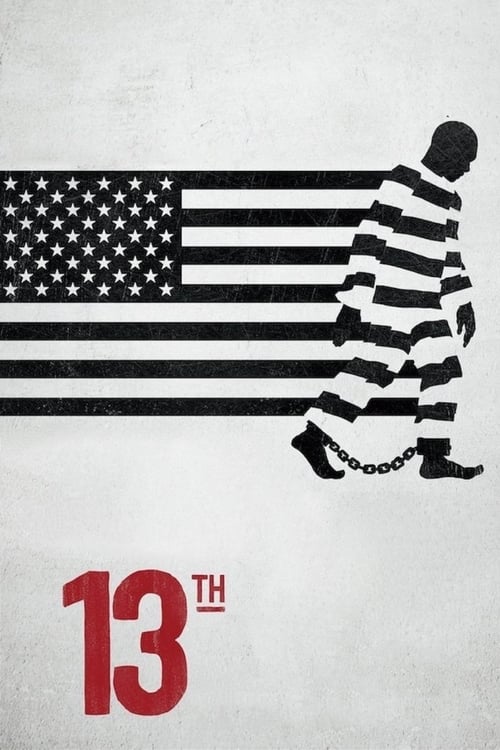
13th (2016)
Directed by Ava DuVernay
Yes — 13th is very woke, scoring 92 out of 100 on our wokeness meter.
Netflix opens its vaults and Ava DuVernay walks us through the American penal system, beginning with a statistic from Barack Obama about population and prisoners that lands like a bill arriving after a very large dinner.
Consciousness Markers
The entire film is an examination of systemic racism, mass incarceration, and the legacy of slavery in the United States.
The film is explicitly didactic, using expert interviews, statistics, and graphic footage to argue its thesis and provoke action.
The film critiques the prison-industrial complex, private prisons, corporate lobbying, and profit incentives to incarcerate.
The documentary reframes US history by arguing the Thirteenth Amendment's exception clause enabled slavery to continue through penal labor and mass incarceration.
The film centers Black scholars, activists, and political figures, presenting a predominantly African American cast of interviewees and experts.
Ava DuVernay directs and the film features prominent Black women experts, but it does not advance a distinct feminist analysis.
No LGBTQ+ themes or characters are explored in the documentary.
No climate change or environmental themes are present.
No body positivity or body image themes are present.
No neurodivergence or mental health themes are explored.
Why it received this score
Netflix opens its vaults and Ava DuVernay walks us through the American penal system, beginning with a statistic from Barack Obama about population and prisoners that lands like a bill arriving after a very large dinner. The title refers to the Thirteenth Amendment, which abolished slavery except as punishment for crime, an exception the film treats as the load-bearing wall of everything that follows. Convict leasing, Jim Crow, the war on drugs, mandatory sentencing: the through-line is drawn with the patience of someone connecting pipes in a basement.
The interview roster is deep and largely African American, with Angela Davis, Michelle Alexander, Jelani Cobb, and Henry Louis Gates Jr. doing the heavy lifting. DuVernay has assembled a formidable bench, and the film gives its women experts real room, though it never turns its attention to a distinct set of questions about gender. The economic argument is where the knives come out. Private prisons, corporate lobbying, rural towns built on cell blocks, the American Legislative Exchange Council drafting legislation for legislators who may not have read it. The profit motive gets a thorough audit, and the audit does not come back clean.
As cinema, the film prefers the lecture hall to the campfire. Statistics arrive in orderly ranks, experts speak in measured tones, and the final sequence of police shooting footage functions as a closing argument delivered without a closing argument. It is rigorous, it is furious, and it is entirely certain of its verdict. We are told what to think and why, at length, with footnotes. The result is a documentary that works as an indictment and as a syllabus, which is either its greatest strength or its most exhausting habit. The sommelier's note: a full-bodied vintage, served at room temperature, no dessert.
Analysis generated by our Consciousness Algorithm


Synopsis
An in-depth look at the prison system in the United States and how it reveals the nation's history of racial inequality.
Questions about 13th
Is 13th woke?
Yes — 13th is very woke, scoring 92 out of 100 on our wokeness meter. That earns it a verdict of Peak Woke.
What makes 13th woke?
5 of the 10 markers register at 30 or above, led by Racial Consciousness (98), Lecture Energy (95) and Eat the Rich (90). On Racial Consciousness: The entire film is an examination of systemic racism, mass incarceration, and the legacy of slavery in the United States.
How does 13th compare to other 2016 movies?
It is the wokest of the 285 films from 2016 we've scored; their average is 16.
How is the Woke Score calculated?
An AI-assisted process researches the film and its reception, scores it 0–100 on ten markers, then combines those into one 0–100 Woke Score. It measures a specific set of 2020s cultural themes, not film quality.