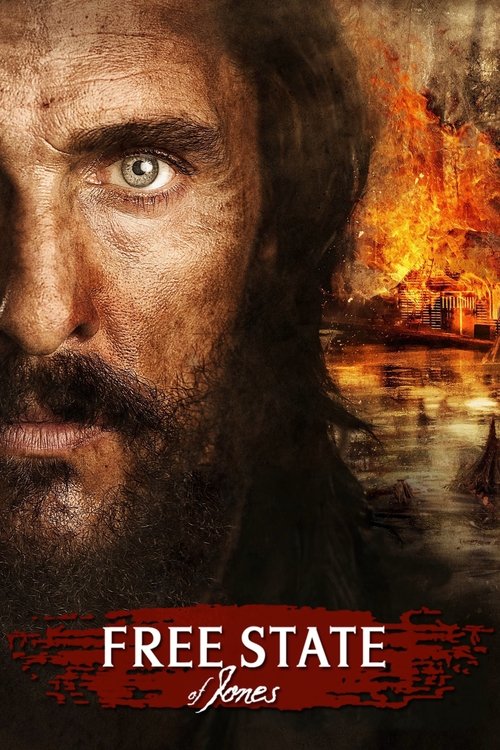
Free State of Jones (2016)
Directed by Gary Ross
Yes — Free State of Jones is woke, scoring 74 out of 100 on our wokeness meter.
Free State of Jones arrives with the bearing of a film that has done its homework and wishes us to know it.
Consciousness Markers
The film explicitly confronts slavery, racial inequality, Reconstruction, lynching, and anti-miscegenation laws, centering racial injustice as a core theme.
Explicitly aims to debunk Lost Cause myths and present a suppressed history of Southern Unionists and interracial resistance during and after the Civil War.
The film carries a strong moral message about racial equality and historical injustice, delivered with earnest, sometimes didactic historical drama energy.
The film features Black actors in historically appropriate roles for a story about slavery and the Civil War, but this is natural to the setting and not a modern diversity-casting choice.
No LGBTQ+ themes or characters are present.
Female characters exist but are defined by their relationships to the male lead; no feminist agenda is advanced.
No environmental or climate-related themes.
Depicts class conflict between poor farmers and the Confederate elite, but does not advance a modern anti-capitalist critique.
No body-positivity themes.
No neurodivergence themes.
Why it received this score
Free State of Jones arrives with the bearing of a film that has done its homework and wishes us to know it. Gary Ross spent a decade on the project, and the screen carries the weight of that scholarship, tracing Newton Knight from Confederate medic to swamp-dwelling insurrectionist in Jones County, Mississippi. The Reconstruction material that most Hollywood pictures skip past gets a full hearing here: lynching, voter registration, apprenticeship schemes dressed up as law, and the anti-miscegenation statutes that pursued Knight's descendants into 1948. That closing detour to a courtroom is a bold structural choice, though it lands like a footnote read aloud at a dinner party.
The film's moral architecture is unmistakable. Ross has said plainly that he wanted to debunk the myths handed down by earlier epics, and the picture operates as a corrective, restoring Southern Unionists and interracial resistance to a story the Lost Cause spent a century scrubbing clean. Slavery is not backdrop here but engine. The alliance between Knight and the runaway Moses carries genuine dramatic force, even when the screenplay insists on framing every Black character's suffering through the furrowed brow of its white lead. Critics noticed. The phrase white savior was deployed, fairly or not, and the movie never quite escapes the gravitational pull of its star's centrality.
The casting of Gugu Mbatha-Raw and Mahershala Ali is unremarkable and correct. These are historical roles, staffed with competent actors, not a diversity initiative. Elsewhere the film keeps its gaze narrow. The class resentments of poor farmers against Confederate planters are rendered as regional grievance, not modern economic critique. There is no environmental allegory, no engagement with bodily self-image, no formal interest in neurodivergence, and the women exist chiefly to be abandoned or avenged. What remains is earnest, heavily researched, and occasionally sermonizing, a picture that wants to teach. It teaches. That the lesson arrives with A-minus audience approval and a 48 percent critical rating suggests the classroom was better attended than enjoyed.
Analysis generated by our Consciousness Algorithm


Synopsis
In 1863, Mississippi farmer Newt Knight serves as a medic for the Confederate Army. Opposed to slavery, Knight would rather help the wounded than fight the Union. After his nephew dies in battle, Newt returns home to Jones County to safeguard his family but is soon branded an outlaw deserter. Forced to flee, he finds refuge with a group of runaway slaves hiding out in the swamps. Forging an alliance with the slaves and other farmers, Knight leads a rebellion that would forever change history.
Questions about Free State of Jones
Is Free State of Jones woke?
Yes — Free State of Jones is woke, scoring 74 out of 100 on our wokeness meter. That earns it a verdict of Woke.
What makes Free State of Jones woke?
3 of the 10 markers register at 30 or above, led by Racial Consciousness (80), Revisionist History (75) and Lecture Energy (40). On Racial Consciousness: The film explicitly confronts slavery, racial inequality, Reconstruction, lynching, and anti-miscegenation laws, centering racial injustice as a core theme.
How does Free State of Jones compare to other 2016 movies?
It ranks #4 of the 285 films from 2016 we've scored; their average is 16. The wokest is 13th (92).
How is the Woke Score calculated?
An AI-assisted process researches the film and its reception, scores it 0–100 on ten markers, then combines those into one 0–100 Woke Score. It measures a specific set of 2020s cultural themes, not film quality.