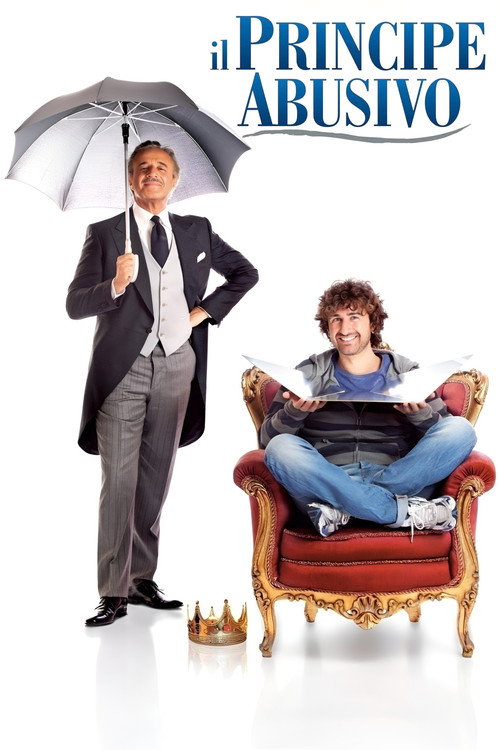
The Unlikely Prince (2013)
Directed by Alessandro Siani
No — The Unlikely Prince is not woke, scoring 0 out of 100 on our wokeness meter.
The Unlikely Prince, known in its homeland as Il principe abusivo, arrives from 2013 with a premise as old as the genre itself: a snooty princess requires good publicity, so she arranges a brief and disposable romance with an ordinary man.
Consciousness Markers
The cast is entirely Italian with no evident attempt at inclusive or color-conscious representation of marginalized groups.
No LGBTQ+ themes, characters, or subtext are present in the story or research summary.
The film is a mainstream romantic comedy about a princess and an ordinary man; it does not advance a feminist agenda or critique patriarchal structures.
There is no exploration of racial identity, systemic racism, or racial consciousness in the film's premise or available details.
The film has no environmental or climate-change themes.
While the plot involves a princess and a commoner, it does not present an explicit anti-capitalist or eat-the-rich critique.
No body-positivity themes or plus-size representation are evident in the premise or cast information.
There is no depiction or discussion of neurodivergence in the film.
The film is a fictional romantic comedy and does not revise or reinterpret historical events.
The film is a light comedy with no apparent didactic or preachy messaging.
Why it received this score
The Unlikely Prince, known in its homeland as Il principe abusivo, arrives from 2013 with a premise as old as the genre itself: a snooty princess requires good publicity, so she arranges a brief and disposable romance with an ordinary man. The schlub, naturally, proves more resourceful than anyone planned. Alessandro Siani directs and takes the lead, and Christian De Sica appears as Anastasio, presumably to lend the proceedings a whiff of institutional respectability. It is a comedy about a princess and a commoner, and it has no interest in being anything else.
That lack of interest extends to the cast, which is entirely Italian and entirely unconcerned with the representational audits that would become standard practice within a few years. The film does not interrogate the monarchy, the class system, or the arrangement by which a woman's romantic life becomes public relations strategy. It simply sets the machinery running and watches the gears turn. There is no racial reckoning here, no queer subtext, no body-positive rejoinder, no neurodivergent arc, no environmental lament. The rich are not eaten. They are, at most, mildly inconvenienced, and then forgiven.
A light comedy remains, with no message to deliver and no lecture to perform. It wants a laugh, and then it wants to leave. In an era when even the most trivial entertainment feels obliged to justify its existence with a moral, this is almost restful. We score it accordingly, at the low end, without malice. Some vintages are simply from a different cellar.
Analysis generated by our Consciousness Algorithm
Synopsis
Needing good PR, a snooty princess orchestrates a brief romance with an ordinary guy. But the schlub she picks proves more resourceful than expected.
Questions about The Unlikely Prince
Is The Unlikely Prince woke?
No — The Unlikely Prince is not woke, scoring 0 out of 100 on our wokeness meter. That earns it a verdict of Ultra Based.
Does The Unlikely Prince have any woke elements?
No. All 10 markers score zero.
How does The Unlikely Prince compare to other 2013 movies?
It ranks #249 of the 274 films from 2013 we've scored; their average is 14. The wokest is Belle (76).
How is the Woke Score calculated?
An AI-assisted process researches the film and its reception, scores it 0–100 on ten markers, then combines those into one 0–100 Woke Score. It measures a specific set of 2020s cultural themes, not film quality.