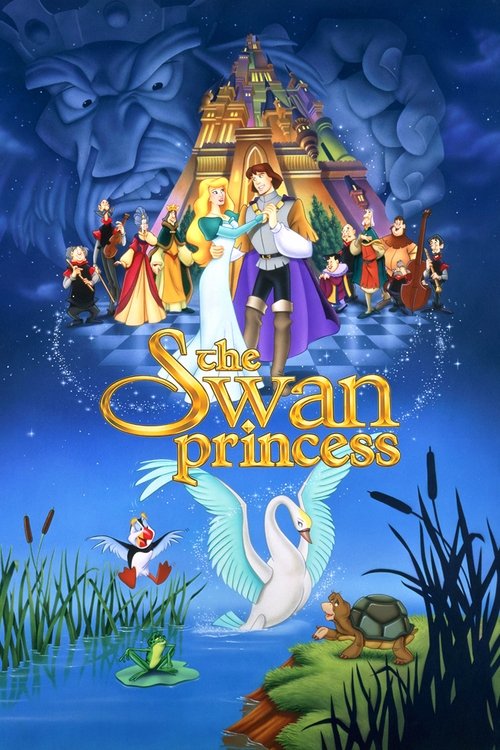
The Swan Princess (1994)
Directed by Richard Rich
No — The Swan Princess is not woke, scoring 9 out of 100 on our wokeness meter.
The Swan Princess arrives from 1994, a hand-painted adaptation of the Swan Lake ballet assembled by Richard Rich, a former Disney director who left that studio under circumstances best left to the trades.
Consciousness Markers
Princess Odette rejects Prince Derek because he loves only her beauty, and he must learn to love her for who she is; this is a mild proto-feminist agency note, but the film remains a traditional damsel-in-distress narrative.
The film carries a gentle moral about inner beauty versus outer beauty, but it is delivered as a standard fairy-tale lesson rather than a preachy modern lecture.
The voice cast and character designs are uniformly white European fairy-tale figures, with no meaningful racial diversity or inclusive casting.
No LGBTQ+ characters, themes, or subtext appear in the film.
The film engages no racial themes, commentary, or consciousness whatsoever.
There is no environmental or climate-related messaging in the story.
The film contains no critique of wealth, capitalism, or class structures.
No body-positivity themes or diverse body representations are present.
The film does not depict or discuss neurodivergence.
The film is a fairy-tale fantasy with no historical revisionism.
Why it received this score
The Swan Princess arrives from 1994, a hand-painted adaptation of the Swan Lake ballet assembled by Richard Rich, a former Disney director who left that studio under circumstances best left to the trades. It grossed 9.8 million dollars against a 21 million dollar budget, which in the accounting of animated features qualifies as a quiet catastrophe, and it has since been kept alive by nine direct-to-video sequels and a devoted home-video constituency. The animation is lush in places, the songs are serviceable, and the whole enterprise carries the faint aroma of a Disney film that wandered off and got lost in the woods.
Odette rejects Prince Derek when he cannot name a single thing he loves about her beyond her face, and the film spends its remaining runtime making him earn her back. This is a small gesture of self-possession, and we record it as such. It is not a manifesto. She still spends the climax imprisoned, transformed, and then dead in his arms until his love revives her, which is the oldest arrangement in the fairy-tale catalog. The lesson about inner beauty over outer beauty is delivered with the gentle hand of a bedtime story, not the raised voice of a seminar. Nobody in this kingdom has a political opinion.
On the metrics that occupy our attention, the film is largely silent. The cast and the character designs are uniformly Northern European, the romance is strictly and uncomplicatedly heterosexual, and the villain's scheme involves a kingdom, not a market economy. There is no racial commentary, no environmental sermon, no interrogation of class. That leaves a modest, old-fashioned children's musical that means well and says little. We file it accordingly.
Analysis generated by our Consciousness Algorithm


Synopsis
The beautiful princess Odette is transformed into a swan by an evil sorcerer's spell. Held captive at an enchanted lake, she befriends Jean-Bob the frog, Speed the turtle and Puffin the bird. Despite their struggle to keep the princess safe, these good-natured creatures can do nothing about the sorcerer's spell, which can only be broken by a vow of everlasting love.
Questions about The Swan Princess
Is The Swan Princess woke?
No — The Swan Princess is not woke, scoring 9 out of 100 on our wokeness meter. That earns it a verdict of Ultra Based.
Does The Swan Princess have any woke elements?
Very few. None of the 10 markers reaches 30, the level where a marker counts as present; the highest is Feminist Agenda at 15.
How does The Swan Princess compare to other 1994 movies?
It ranks #25 of the 86 films from 1994 we've scored; their average is 10. The wokest is On Deadly Ground (75).
How is the Woke Score calculated?
An AI-assisted process researches the film and its reception, scores it 0–100 on ten markers, then combines those into one 0–100 Woke Score. It measures a specific set of 2020s cultural themes, not film quality.