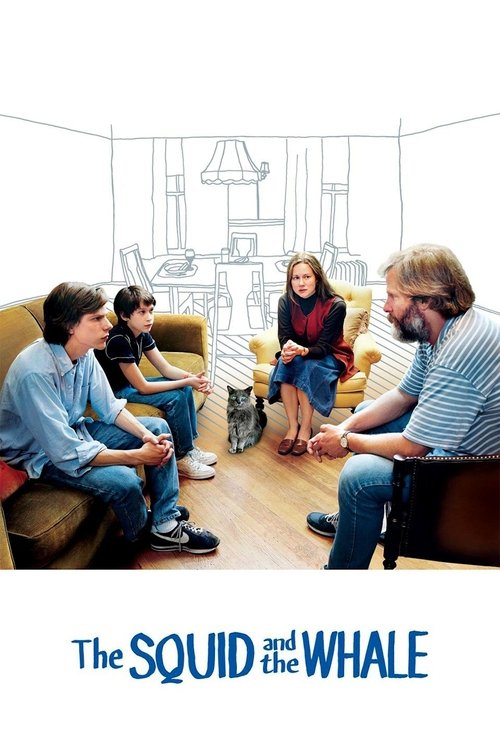
The Squid and the Whale (2005)
Directed by Noah Baumbach
No — The Squid and the Whale is not woke, scoring 5 out of 100 on our wokeness meter.
Noah Baumbach's 2005 divorce chronicle arrives with no agenda beyond the excavation of his own adolescence, and it conducts that excavation with a scalpel rather than a megaphone.
Consciousness Markers
Joan is a genuinely interesting woman with her own literary career, but the film treats this as marital drama rather than feminist argument. No agenda, just an unhappy family.
Cast is entirely white and the film makes no gesture toward diverse representation, though it is set in 1986 Park Slope and makes no claims otherwise.
No LGBTQ+ characters, themes, or subtext of any kind.
Race is simply absent from the film's concerns; no commentary, no engagement.
The environment does not factor into this Brooklyn divorce narrative.
Bernard's declining literary marketability is personal humiliation, not a critique of capitalism. Nobody eats anybody rich here.
Frank's compulsive behavior is played for discomfort, not for body-image affirmation of any kind.
Therapy appears as a plot device for Walt's emotional breakthrough, not as a neurodivergence narrative.
Semi-autobiographical but not revisionist; the 1980s setting is rendered faithfully rather than corrected.
Baumbach deliberately pared down the screenplay and refused moments of reflection. Zero preaching; the film observes rather than instructs.
Why it received this score
Noah Baumbach's 2005 divorce chronicle arrives with no agenda beyond the excavation of his own adolescence, and it conducts that excavation with a scalpel rather than a megaphone. The Berkman family of Park Slope is white, literate, and miserable in the specific manner of people who own too many hardcover first editions. Bernard, a novelist whose sales have curdled, lectures his sons on Kafka and takes up with a student. Joan, his third wife, publishes to acclaim and conducts affairs with a quiet ruthlessness that the film declines to punish or celebrate. The camera simply watches. Nobody learns a lesson about the patriarchy. Nobody learns a lesson about anything, which is the point.
The film is semi-autobiographical, drawn from Baumbach's own childhood, and the 1986 setting is rendered as lived texture instead of corrected history. There is no racial consciousness here, no climate anxiety, no economic sermonizing. Bernard's fading marketability reads as private humiliation, not as an indictment of the publishing industry. Frank's compulsive behavior is played for squirm and sorrow, never for affirmation. Therapy appears as a narrative device that delivers Walt his overdue realization about his mother, not as a case study in neurodivergence. The cast is uniformly pale and the screenplay makes no apology for it, because the screenplay has other business.
What lingers is the tonal discipline. Baumbach pared the script to the bone, refusing the reflective pauses and the sunrise-over-Brooklyn establishing shots that would have let us breathe and moralize. Joan remains the most interesting figure on screen, a woman with her own career and her own appetites, though the film treats her as marital weather rather than as an argument. It observes. It does not instruct. For a picture so consumed with the wreckage of a family, the absence of preaching is nearly austere, and the effect is a small, cold, excellent thing that resists every attempt to draft it into a cause. It is a divorce, not a thesis. That distinction has become rare enough to feel like a relic from another century, which, in a sense, 1986 was.
Release year 2005. Runtime under ninety minutes. Recommended for anyone who has ever wanted a film to stop telling them how to feel about it.
Analysis generated by our Consciousness Algorithm


Synopsis
Based on the true childhood experiences of Noah Baumbach and his brother, The Squid and the Whale tells the touching story of two young boys dealing with their parents' divorce in Brooklyn in the 1980s.
Questions about The Squid and the Whale
Is The Squid and the Whale woke?
No — The Squid and the Whale is not woke, scoring 5 out of 100 on our wokeness meter. That earns it a verdict of Ultra Based.
Does The Squid and the Whale have any woke elements?
Very few. None of the 10 markers reaches 30, the level where a marker counts as present; the highest is Feminist Agenda at 8.
How does The Squid and the Whale compare to other 2005 movies?
It ranks #126 of the 181 films from 2005 we've scored; their average is 13. The wokest is The Constant Gardener (72).
How is the Woke Score calculated?
An AI-assisted process researches the film and its reception, scores it 0–100 on ten markers, then combines those into one 0–100 Woke Score. It measures a specific set of 2020s cultural themes, not film quality.