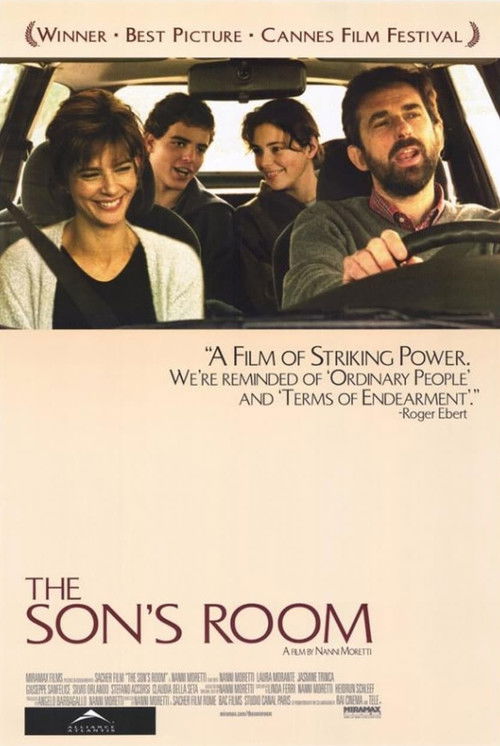
The Son's Room (2001)
Directed by Nanni Moretti
No — The Son's Room is not woke, scoring 0 out of 100 on our wokeness meter.
The Son's Room arrives from 2001, which is to say from a time before the cinema learned to explain itself.
Consciousness Markers
The cast is entirely Italian and reflects the film's natural setting; there is no deliberate diversity or representation casting.
No LGBTQ+ characters, themes, or subtext are present.
The film focuses on grief and family dynamics, with no feminist agenda or commentary on gender roles.
Race and racial identity are not addressed or thematized in the film.
There is no environmental or climate-related message.
The film does not critique capitalism or economic inequality.
Body image and body positivity are not themes in the film.
While the protagonist is a psychoanalyst, the film does not explore neurodivergence as a social or identity category.
The film is a fictional contemporary drama and does not revise or reinterpret historical events.
The film is a quiet, character-driven study of grief and does not preach or lecture the audience.
Why it received this score
The Son's Room arrives from 2001, which is to say from a time before the cinema learned to explain itself. Nanni Moretti directs and stars as Giovanni, a psychoanalyst in Ancona whose teenage son drowns in a diving accident off the coast. There follows an hour of quiet rooms, half-finished sentences, and a family learning to occupy the same house again. The film has no interest in instructing us. It sits with the mourners and waits, and the waiting is the point.
A viewer scanning the frame for social messaging will find the shelves bare. The cast is Italian because the film is set in Italy. The marriage strain is a marriage strain, not a referendum on gender. Giovanni's patients suffer ordinary terror about cancer and mortality, and the film treats them as individuals instead of case studies in a system. When the family learns their dead son had a girlfriend they never met, the discovery is used for tenderness, not for a lesson about adolescent autonomy. The girl, Arianna, hitchhikes toward France with a friend, and nobody pauses to remark on her independence. She is a young person passing through a household that needs her to.
This is not to say the film is empty. It is full of a specific, old-fashioned gravity, the sort that trusts an audience to feel something without being told what to feel. Moretti's camera lingers on a Brian Eno record, on a wall of photographs, on the long drive to Menton that ends with the family standing on a beach at night. Nothing is explained. Nothing is prescribed. The picture took the Palme d'Or and remains, two decades on, a study in restraint. For those of us who spend our days cataloguing the era's ideological fingerprints, it registers as a blank page. A clean vintage. Nothing spilled.
Analysis generated by our Consciousness Algorithm

Synopsis
A psychoanalyst and his family go through profound emotional trauma when their son dies in a scuba diving accident.
Questions about The Son's Room
Is The Son's Room woke?
No — The Son's Room is not woke, scoring 0 out of 100 on our wokeness meter. That earns it a verdict of Ultra Based.
Does The Son's Room have any woke elements?
No. All 10 markers score zero.
How does The Son's Room compare to other 2001 movies?
It ranks #128 of the 148 films from 2001 we've scored; their average is 12. The wokest is Monster's Ball (60).
How is the Woke Score calculated?
An AI-assisted process researches the film and its reception, scores it 0–100 on ten markers, then combines those into one 0–100 Woke Score. It measures a specific set of 2020s cultural themes, not film quality.