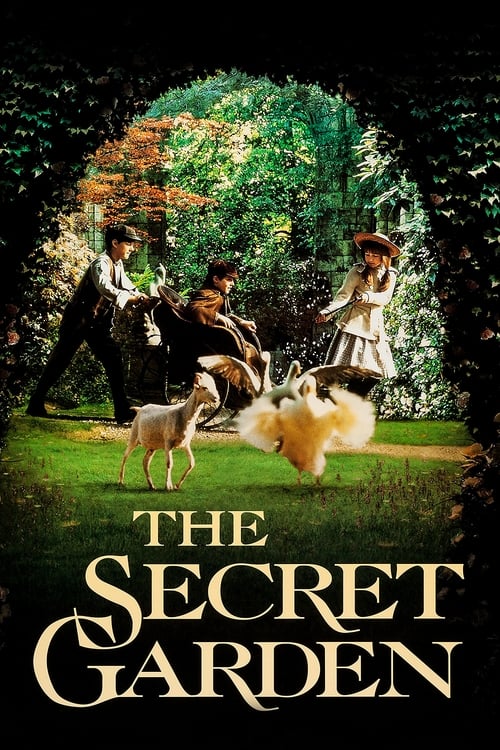
The Secret Garden (1993)
Directed by Agnieszka Holland
No — The Secret Garden is not woke, scoring 5 out of 100 on our wokeness meter.
Agnieszka Holland's 1993 adaptation arrives with the sober dignity of a well-appointed period piece and almost none of the modern cultural furniture we are asked to inventory.
Consciousness Markers
A female director (Agnieszka Holland) and screenwriter (Caroline Thompson) helm a story centered on a strong-willed girl, but the 1911 source material's themes of self-reliance predate and do not map onto a modern feminist agenda.
The restoration of the walled garden carries a mild 'green consciousness' subtext noted by contemporary critics, but it functions as a metaphor for emotional healing rather than an environmental crusade.
The film is a gentle, atmospheric children's drama that shows rather than preaches; any moral lessons about family and nature are embedded in the story, not delivered as lectures.
The cast is a conventional British ensemble of the era, with no deliberate race-blind or diversity-driven casting choices; the colonial Indian setting is period backdrop, not a representational statement.
No LGBTQ+ characters, themes, or subtext of any kind appear in the film.
Mary's birth in British India is treated purely as biographical setup for her orphanhood; the film offers no commentary on colonialism, race, or racial identity.
The film concerns an aristocratic manor and its household; there is no critique of wealth, class, or capitalism.
Colin's arc is about recovering from being treated as a sickly invalid, framed as psychosomatic neglect rather than any body-acceptance or body-positivity message.
No neurodivergent characters or themes are present or implied.
The film is a faithful period adaptation of its Edwardian source, with no historical revisionism.
Why it received this score
Agnieszka Holland's 1993 adaptation arrives with the sober dignity of a well-appointed period piece and almost none of the modern cultural furniture we are asked to inventory. A girl orphaned in British India is returned to a Yorkshire manor, where she restores a locked garden and a shut-down family. The Indian setting functions as biographical setup, not a platform for colonial critique. The cast is a conventional British ensemble of the era. There is no representational arithmetic to audit. The film is content to be an adaptation of Frances Hodgson Burnett's novel, and it does so with restraint.
A female director and a female screenwriter steer a story built around a strong-willed girl, and that fact has some historical weight. Yet the source material's self-reliance predates the modern feminist vocabulary, and the film does not retrofit it. Colin's recovery from invalidism is framed as the correction of neglect, not a lesson in body acceptance. The garden's green pulse has been read as early environmental consciousness, but here it is a metaphor for emotional thaw. No character lectures us about the planet. No one is asked to check a category before entering the gate.
The manor's aristocratic household is not indicted. The servants are loyal, the uncle is sad, and the economic order remains as fixed as the stone walls. There is no LGBTQ subtext, no neurodivergent arc, no revisionist history, and no sermonizing. The film shows rather than preaches, which in this ledger is both its virtue and its low score. It is a gentle, atmospheric children's drama that treats kindness and family as narrative facts. The cultural inventory comes up light. That is not a failure. It is simply an older film minding its own business.
Analysis generated by our Consciousness Algorithm
Part of


Synopsis
A young British girl born and reared in India loses her neglectful parents in an earthquake. She is returned to England to live at her uncle's castle. Her uncle is very distant due to the loss of his wife ten years before. Neglected once again, she begins exploring the estate and discovers a garden that has been locked and forgotten. Aided by one of the servants' boys, she begins restoring the garden, and eventually discovers some other secrets of the manor.
Questions about The Secret Garden
Is The Secret Garden woke?
No — The Secret Garden is not woke, scoring 5 out of 100 on our wokeness meter. That earns it a verdict of Ultra Based.
Does The Secret Garden have any woke elements?
Very few. None of the 10 markers reaches 30, the level where a marker counts as present; the highest is Climate Crusade at 12.
How does The Secret Garden compare to other 1993 movies?
It ranks #55 of the 97 films from 1993 we've scored; their average is 11. The wokest is Bound by Honor (60).
How is the Woke Score calculated?
An AI-assisted process researches the film and its reception, scores it 0–100 on ten markers, then combines those into one 0–100 Woke Score. It measures a specific set of 2020s cultural themes, not film quality.