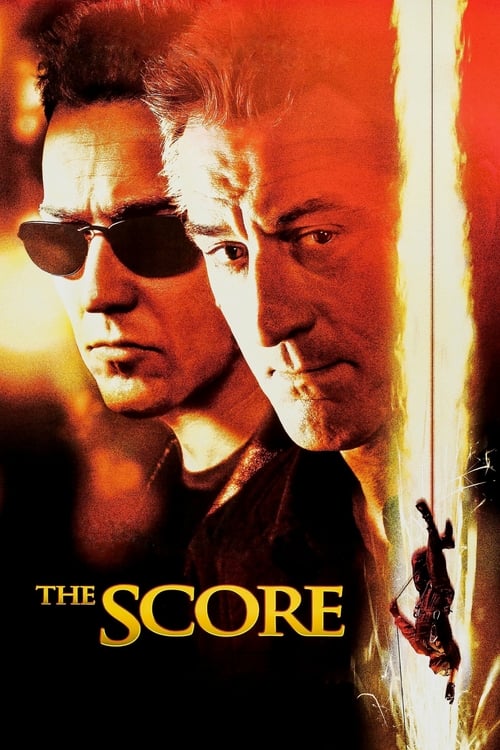
The Score (2001)
Directed by Frank Oz
No — The Score is not woke, scoring 5 out of 100 on our wokeness meter.
Frank Oz's The Score belongs to a vanishing species: the patient, procedural heist picture, assembled with the sober craftsmanship of a man building a clock.
Consciousness Markers
Angela Bassett and Gary Farmer appear in supporting roles, giving the cast some diversity, but their presence is unremarked and carries no representational agenda.
Angela Bassett's Diane exists largely as the girlfriend who disapproves of the hero's last job; she has no agency or thematic weight beyond the domestic subplot.
A crew of thieves robs a customs house for personal enrichment, not out of any critique of wealth or class; the film is indifferent to economics.
No LGBTQ+ characters, themes, or subtext of any kind.
Race is never addressed or thematized; the film is a straightforward Montreal heist caper.
No environmental themes whatsoever.
No body-positivity themes or messaging.
Edward Norton's character poses as a 'mentally challenged' janitor as a disguise, which is a plot device rather than genuine neurodivergent representation.
No historical revisionism; the film is a contemporary fictional heist.
A genre exercise in methodical caper mechanics with no preachy or didactic messaging.
Why it received this score
Frank Oz's The Score belongs to a vanishing species: the patient, procedural heist picture, assembled with the sober craftsmanship of a man building a clock. Robert De Niro plays Nick, a Montreal safecracker coaxed out of retirement for one last job, and the film devotes itself to sewers, schematics, bypass codes and the hydraulics of a pressurized beer keg. It is a movie about logistics. The cultural inventory, when we take it, comes back nearly empty.
Angela Bassett appears as Diane, the girlfriend who frowns at the hero's relapse into crime and then waits at the airport. She won an NAACP Image Award for the role, which tells us more about the scarcity of substantial parts than about the part itself. Gary Farmer turns up in support, unremarked and unthematized. Edward Norton spends much of the running time pretending to be a mentally challenged janitor, a disguise the screenplay treats as a clever costume and nothing more. Race, sexuality, class and the environment are absent from the ledger, not suppressed but simply beside the point. The thieves rob a customs house for six million dollars and a royal sceptre, and the film regards their greed with the neutrality of a hardware manual.
Brando, in his final screen appearance, spent the shoot feuding with his director and calling him Miss Piggy. That anecdote has outlived the film, and reasonably so. The Score is competent, unhurried, and entirely without a sermon in its pocket. In an era that would soon demand that even a jewel heist carry a message, this one carries only a sceptre. We can respect the restraint while noting the emptiness.
Analysis generated by our Consciousness Algorithm
Part of


Synopsis
An aging thief hopes to retire and live off his ill-gotten wealth when a young kid convinces him into doing one last heist.
Questions about The Score
Is The Score woke?
No — The Score is not woke, scoring 5 out of 100 on our wokeness meter. That earns it a verdict of Ultra Based.
Does The Score have any woke elements?
Very few. None of the 10 markers reaches 30, the level where a marker counts as present; the highest is Representation Casting at 20.
How does The Score compare to other 2001 movies?
It ranks #101 of the 148 films from 2001 we've scored; their average is 12. The wokest is Monster's Ball (60).
How is the Woke Score calculated?
An AI-assisted process researches the film and its reception, scores it 0–100 on ten markers, then combines those into one 0–100 Woke Score. It measures a specific set of 2020s cultural themes, not film quality.