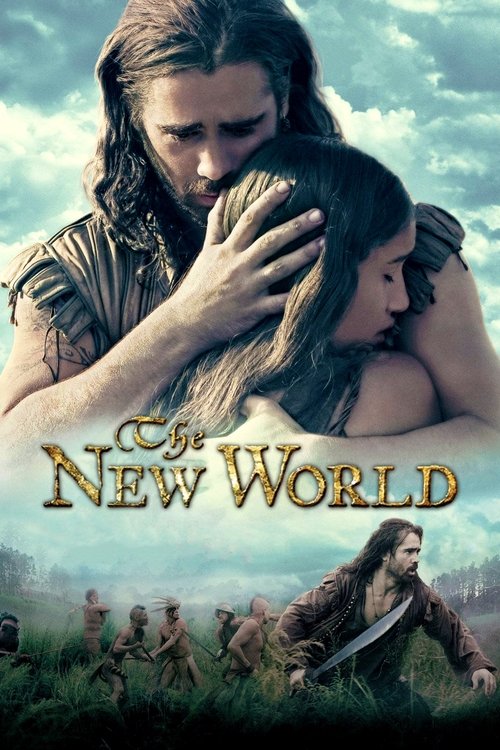
The New World (2005)
Directed by Terrence Malick
No — The New World is not especially woke, scoring 29 out of 100 on our wokeness meter.
Terrence Malick's 2005 account of Jamestown arrives with a commitment to authenticity that borders on the archaeological.
Consciousness Markers
Malick deliberately cast Native American actors (Q'orianka Kilcher, Wes Studi, August Schellenberg, Michael Greyeyes) and trained them to speak a reconstructed form of the extinct Powhatan language, an unusual commitment to authentic Indigenous representation for 2005.
The film sympathetically centers the Powhatan perspective and portrays the English settlers as encroaching invaders whose greed and disease devastate a harmonious world, a genuine colonial critique, though rendered poetically rather than polemically.
Pocahontas is the emotional and narrative center, particularly in the second half, granted interiority and agency through voiceover and perspective, though the film frames her primarily through romance rather than as an ideological statement.
The film offers a more Native-sympathetic and linguistically authentic retelling of Jamestown, but it also perpetuates the historically dubious Pocahontas-Smith romance and softens her marriage to Rolfe, so its revisionism is mythic rather than ideological.
The settlers' commercial motives—trade, gold, profit—are shown as corrosive to the peace Smith found among the Powhatan, but this is a historical observation rather than a modern eat-the-rich thesis.
Malick's whispered voiceovers are meditative and poetic rather than preachy; the film observes and evokes instead of instructing the audience.
No LGBTQ+ characters, themes, or subtext appear anywhere in the film.
Malick's lush nature imagery reflects a spiritual reverence for the natural world, but there is no climate-change message or environmental crusade.
No body-positivity themes or messaging are present.
No neurodivergent characters or themes are depicted.
Why it received this score
Terrence Malick's 2005 account of Jamestown arrives with a commitment to authenticity that borders on the archaeological. Native actors were cast in the principal Indigenous roles and drilled by a linguist to speak a reconstructed form of Powhatan, a language that had been extinct for centuries. The result is a film that grants its Native characters a full interior life and their own tongue, an effort that predates the era when such choices became a matter of studio policy. For 2005, this was unusual. It still is.
The film takes the Powhatan side of the encounter, framing the English as carriers of greed, disease, and appetite. Trade and gold corrode the peace John Smith briefly finds upriver, and the settlement's decay reads as a verdict on commerce itself. Pocahontas anchors the second half, given voice and perspective through Malick's drifting narration. Yet the romance at the center remains the old myth, the one scholars have spent decades dismantling, and her marriage to Rolfe is smoothed into something gentler than the record supports. The revisionism here is poetic, not programmatic.
There is no climate sermon, no lesson in body acceptance, no LGBTQ subtext, no neurodivergent arc. Nature is revered for spiritual reasons, not political ones, and the voiceovers murmur instead of instructing. What remains is a beautiful, slow, occasionally exasperating tone poem that critiques empire while keeping its most dubious love story intact. The film observes. It does not scold. We register the absence of a sermon with something close to gratitude.
Analysis generated by our Consciousness Algorithm


Synopsis
A drama about explorer John Smith and the clash between Native Americans and English settlers in the 17th century.
Questions about The New World
Is The New World woke?
No — The New World is not especially woke, scoring 29 out of 100 on our wokeness meter. That earns it a verdict of Based.
Does The New World have any woke elements?
3 of the 10 markers register at 30 or above, led by Racial Consciousness (50), Representation Casting (50) and Feminist Agenda (35). On Racial Consciousness: The film sympathetically centers the Powhatan perspective and portrays the English settlers as encroaching invaders whose greed and disease devastate a harmonious world, a genuine colonial critique, though rendered poetically rather than polemically.
How does The New World compare to other 2005 movies?
It ranks #18 of the 181 films from 2005 we've scored; their average is 13. The wokest is The Constant Gardener (72).
How is the Woke Score calculated?
An AI-assisted process researches the film and its reception, scores it 0–100 on ten markers, then combines those into one 0–100 Woke Score. It measures a specific set of 2020s cultural themes, not film quality.