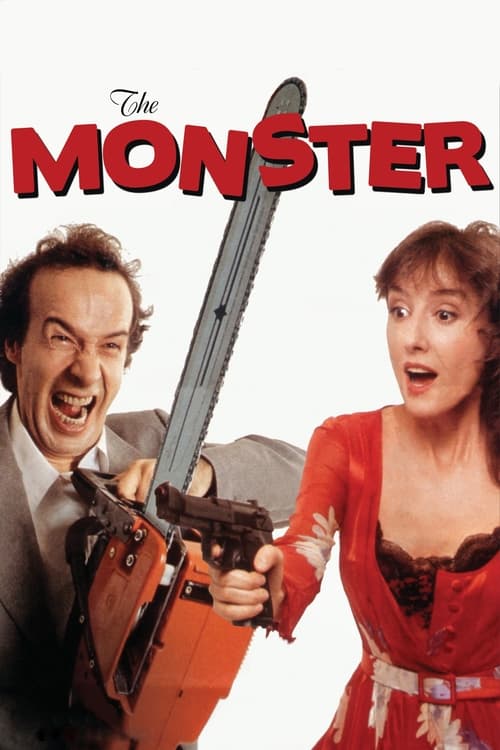
The Monster (1994)
Directed by Roberto Benigni
No — The Monster is not woke, scoring 7 out of 100 on our wokeness meter.
Roberto Benigni's 1994 farce concerns Loris, a mannequin handler and would-be assistant manager whose talent for being discovered in compromising positions makes him the prime suspect in a string of murders.
Consciousness Markers
Scholars read the film as a satirical jab at the 'compulsory consumption' and conformity of Berlusconi's media society, a mild anti-consumerist critique rather than an explicit eat-the-rich polemic.
The undercover officer Jessica is the competent one who ultimately solves the case, but the plot largely uses her as bait dressed provocatively to entrap a man, which is hardly a feminist agenda.
This is a broad Commedia dell'arte-style farce with no preachy messaging; any social critique is buried under physical comedy.
The cast is entirely Italian and French performers playing Italian characters; there is no deliberate diverse or inclusive casting agenda.
No LGBTQ+ characters, themes, or subtext appear anywhere in this 1994 Italian sex-farce comedy.
There is no engagement with race, racism, or racial identity; the film's social satire is entirely about Italian conformity and consumerism.
No environmental or climate themes are present in the film.
No body-positivity themes or messaging are present.
Loris's odd behavior drives the mistaken-identity plot, but it is played purely for slapstick comedy and is never framed as neurodivergence.
The film is a contemporary fictional comedy with no historical revisionism.
Why it received this score
Roberto Benigni's 1994 farce concerns Loris, a mannequin handler and would-be assistant manager whose talent for being discovered in compromising positions makes him the prime suspect in a string of murders. The police, lacking evidence, install an undercover officer in his apartment and instruct her to dress provocatively in order to provoke his passions. The remainder is a long exercise in mistaken identity, medical examinations conducted under the pretext of tailoring, and a Little Red Riding Hood costume deployed as a trap. It is Commedia dell'arte with a department store budget.
The film's political energies are modest and mostly scholarly. Critics of a certain disposition have read it as a jab at the compulsory consumption and conformity of Berlusconi's media society, an anti-consumerist nudge delivered through slapstick. The on-screen evidence for this is thin but present: the mannequins, the shop windows, a population that mistakes appetite for identity. Nicoletta Braschi's Jessica is the competent investigator who actually cracks the case, though she spends most of her screen time being used as bait, which tempers any claim of progressive intent. The movie's interest in gender begins and ends with the costume department.
There is no racial or environmental argument here, no engagement with identity, no body-positive or neurodivergent framing. Loris's strangeness is a comic engine, not a diagnosis. The film wants us to laugh at a man who cannot answer the simplest question at a job interview, and it succeeds often enough. As a document of social consciousness it is nearly blank, a warm-hearted sex farce with a faint consumerist grumble underneath. The Italian public made it the highest-grossing film in the nation's history at the time. They were not there for the politics.
Analysis generated by our Consciousness Algorithm


Synopsis
A vicious serial sex killer is on the loose, and landscape gardener and shop-window outfitter Loris is the prime suspect, thanks to his unfortunate habit of getting caught in compromising situations (for which there is always a totally innocent explanation that the police fail to spot). Undercover policewoman Jessica is assigned by eccentric police psychologist Taccone to follow Loris.
Questions about The Monster
Is The Monster woke?
No — The Monster is not woke, scoring 7 out of 100 on our wokeness meter. That earns it a verdict of Ultra Based.
Does The Monster have any woke elements?
Very few. None of the 10 markers reaches 30, the level where a marker counts as present; the highest is Eat the Rich at 15.
How does The Monster compare to other 1994 movies?
It ranks #40 of the 86 films from 1994 we've scored; their average is 10. The wokest is On Deadly Ground (75).
How is the Woke Score calculated?
An AI-assisted process researches the film and its reception, scores it 0–100 on ten markers, then combines those into one 0–100 Woke Score. It measures a specific set of 2020s cultural themes, not film quality.