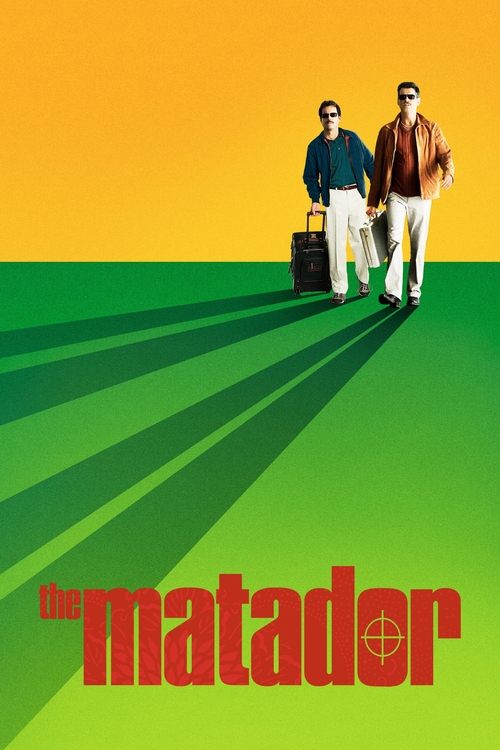
The Matador (2005)
Directed by Richard Shepard
No — The Matador is not woke, scoring 3 out of 100 on our wokeness meter.
The Matador arrives from 2005, a black comedy thriller in which Pierce Brosnan plays a dissolving hitman and Greg Kinnear plays the salesman who befriends him in a Mexico City hotel bar.
Consciousness Markers
The cast is overwhelmingly white and Anglo, with Mexican performers confined to anonymous background roles in the Mexico City setting; no deliberate diversity casting agenda is present.
Danny's corporate sales anxieties and midlife malaise touch on business culture, but the film is amoral and indifferent to any critique of capitalism.
Mexico City serves as an exotic backdrop for a hitman caper, but the film engages in no racial commentary or consciousness whatsoever.
Hope Davis's Bean is a supportive wife in a domestic subplot; the film has no feminist framework or commentary on gender.
The film is a wry, amoral black comedy that pointedly avoids moralizing or preaching of any kind.
No LGBTQ+ characters, themes, or subtext appear anywhere in the film.
No environmental or climate themes are present.
A 'portly spectator' is referenced as a target in a murder tutorial, which is the opposite of body-positive messaging.
Julian's instability and midlife crisis are framed as moral and existential breakdown, not neurodivergence.
The film is a fictional contemporary thriller with no historical subject matter to revise.
Why it received this score
The Matador arrives from 2005, a black comedy thriller in which Pierce Brosnan plays a dissolving hitman and Greg Kinnear plays the salesman who befriends him in a Mexico City hotel bar. Richard Shepard directs with a shrug, which is the film's defining gesture. Julian Noble freezes on a job, drinks too much, and confesses his profession to a stranger over cocktails; Danny Wright, fearing for his job, listens. There is no thesis here, no lesson, no earnest plea for anything at all. The film is content to watch two men circle each other.
On the cultural ledger, the picture is nearly bare, and it seems proud of that. The cast is Anglo to the bone, with Mexican performers drifting through the Mexico City scenes as scenery, unnamed and unconsulted. Portia Dawson, listed fourth, appears briefly. Hope Davis gets a wife's subplot and little else, and the film has no interest in what she might think about any of it. There are no queer currents, no environmental sermons, no neurodivergent reading of Julian's collapse, which the film treats as a moral crisis rather than a diagnosis. The one body-conscious moment involves a portly spectator selected as a hypothetical victim during a murder tutorial. It is a joke, and a mean one.
Business culture gets a glancing brush, mostly as backdrop for Danny's midlife panic, and the film refuses to draw conclusions from it. Its amorality is deliberate and total. Nothing is preached. Nobody is lectured. For a certain temperament this is a virtue, and for another it is merely an absence. The film holds its tongue and lets the two men sit in it, which is either integrity or exhaustion, and after twenty years of earnest cinema it is hard to tell the difference anymore.
Analysis generated by our Consciousness Algorithm


Synopsis
The life of Danny Wright, a salesman forever on the road, veers into dangerous and surreal territory when he wanders into a Mexican bar and meets a mysterious stranger, Julian, who's very likely a hit man. Their meeting sets off a chain of events that will change their lives forever, as Wright is suddenly thrust into a far-from-mundane existence that he takes to surprisingly well … once he gets acclimated to it.
Questions about The Matador
Is The Matador woke?
No — The Matador is not woke, scoring 3 out of 100 on our wokeness meter. That earns it a verdict of Ultra Based.
Does The Matador have any woke elements?
Very few. None of the 10 markers reaches 30, the level where a marker counts as present; the highest is Representation Casting at 8.
How does The Matador compare to other 2005 movies?
It ranks #150 of the 181 films from 2005 we've scored; their average is 13. The wokest is The Constant Gardener (72).
How is the Woke Score calculated?
An AI-assisted process researches the film and its reception, scores it 0–100 on ten markers, then combines those into one 0–100 Woke Score. It measures a specific set of 2020s cultural themes, not film quality.