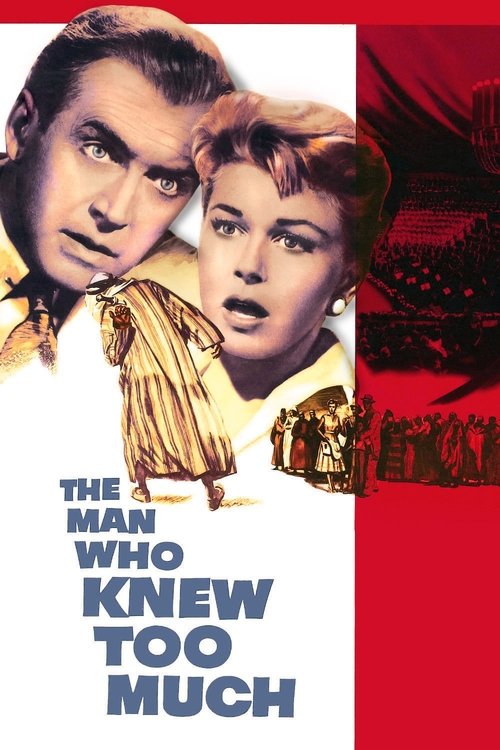
The Man Who Knew Too Much (1956)
Directed by Alfred Hitchcock
No — The Man Who Knew Too Much is not woke, scoring 0 out of 100 on our wokeness meter.
Alfred Hitchcock's 1956 remake of his own 1934 thriller arrives from a distant era, a VistaVision postcard of international intrigue in which an American physician and his retired-singer wife stumble into an assassination plot and a kidnapping.
Consciousness Markers
The cast is entirely white, with no deliberate representation casting or diverse leads. Non-white characters appear only as background extras in Morocco.
No LGBTQ+ characters, themes, or subtext are present.
Doris Day's character is a mother and former singer who acts to save her son, but the film contains no feminist agenda or commentary on gender roles.
The Moroccan setting is exotic backdrop only; the film has no racial consciousness or commentary on race.
No environmental or climate themes are present.
No critique of capitalism or wealth inequality appears.
No body positivity themes or diverse body representations are present.
No neurodivergent characters or themes are present.
The film is a straightforward thriller remake, not a revisionist historical narrative.
The film is pure suspense entertainment with no preachy or lecture-like messaging.
Why it received this score
Alfred Hitchcock's 1956 remake of his own 1934 thriller arrives from a distant era, a VistaVision postcard of international intrigue in which an American physician and his retired-singer wife stumble into an assassination plot and a kidnapping. The picture is efficient, glossy, and entirely untroubled by the questions that occupy the contemporary cultural ledger. We examined it thoroughly. We found nothing.
The cast is uniformly white, and the Moroccan setting functions as a picturesque backdrop for a spy chase, its residents consigned to the margins of the frame. No racial commentary intrudes. Doris Day's Jo McKenna is a mother who screams at a cymbal crash to save her son and a foreign statesman, an act of maternal nerve the film presents without a whisper of gender theory. The villains are a polite English couple and a foreign ambassador, motivated by geopolitics and nothing so legible as capital. Nobody lectures. Nobody delivers a monologue about the environment, the body, or the spectrum of human neurology. The suspense is the point, and Hitchcock guards it jealously.
What remains is craft. The Royal Albert Hall sequence runs twelve minutes without dialogue, a feat of pure cinematic nerve, and Bernard Herrmann's cameo as the conductor is the sort of inside joke that requires no footnotes. The film won an Academy Award for "Que Sera, Sera," a song that does narrative work instead of moral work, which is its own quiet achievement. This is a thriller from a time when a thriller was permitted to be merely thrilling. We classify it accordingly, with the respect owed to an artifact that asks nothing of us but attention.
Analysis generated by our Consciousness Algorithm
Part of


Synopsis
An American doctor and his wife, a former singing star, witness a murder while vacationing in Morocco, and are drawn into a twisting plot of international intrigue when their young son is kidnapped.
Questions about The Man Who Knew Too Much
Is The Man Who Knew Too Much woke?
No — The Man Who Knew Too Much is not woke, scoring 0 out of 100 on our wokeness meter. That earns it a verdict of Ultra Based.
Does The Man Who Knew Too Much have any woke elements?
No. All 10 markers score zero.
How does The Man Who Knew Too Much compare to other 1956 movies?
It ranks #8 of the 11 films from 1956 we've scored; their average is 4. The wokest is Giant (28).
How is the Woke Score calculated?
An AI-assisted process researches the film and its reception, scores it 0–100 on ten markers, then combines those into one 0–100 Woke Score. It measures a specific set of 2020s cultural themes, not film quality.