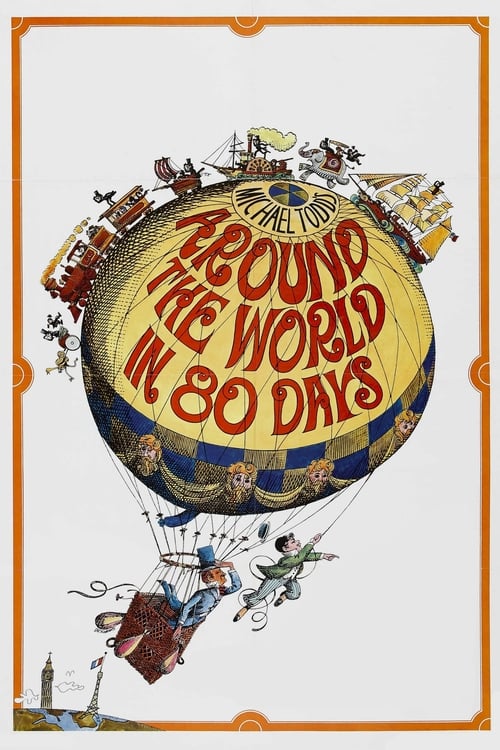
Around the World in 80 Days (1956)
Directed by Michael Anderson
No — Around the World in 80 Days is not woke, scoring 6 out of 100 on our wokeness meter.
Michael Todd's 1956 epic arrives as a monument to a vanished kind of showmanship, a globe-trotting pageant assembled from 112 locations and roughly 68,000 human beings, most of whom were paid to stand in the sun.
Consciousness Markers
The international cast includes Mexican comedy star Cantinflas in a major co-lead role and a globe-trotting ensemble, but this reflects 1950s showmanship rather than modern inclusive casting; the Native American extras were famously dyed with orange pigment.
Aouda is rescued from a funeral pyre and largely functions as a romantic prize, though the closing gag that no woman has ever entered the Reform Club carries a faint proto-feminist wink.
The film depicts colonial-era India and the American West through a purely exoticized, adventure-lens, with no interrogation of race or empire.
No LGBTQ+ characters, themes, or subtext of any kind appear in this Victorian adventure romp.
No environmental or climate themes; the burning of the ship's lifeboats for fuel is played for plucky resourcefulness, not ecological commentary.
Fogg's lavish spending and bribery are celebrated as gentlemanly virtues that grease the wheels of his wager, hardly a critique of wealth.
No body-positivity themes or messaging present.
No neurodivergence themes or characters.
A straightforward period adventure faithful to its 1873 source; no historical revisionism.
Pure light-hearted spectacle and slapstick; the film lectures no one about anything.
Why it received this score
Michael Todd's 1956 epic arrives as a monument to a vanished kind of showmanship, a globe-trotting pageant assembled from 112 locations and roughly 68,000 human beings, most of whom were paid to stand in the sun. The picture is charming, sprawling, and entirely innocent of the social preoccupations that would later become the industry's house style. Its international casting, anchored by the Mexican comedian Cantinflas in a genuine co-lead, reflects the commercial logic of a producer chasing Spanish-language markets, not any modern commitment to inclusive hiring. The 650 Native American extras in the train sequence had their skin painted with some fifty gallons of orange dye. We record this without comment, because the film did not comment on it either.
The narrative runs on Victorian confidence. Fogg bribes captains, buys steamships, and burns his own lifeboats for fuel, and each act is framed as plucky resourcefulness. No one suggests that wealth might be a problem. The film's treatment of empire is untroubled in the same way. India appears as a backdrop for a rescue, the American West as a backdrop for a chase, and the young widow Aouda exists chiefly to be saved and then won. A closing gag notes that no woman has ever entered the Reform Club, a wink that lands somewhere between a joke and a shrug. There is no LGBTQ+ presence, no meditation on the body, no neurodivergent character, and no environmental concern to be found. The lifeboats burn for comedy.
The picture offers spectacle instead, and it offers it generously. The balloon flight, invented for the screen, exists to show off a curved 70mm frame. The cameos, the animals, the costumes numbering in the tens of thousands: all of it engineered for wonder, not instruction. The film lectures nobody about anything, which in the current climate reads almost as an achievement. It is a Best Picture winner, a faithful adaptation of Jules Verne, and a box office juggernaut of its day. It is also, by the standards of our present taxonomy, a nearly blank specimen. A charming one. Nearly blank all the same.
THEMATIC_TAGS: oscar_winner, book_adaptation, box_office_number_one
Analysis generated by our Consciousness Algorithm


Synopsis
Based on the famous book by Jules Verne the movie follows Phileas Fogg on his journey around the world. Which has to be completed within 80 days, a very short period for those days.
Questions about Around the World in 80 Days
Is Around the World in 80 Days woke?
No — Around the World in 80 Days is not woke, scoring 6 out of 100 on our wokeness meter. That earns it a verdict of Ultra Based.
Does Around the World in 80 Days have any woke elements?
Very few. None of the 10 markers reaches 30, the level where a marker counts as present; the highest is Representation Casting at 15.
How does Around the World in 80 Days compare to other 1956 movies?
It ranks #2 of the 11 films from 1956 we've scored; their average is 4. The wokest is Giant (28).
How is the Woke Score calculated?
An AI-assisted process researches the film and its reception, scores it 0–100 on ten markers, then combines those into one 0–100 Woke Score. It measures a specific set of 2020s cultural themes, not film quality.