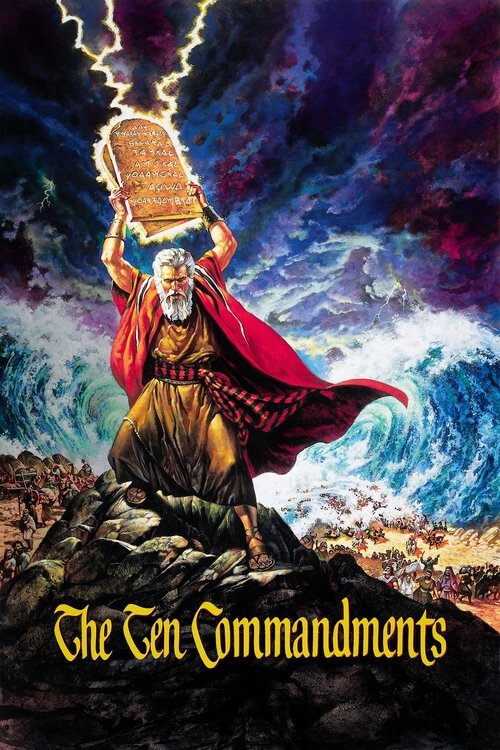
The Ten Commandments (1956)
Directed by Cecil B. DeMille
No — The Ten Commandments is not woke, scoring 2 out of 100 on our wokeness meter.
Cecil B. DeMille's final directorial effort arrives with its own onscreen introduction, the director stepping before the curtain to explain that this is not a film about the past but about freedom under God.
Consciousness Markers
DeMille's onscreen introduction and the film's heavy moralizing about 'freedom under God' give it a didactic tone, but the message is religious and traditional rather than progressive or social-justice oriented.
The cast is overwhelmingly white Hollywood stars (Heston, Brynner, Baxter, Robinson) playing Egyptian, Hebrew, and Midianite characters, with no effort at authentic representation. This is the inverse of representation casting.
No LGBTQ+ characters, themes, or subtext of any kind appear in this 1956 biblical epic.
Female characters such as Nefretiri and Sephora occupy traditional biblical-era roles; the film advances no feminist critique or agenda.
The liberation of the enslaved Hebrews is framed entirely as a religious and national deliverance, not as a modern racial-consciousness narrative.
No environmental or climate themes are present in the story of the Exodus.
The film contains no critique of capitalism, wealth, or class structures in the modern sense.
No body-positivity themes or messaging appear in the film.
No neurodivergence themes or characters are present.
The film follows the Book of Exodus and ancient sources (Josephus, Philo, Midrash) rather than revising history for modern ideological purposes.
Why it received this score
Cecil B. DeMille's final directorial effort arrives with its own onscreen introduction, the director stepping before the curtain to explain that this is not a film about the past but about freedom under God. It was, at the time of its release, the most expensive motion picture ever made, a VistaVision colossus of plaster cities, parted waters, and a green cloud of death that descends on Egyptian firstborns with the enthusiasm of a studio accountant approving overtime. The picture runs three hours and forty minutes, and it is never in a hurry, because it believes eternity is on its side.
The casting deserves a moment of quiet contemplation. Charlton Heston, a Midwestern American, plays the Hebrew deliverer. Yul Brynner, born in Vladivostok, plays the Pharaoh. Anne Baxter, from Indiana, plays Nefretiri, and Edward G. Robinson, who grew up on the Lower East Side, plays the Hebrew overseer Dathan. Egyptian royalty, Hebrew slaves, and Midianite shepherds are all rendered by the same pool of Hollywood contract players, and nobody in 1956 thought to remark upon it. The enslavement of the Hebrews is framed as national and religious deliverance, a covenant with a deity, not as an occasion for modern racial commentary.
What remains is a sermon, delivered at length, and the congregation is expected to sit still for it. The moral instruction is traditional and biblical, aimed at the human soul, which spares the film the more recent varieties of cultural instruction. It airs every spring, preserved by the Library of Congress, and it endures. So it was written. So it shall be done.
Analysis generated by our Consciousness Algorithm
Part of


Synopsis
Escaping death, a Hebrew infant is raised in a royal household to become a prince. Upon discovery of his true heritage, Moses embarks on a personal quest to reclaim his destiny as the leader and liberator of the Hebrew people.
Questions about The Ten Commandments
Is The Ten Commandments woke?
No — The Ten Commandments is not woke, scoring 2 out of 100 on our wokeness meter. That earns it a verdict of Ultra Based.
Does The Ten Commandments have any woke elements?
Very few. None of the 10 markers reaches 30, the level where a marker counts as present; the highest is Lecture Energy at 10.
How does The Ten Commandments compare to other 1956 movies?
It ranks #4 of the 11 films from 1956 we've scored; their average is 4. The wokest is Giant (28).
How is the Woke Score calculated?
An AI-assisted process researches the film and its reception, scores it 0–100 on ten markers, then combines those into one 0–100 Woke Score. It measures a specific set of 2020s cultural themes, not film quality.