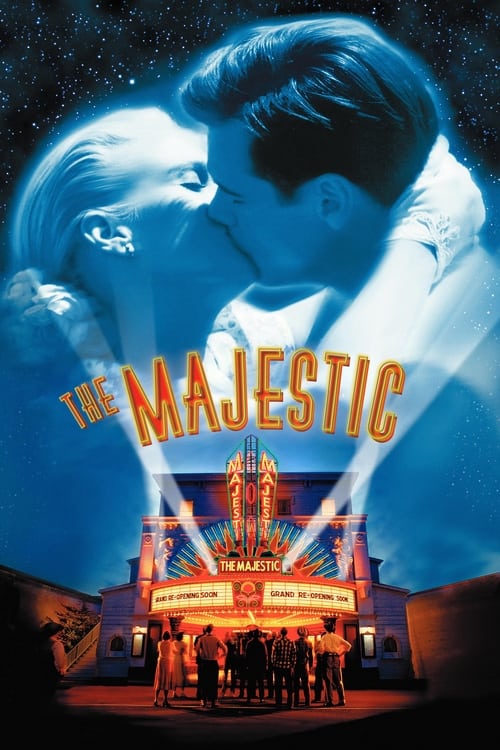
The Majestic (2001)
Directed by Frank Darabont
No — The Majestic is not woke, scoring 6 out of 100 on our wokeness meter.
Frank Darabont's The Majestic arrives in 2001 wearing its influences on its sleeve, a Capra pastiche about a blacklisted screenwriter who loses his memory and is absorbed into a small town that mistakes him for a dead war hero.
Consciousness Markers
The climactic congressional hearing features an impassioned speech reading from the First Amendment, but its message is patriotic reverence for traditional American ideals rather than progressive sermonizing.
Adele Stanton has a few moments of resolve, urging Peter to fight rather than capitulate, but the film is a traditional romance in which she largely functions as the emotional prize and moral support.
The Hollywood studio executives are portrayed as cowardly and shallow, and Peter ultimately rejects their commercial instincts, but this is a mild anti-Hollywood sentiment rather than an economic critique.
The cast is overwhelmingly white, with the only notable non-white presence being Cliff Curtis in a brief film-within-the-film cameo. There is no deliberate diverse casting agenda at work.
No LGBTQ+ characters, themes, or subtext appear anywhere in the film.
The film engages no racial themes whatsoever; its social conflict is entirely about political ideology and small-town grief.
There is no environmental or climate content in the film.
No body-positivity themes or messaging are present.
Amnesia functions purely as a plot device for mistaken identity; it is not framed as neurodivergence or treated with any awareness angle.
The film is a nostalgic, traditionalist Capra-esque fable about 1950s small-town America and WWII heroism, not a modern reinterpretation of history through a progressive lens.
Why it received this score
Frank Darabont's The Majestic arrives in 2001 wearing its influences on its sleeve, a Capra pastiche about a blacklisted screenwriter who loses his memory and is absorbed into a small town that mistakes him for a dead war hero. The film has politics, but they are the politics of 1951 as filtered through a fondness for 1951. It disapproves of the House Un-American Activities Committee, which is not a controversial position, and it does so while waving the flag, quoting the Constitution, and mourning the loss of sixty local boys. Nostalgia is the engine here, and nostalgia does not audit its own casting.
On that front, the town of Lawson is very white, very wholesome, and very certain about the way things ought to be. Cliff Curtis turns up briefly inside the film-within-the-film, a studio confection called Sand Pirates of the Sahara, and then the matter is dropped. Laurie Holden's Adele gets a scene or two of resolve, urging her man to stand and fight, though she spends most of the running time as the emotional prize awaiting collection. The Hollywood executives are drawn as shallow cowards, which amounts to a mild jab at the industry's commercial instincts and nothing further. The amnesia is a plot device, not a condition, and no one in the screenplay treats it as anything else.
The finale stages a congressional hearing, where Jim Carrey reads from the First Amendment while clutching a Medal of Honor, and the radio carries his words back to Lawson. It is a sermon, but a patriotic one, aimed at reverence instead of reform. The film wants us to feel something about a vanished America. It succeeds, intermittently, and it never notices that the America it mourns was not quite available to everyone.
Analysis generated by our Consciousness Algorithm


Synopsis
Set in 1951, a blacklisted Hollywood writer gets into a car accident, loses his memory and settles down in a small town where he is mistaken for a long-lost son.
Questions about The Majestic
Is The Majestic woke?
No — The Majestic is not woke, scoring 6 out of 100 on our wokeness meter. That earns it a verdict of Ultra Based.
Does The Majestic have any woke elements?
Very few. None of the 10 markers reaches 30, the level where a marker counts as present; the highest is Lecture Energy at 20.
How does The Majestic compare to other 2001 movies?
It ranks #92 of the 148 films from 2001 we've scored; their average is 12. The wokest is Monster's Ball (60).
How is the Woke Score calculated?
An AI-assisted process researches the film and its reception, scores it 0–100 on ten markers, then combines those into one 0–100 Woke Score. It measures a specific set of 2020s cultural themes, not film quality.