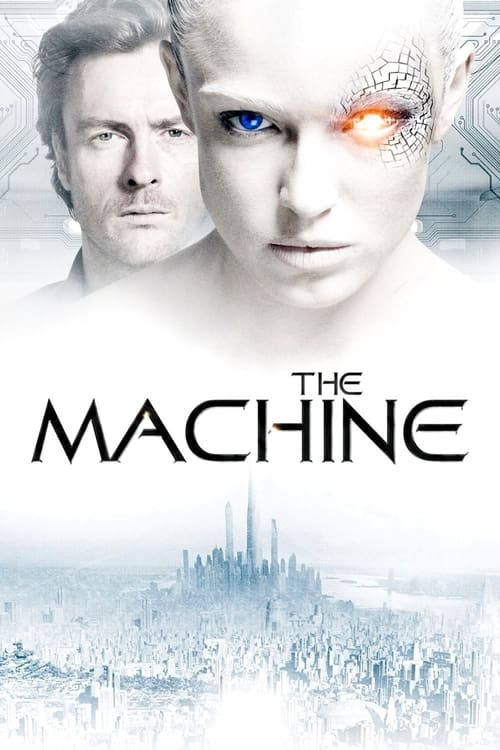
The Machine (2013)
Directed by Caradog W. James
No — The Machine is not especially woke, scoring 28 out of 100 on our wokeness meter.
Caradog W. James brings us a modestly budgeted British science fiction thriller in which the Ministry of Defence, deep in a second Cold War, builds a conscious android from the brain scan of a dead researcher.
Consciousness Markers
The film heavily features neurological themes, specifically the brain damage of Paul Dawson and the use of brain scans to create Machine, linking the plot to cognitive function and disability.
While the film is intellectually ambitious and deals with complex ethical dilemmas regarding AI, its execution leans more toward a thriller than a didactic lecture.
The character of Ava demonstrates professional autonomy and moral agency, and the creation of Machine represents a powerful, self-aware entity, though the narrative is not explicitly structured around a feminist agenda.
The primary conflict is against the state military apparatus rather than a critique of unchecked corporate capitalism or extreme wealth disparity.
The film features a predominantly white British cast, offering little in the way of diverse representation in its key roles.
There is no discernible presence of LGBTQ+ themes or characters within the provided plot summary or metadata.
The film focuses on technological and military ethics, showing no specific engagement with racial issues or social justice related to race.
The narrative is set within a military and scientific framework, with no thematic focus on environmental degradation or climate change.
The focus is on cybernetic augmentation and neurological function, with no commentary on body image or diverse physical forms.
As a work of speculative fiction, the film does not attempt to challenge or rewrite established historical facts.
Why it received this score
Caradog W. James brings us a modestly budgeted British science fiction thriller in which the Ministry of Defence, deep in a second Cold War, builds a conscious android from the brain scan of a dead researcher. The film carries itself with the grim self-importance of a laboratory that has forgotten why anyone funded it. Toby Stephens glowers as the obsessive programmer. Caity Lotz does double duty as the murdered scientist and the machine built in her image, and she performs her own stunts, which is the sort of production detail that tends to impress people at festivals.
The film's real preoccupation is neurological. A soldier with a left hemispherectomy, a daughter with Rett syndrome, brain scans repurposed as software: the plot runs on questions of cognition, memory, and what remains of a person when the wiring fails. This gives the proceedings a weight that most low-budget genre pictures never approach. The machine herself develops a conscience, refuses immoral orders, and asks to be protected, which is a more interesting arc than the usual robot rampage. Ava, meanwhile, gets a measure of professional authority and moral stubbornness before the script disposes of her, though the film never organizes itself around her grievances.
Elsewhere the film keeps its gaze fixed on military and technological ethics, and little else. The enemy is the state apparatus, not the boardroom, so the economic critique stays muted. The cast is white and British in the manner of a regional repertory company. There is no engagement with racial politics, no environmental anxiety, no commentary on body image, and no historical revisionism, this being speculative fiction with no interest in the past. The screenplay debates sentience and the ethics of creation at some length, and the debates are smart, but they arrive wrapped in a thriller, so the sermonizing never quite takes over. It is a serious, chilly little film that knows exactly which arguments it wants to have, and declines to have the rest.
Analysis generated by our Consciousness Algorithm


Synopsis
Already deep into a second Cold War, Britain’s Ministry of Defense seeks a game-changing weapon. Programmer Vincent McCarthy unwittingly provides an answer in The Machine, a super-strong human cyborg. When a programming bug causes the prototype to decimate his lab, McCarthy takes his obsessive efforts underground, far away from inquisitive eyes.
Questions about The Machine
Is The Machine woke?
No — The Machine is not especially woke, scoring 28 out of 100 on our wokeness meter. That earns it a verdict of Based.
Does The Machine have any woke elements?
2 of the 10 markers register at 30 or above, led by Neurodivergence (60) and Lecture Energy (30). On Neurodivergence: The film heavily features neurological themes, specifically the brain damage of Paul Dawson and the use of brain scans to create Machine, linking the plot to cognitive function and disability.
How does The Machine compare to other 2013 movies?
It ranks #37 of the 274 films from 2013 we've scored; their average is 14. The wokest is Belle (76).
How is the Woke Score calculated?
An AI-assisted process researches the film and its reception, scores it 0–100 on ten markers, then combines those into one 0–100 Woke Score. It measures a specific set of 2020s cultural themes, not film quality.