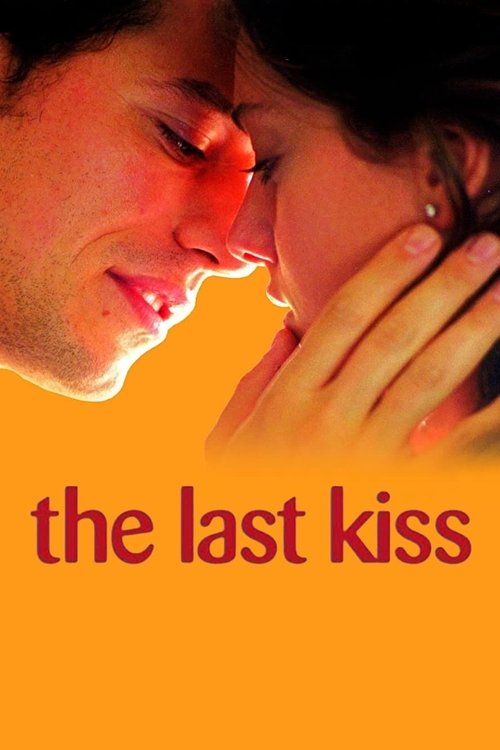
The Last Kiss (2001)
Directed by Gabriele Muccino
No — The Last Kiss is not woke, scoring 0 out of 100 on our wokeness meter.
The Last Kiss arrives from 2001, a vintage cellared well before the current cultural harvest, and it tastes of nothing but its own era.
Consciousness Markers
The cast is entirely Italian and lacks any deliberate modern diversity or inclusive casting markers.
There are no LGBTQ+ characters, relationships, or themes in the film.
The film focuses on a man's fear of commitment and infidelity; it does not advance a modern feminist agenda.
Race and racial justice are not addressed in the story.
Environmental or climate themes are entirely absent.
The film does not critique capitalism, wealth inequality, or class structures.
There is no body-positivity messaging or related thematic content.
Neurodivergence is not represented or discussed.
The film is a contemporary relationship drama with no historical revisionism.
It is a character-driven dramedy without explicit ideological sermons or preachy messaging.
Why it received this score
The Last Kiss arrives from 2001, a vintage cellared well before the current cultural harvest, and it tastes of nothing but its own era. Gabriele Muccino's comedy-drama follows Carlo, a man of thirty who learns his girlfriend Giulia is pregnant and promptly spirals into a private panic. He meets Francesca, eighteen and radiant, at a wedding. The rest is a slow tumble toward betrayal, followed by the morning after and the reckoning. It is a film about cowardice, which the keywords confirm without apology, and about the ordinary wreckage that men leave behind when they confuse freedom with escape.
Our survey finds the cupboard bare. The cast is uniformly Italian, with no inclusive casting apparatus at work behind the camera. There are no queer characters or themes. Race goes unmentioned. The climate does not intrude upon a single scene. Nobody eats the rich, or anyone else, in the economic sense. Bodies are presented without commentary, neither celebrated nor interrogated. Neurodivergence is absent. History is left unrevised, because no history is invoked. What remains is a study of a man behaving badly toward two women, which is a dramatic premise and not a social program. The film has no interest in instructing anyone about anything beyond the hazards of its own protagonist.
And the film does not lecture. This is its quiet virtue, if virtue is the word we want. Muccino lets Carlo's failures speak for themselves, and the camera observes instead of instructing. No sermon arrives. No lesson is pressed upon the audience in the final reel. The result is a relic from a time when Italian relationship dramas were content to be Italian relationship dramas, and nothing more ambitious. We classify it accordingly, with a flat and unremarkable verdict across every category we maintain. The cellar is empty. The bottle is dry.
Analysis generated by our Consciousness Algorithm
Synopsis
Giulia and Carlo have been happy together for three years, but Giulia's announcement that she is pregnant sends him into a secret panic. Terrified at his imminent entry into the adult world of irreversible responsibilities, Carlo finds himself tempted by a bewitching 18-year-old girl, Francesca, whom he meets by chance at a wedding. The possibility of one last youthful crazy fling before the impending prison of parenthood proves to be too attractive to resist.
Questions about The Last Kiss
Is The Last Kiss woke?
No — The Last Kiss is not woke, scoring 0 out of 100 on our wokeness meter. That earns it a verdict of Ultra Based.
Does The Last Kiss have any woke elements?
No. All 10 markers score zero.
How does The Last Kiss compare to other 2001 movies?
It ranks #128 of the 148 films from 2001 we've scored; their average is 12. The wokest is Monster's Ball (60).
How is the Woke Score calculated?
An AI-assisted process researches the film and its reception, scores it 0–100 on ten markers, then combines those into one 0–100 Woke Score. It measures a specific set of 2020s cultural themes, not film quality.