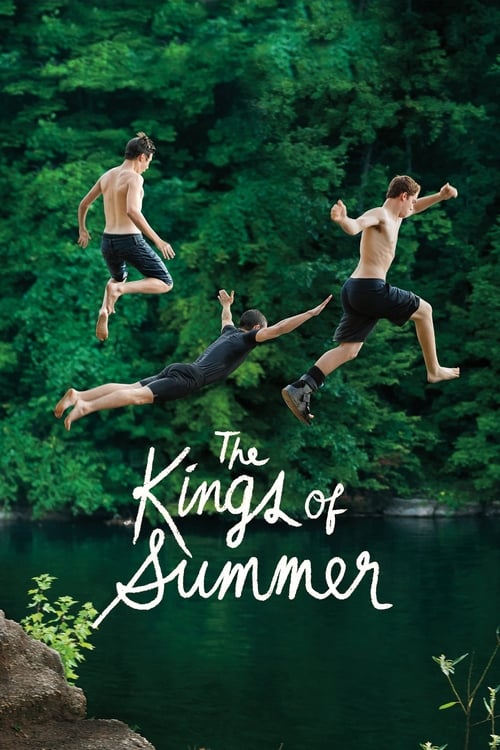
The Kings of Summer (2013)
Directed by Jordan Vogt-Roberts
No — The Kings of Summer is not woke, scoring 0 out of 100 on our wokeness meter.
The Kings of Summer arrived from Sundance in 2013 with the usual festival plumage: an indie soundtrack, a first-time director, and a handful of teenagers fleeing their parents for a clearing in the Ohio woods.
Consciousness Markers
The cast is predominantly white with one Hispanic actor in a non-ethnic-specific role; no deliberate diversity casting or commentary.
No LGBTQ+ characters, themes, or subtext.
Female characters serve mainly as romantic interests or mothers; no feminist agenda or gender-political critique.
No engagement with race, racism, or racial identity.
The boys' woodland survival is a teen fantasy, not an environmentalist or climate-crisis narrative.
Teen rebellion against parental authority and suburban life, but no critique of capitalism or wealth inequality.
No body-positivity themes or diverse body representation as a message.
Biaggio is quirky and eccentric, but the film does not frame him through neurodivergence or disability advocacy.
No historical revisionism; it is a contemporary fictional coming-of-age story.
No preachy social-issue monologues or didactic messaging.
Why it received this score
The Kings of Summer arrived from Sundance in 2013 with the usual festival plumage: an indie soundtrack, a first-time director, and a handful of teenagers fleeing their parents for a clearing in the Ohio woods. It concerns Joe, Patrick, and a stray named Biaggio, who build a house out of scrap lumber and declare themselves sovereign. The rebellion is aimed squarely at fathers, mothers, and the general indignity of being sixteen. Nobody in the film pauses to address the audience about the structure of power. The camera simply watches boys hammer nails badly.
The cast is white throughout, with Moisés Arias drifting past as a curiosity instead of a statement. The women exist to be crushes or mothers, and the film shows no interest in correcting this arrangement. Biaggio's oddness is played for laughs, never diagnosed. The boys do not escape capitalism, only curfews, and their woodland idyll is a fantasy of independence, not an environmental parable. A snake, a rabbit, and a machete carry the third act. The moral, such as it is, involves going home.
We are left with a film that has no argument to make about the culture that produced it. It wants to be about friendship and the summer before everything changes, and it achieves that modest aim without incident. There is no sermon, no corrective casting, no lecture smuggled into the campfire scenes. For a viewer trained to audit such things, the silence is nearly restful. The tally comes back empty, and the emptiness is earned.
Analysis generated by our Consciousness Algorithm


Synopsis
Three restless teenagers run away to the woods for the summer, determined to escape their parents and live by their own rules. In a hidden clearing, they build a makeshift house and attempt to create an independent life, testing their friendship, freedom, and the challenges of living off the land.
Questions about The Kings of Summer
Is The Kings of Summer woke?
No — The Kings of Summer is not woke, scoring 0 out of 100 on our wokeness meter. That earns it a verdict of Ultra Based.
Does The Kings of Summer have any woke elements?
No. All 10 markers score zero.
How does The Kings of Summer compare to other 2013 movies?
It ranks #249 of the 274 films from 2013 we've scored; their average is 14. The wokest is Belle (76).
How is the Woke Score calculated?
An AI-assisted process researches the film and its reception, scores it 0–100 on ten markers, then combines those into one 0–100 Woke Score. It measures a specific set of 2020s cultural themes, not film quality.