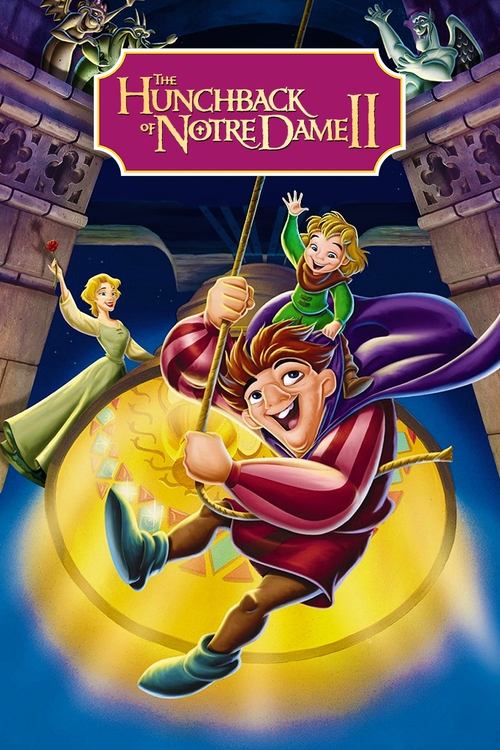
The Hunchback of Notre Dame II (2002)
Directed by Bradley Raymond
No — The Hunchback of Notre Dame II is not woke, scoring 0 out of 100 on our wokeness meter.
Sequels arrive for many reasons, and artistic compulsion is rarely among them.
Consciousness Markers
Voice cast is predominantly white and does not feature conscious identity-matched casting; disabled and Romani characters are inherited from the source and not framed as modern representation.
No LGBTQ+ characters, themes, or subtext.
Female characters exist as love interest and mother; no feminist agenda or gender-power critique.
Esmeralda is Romani, but the film does not engage with racial consciousness or systemic prejudice.
No environmental or climate themes.
Villain is a thief and exploiter, but the film lacks an anti-capitalist or eat-the-rich message.
Quasimodo's appearance is a plot point, but the theme is classic inner-beauty acceptance, not modern body positivity.
No neurodivergent characters or themes.
Medieval Paris setting is not used for historical revisionism.
No preachy modern lecture energy; moral is conventional fairy-tale romance.
Why it received this score
Sequels arrive for many reasons, and artistic compulsion is rarely among them. The Hunchback of Notre Dame II, a direct-to-video continuation released in 2002, returns us to Notre-Dame, where Quasimodo rings bells, mentors a small boy named Zephyr, and pines for a circus performer called Madellaine whose employer intends to steal the cathedral's finest bell. The animation is thin, the songs are brief, and the gargoyles have been downgraded to comic relief on a diminished budget. It is a cash grab, and it makes no effort to disguise the fact.
What fascinates, from a taxonomic standpoint, is how little the film has to say. Quasimodo's appearance is treated as an obstacle to romance, and the resolution is the oldest kind of inner-beauty moral, the sort that long predates any modern conversation about bodies and self-acceptance. Esmeralda remains Romani, a detail the screenplay neither examines nor exploits. The villain runs a circus as a front for robbery, which is a crime story, not an indictment of wealth. Madellaine is an assistant in a leotard, defined entirely by her feelings for the bell ringer. No identity is interrogated. No system is named. No viewer is scolded.
There is something almost restful about it. Here is a film with no argument to make, no lesson to deliver, no contemporary grievance to rehearse. It wants to sell a few tapes and reach the credits. That modest ambition defeats it anyway, with a serene incompetence that borders on the admirable. We are left with a document of 2002 that could have been made in 1992 and would have been equally unnecessary in either year. It offends no one. It instructs no one. It improves no one. The classification stands, and it stands in silence, much like a bell that nobody has bothered to ring.
It is a sequel to a beloved film, and that is the whole of its taxonomy.
Analysis generated by our Consciousness Algorithm
Part of


Synopsis
Now that Frollo is gone, Quasimodo rings the bell with the help of his new friend and Esmeralda and Phoebus' little son, Zephyr. But when Quasi stops by a traveling circus owned by evil magician Sarousch, he falls for Madellaine, Sarouch's assistant.
Questions about The Hunchback of Notre Dame II
Is The Hunchback of Notre Dame II woke?
No — The Hunchback of Notre Dame II is not woke, scoring 0 out of 100 on our wokeness meter. That earns it a verdict of Ultra Based.
Does The Hunchback of Notre Dame II have any woke elements?
No. All 10 markers score zero.
How does The Hunchback of Notre Dame II compare to other 2002 movies?
It ranks #129 of the 150 films from 2002 we've scored; their average is 12. The wokest is Far from Heaven (78).
How is the Woke Score calculated?
An AI-assisted process researches the film and its reception, scores it 0–100 on ten markers, then combines those into one 0–100 Woke Score. It measures a specific set of 2020s cultural themes, not film quality.