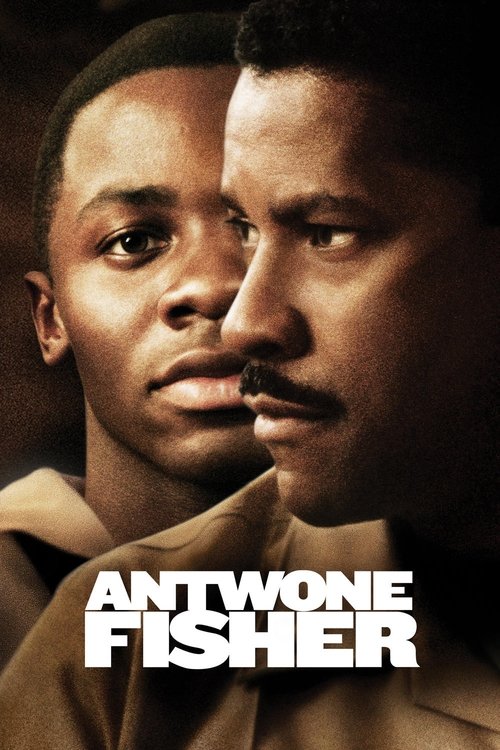
Antwone Fisher (2002)
Directed by Denzel Washington
Partly — Antwone Fisher is somewhat woke, scoring 47 out of 100 on our wokeness meter.
Antwone Fisher arrives as a biographical drama of unusual restraint, directed by Denzel Washington in his first turn behind the camera and written by the man whose life it depicts.
Consciousness Markers
A Black-centered story with a predominantly Black principal cast, a Black director (Denzel Washington), and a Black screenwriter (Antwone Fisher), authentically depicting a Black American life rather than diverse casting for its own sake.
The film explicitly invokes John W. Blassingame's 'The Slave Community' to explain how the psychology of slavery was passed down into the abusive foster-home mentality, framing Antwone's trauma within a legacy of Black American history.
The psychiatrist-driven structure and the author's stated hope that viewers 'do something to better the lives of children' give the film a gentle didactic, message-forward quality, though it stays largely within the drama rather than preaching.
The protagonist's violent outbursts and psychiatric treatment are central, but they stem from childhood abuse and PTSD rather than any neurodivergence framing in the modern sense.
Female characters (Cheryl, Eva Mae, Mrs. Tate) are present and consequential, but the film is squarely a male-centered therapeutic narrative with no feminist agenda.
The only reference to homosexuality is a fellow sailor's taunt insinuating Antwone is gay, which triggers a fight — an insult, not LGBTQ+ representation or theme.
No environmental or climate themes whatsoever.
No economic critique or class-based commentary; the story is personal and psychological.
No body-image or body-positivity themes present.
The film is a faithful autobiographical account of real events, not a revisionist reinterpretation of history.
Why it received this score
Antwone Fisher arrives as a biographical drama of unusual restraint, directed by Denzel Washington in his first turn behind the camera and written by the man whose life it depicts. The casting is Black from top to bottom, and not as a gesture. Derek Luke, Viola Davis, Joy Bryant, and Washington himself carry a story drawn from a specific American childhood, and the film treats that specificity as the point. This is representation that predates the era of the casting spreadsheet. It simply tells the story it came to tell.
The architecture is therapeutic. A sailor with a violent temper is ordered into a psychiatrist's office, resists, then slowly unburdens a childhood of foster-home cruelty and sexual abuse. The film reaches for John W. Blassingame's The Slave Community to explain the inherited psychology behind Mrs. Tate's beatings, a heavier intellectual move than most dramas of its year attempted. The result carries a faint sermon in its bones. Antwone Fisher has said he hoped audiences would leave and do something for children. That hope sits just beneath the surface, patient and unmoving, though the film mostly lets the drama speak for itself.
What the film declines to do is equally instructive. There is no environmental lament, no indictment of capital, no meditation on the body. A shipmate's taunt about Antwone's sexuality triggers a brawl, which makes it an insult and not a thesis. The women here are consequential, but the narrative belongs to men and their wounds. The protagonist's outbursts are the residue of abuse, not a study in how a mind is wired. A quiet, well-made film about damage and repair, and about very little else besides.
Analysis generated by our Consciousness Algorithm
Part of


Synopsis
A sailor prone to violent outbursts is sent to a naval psychiatrist for help. Refusing at first to open up, the young man eventually breaks down and reveals a horrific childhood. Through the guidance of his doctor, he confronts his painful past and begins a quest to find the family he never knew.
Questions about Antwone Fisher
Is Antwone Fisher woke?
Partly — Antwone Fisher is somewhat woke, scoring 47 out of 100 on our wokeness meter. That earns it a verdict of Woke-Adjacent.
What makes Antwone Fisher woke?
3 of the 10 markers register at 30 or above, led by Representation Casting (65), Racial Consciousness (50) and Lecture Energy (30). On Representation Casting: A Black-centered story with a predominantly Black principal cast, a Black director (Denzel Washington), and a Black screenwriter (Antwone Fisher), authentically depicting a Black American life rather than diverse casting for its own sake.
How does Antwone Fisher compare to other 2002 movies?
It ranks #4 of the 150 films from 2002 we've scored; their average is 12. The wokest is Far from Heaven (78).
How is the Woke Score calculated?
An AI-assisted process researches the film and its reception, scores it 0–100 on ten markers, then combines those into one 0–100 Woke Score. It measures a specific set of 2020s cultural themes, not film quality.