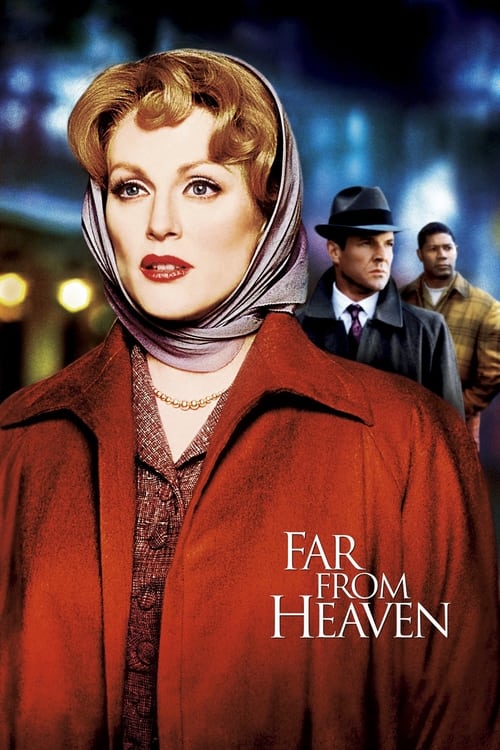
Far from Heaven (2002)
Directed by Todd Haynes
Yes — Far from Heaven is woke, scoring 78 out of 100 on our wokeness meter.
Todd Haynes builds his 2002 melodrama on the bones of Douglas Sirk, and the scaffolding holds.
Consciousness Markers
Racism and miscegenation are explicit subjects: segregated lunch counters, the Miami pool incident, Little Rock as backdrop, and a community destroyed by rumors of an interracial romance.
Frank Whitaker's closeted homosexuality, his forays into Hartford's gay underground, conversion therapy, and the marital collapse it triggers form one of the film's two central axes of social taboo.
The film systematically dismantles the 1950s housewife ideal, framing Cathy's admired domesticity as a form of oppression and showing her punished for transgressing narrow gender roles.
Dennis Haysbert and Viola Davis anchor substantial Black roles, with Haysbert's Raymond functioning as a co-lead whose perspective drives the film's central racial drama rather than serving as background color.
Haynes deliberately shatters the romanticized image of 1950s suburban America, re-narrating the era through the suppressed perspectives of race and homosexuality.
The film can turn didactic, as critics noted, though it mostly delivers its social critique through Sirkian melodrama and mise-en-scène rather than speeches.
The film gestures at the conformity and emptiness of corporate suburban affluence and the oppressive social order of the wealthy, but its critique is cultural rather than economic.
No environmental or climate themes appear anywhere in the film.
No body-positivity themes are present.
No neurodivergence themes are present.
Why it received this score
Todd Haynes builds his 2002 melodrama on the bones of Douglas Sirk, and the scaffolding holds. Cathy Whitaker has the house, the husband, the children and the pressed linen, and within twenty minutes the arrangement is revealed as a cage with good wallpaper. The film runs two engines of taboo in parallel: Frank's closeted homosexuality, complete with Hartford's basement bars and a course of conversion therapy, and Cathy's growing attachment to Raymond Deagan, the Black gardener who inherited his father's accounts. Neither thread is decorative. Each one is permitted to destroy a life on screen, and the destruction is filmed with the same even, amber light as the dinner parties.
The racial material arrives with unusual directness. A lunch counter refuses the pair a seat. A Miami hotel empties its pool when a Black child enters the water. Little Rock flickers from a television set as context no one discusses. Dennis Haysbert gives Raymond a full interior life and a dignity the screenplay keeps testing, and Viola Davis makes her few minutes count. The community's punishment is thorough: Raymond's business collapses, his neighbors throw rocks through his windows, and his daughter is assaulted by boys working from rumor alone.
Haynes also takes a hammer to the housewife ideal, presenting Cathy's celebrated domestic competence as a job with no exit and no pay. The revisionism is deliberate. The autumn leaves, the Elmer Bernstein score and the saturated color exist to be peeled back. The film lectures at moments when it should trust its own surfaces, and a few exchanges land with the thud of a seminar. Its economic critique stays thin, more concerned with the emptiness of affluence than the machinery of it. What survives is a precise, sorrowful apparatus, and the farewell at the train station is the quietest devastation in the director's filmography.
Analysis generated by our Consciousness Algorithm


Synopsis
In 1950s Connecticut, a housewife's life is upended by a marital crisis and mounting racial tensions in society.
Questions about Far from Heaven
Is Far from Heaven woke?
Yes — Far from Heaven is woke, scoring 78 out of 100 on our wokeness meter. That earns it a verdict of Woke.
What makes Far from Heaven woke?
6 of the 10 markers register at 30 or above, led by Racial Consciousness (82), LGBTQ+ Themes (80) and Feminist Agenda (65). On Racial Consciousness: Racism and miscegenation are explicit subjects: segregated lunch counters, the Miami pool incident, Little Rock as backdrop, and a community destroyed by rumors of an interracial romance.
How does Far from Heaven compare to other 2002 movies?
It is the wokest of the 150 films from 2002 we've scored; their average is 12.
How is the Woke Score calculated?
An AI-assisted process researches the film and its reception, scores it 0–100 on ten markers, then combines those into one 0–100 Woke Score. It measures a specific set of 2020s cultural themes, not film quality.