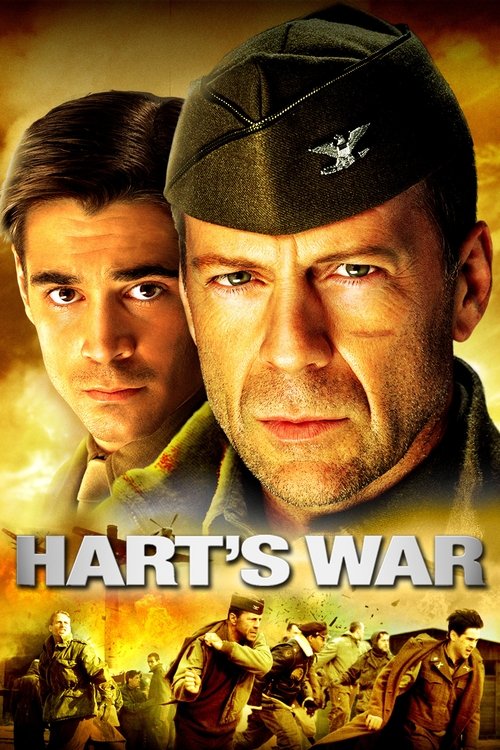
Hart's War (2002)
Directed by Gregory Hoblit
Partly — Hart's War is somewhat woke, scoring 41 out of 100 on our wokeness meter.
This is a film that cannot decide whether it wants to be a prison-break thriller or a courtroom drama, and settles for being both at a length that tests the patience of even the devout.
Consciousness Markers
Racial injustice in the U.S. Army is the film's central moral engine: two Black pilots are segregated into enlisted barracks, one is lynched via a planted weapon, and Lt. Scott delivers a courtroom indictment of the racism he and Archer endured.
The film prominently casts Terrence Howard and Vicellous Shannon as the only two Black officers in the POW camp, with their presence driving a major subplot. This is notable diverse casting for 2002, though it is narratively motivated by the race plot rather than colorblind inclusion.
Lt. Scott's courtroom speech against Army racism and the film's closing sermonizing on honor, duty, and sacrifice give it a moderate didactic streak.
No LGBTQ+ characters, themes, or subtext appear anywhere in the film.
The film is an all-male POW drama with no female characters of consequence and no feminist themes.
No environmental or climate themes are present.
No critique of capitalism or wealth inequality; the conflict is strictly military and moral.
No body positivity themes; the film depicts frostbite and wartime suffering without any body-image discourse.
No neurodivergent characters or themes are present.
The film is a fictional adaptation of a novel, not a re-framing of historical events; it invents a story rather than revising the record.
Why it received this score
This is a film that cannot decide whether it wants to be a prison-break thriller or a courtroom drama, and settles for being both at a length that tests the patience of even the devout. Gregory Hoblit directs with the sober competence of a man filing paperwork. Bruce Willis plays Colonel McNamara as a slab of granite with a secret, Colin Farrell plays Lieutenant Hart as a law student who has read all the books and understood none of the war, and somewhere in the middle of the second act the picture remembers it has something to say.
The film's moral engine is race, and it is a loud engine. Two Black pilots arrive at Stalag VI-A and are promptly bunked with the enlisted men, a humiliation the script treats as the central outrage. Terrence Howard, given the thankless task of being the conscience of a Bruce Willis movie, takes the stand and delivers an indictment of Army racism that lands with the subtlety of a dropped anvil. It is effective. It is also a speech, and the film knows it, and the film does not care.
Elsewhere the film is a lean, all-male affair with no room for anything else. There is no queerness, no feminist reading to be had, no environmental conscience, no interest in bodies beyond their capacity to freeze. The dead are counted in the dozens and the tone never wavers from solemn. The final reel offers a sermon on honor, duty, and sacrifice, delivered by men who have earned the right to deliver it, which softens the preaching without removing it. A middlebrow picture, then, well acted and overlong, and remembered mostly for the speech.
Analysis generated by our Consciousness Algorithm


Synopsis
When Col. William McNamara is stripped of his freedom in a German POW camp, he's determined to keep on fighting even from behind enemy lines. Enlisting the help of a young lieutenant in a brilliant plot against his captors, McNamara risks everything on a mission to free his men and change the outcome of the war.
Questions about Hart's War
Is Hart's War woke?
Partly — Hart's War is somewhat woke, scoring 41 out of 100 on our wokeness meter. That earns it a verdict of Woke-Adjacent.
What makes Hart's War woke?
3 of the 10 markers register at 30 or above, led by Racial Consciousness (65), Representation Casting (45) and Lecture Energy (35). On Racial Consciousness: Racial injustice in the U.S.
How does Hart's War compare to other 2002 movies?
It ranks #7 of the 150 films from 2002 we've scored; their average is 12. The wokest is Far from Heaven (78).
How is the Woke Score calculated?
An AI-assisted process researches the film and its reception, scores it 0–100 on ten markers, then combines those into one 0–100 Woke Score. It measures a specific set of 2020s cultural themes, not film quality.