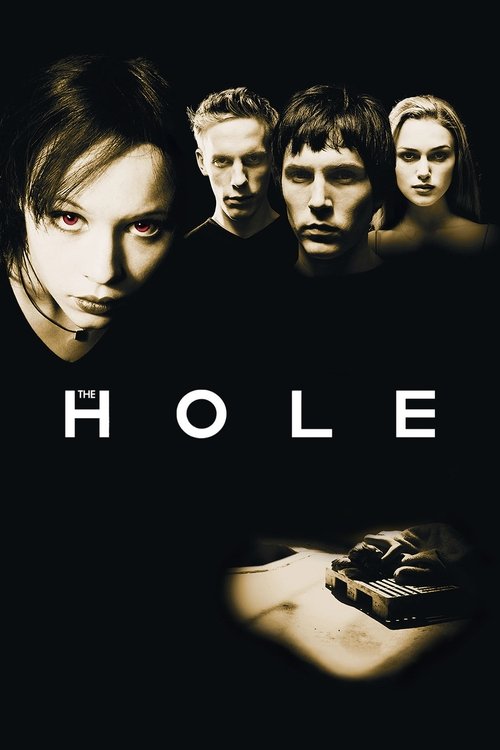
The Hole (2001)
Directed by Nick Hamm
No — The Hole is not woke, scoring 0 out of 100 on our wokeness meter.
The Hole arrives from 2001, a year in which a British psychological thriller could still concern itself with nothing more than four teenagers, one locked bunker, and a young woman with a plan.
Consciousness Markers
The cast is almost entirely white British performers with no deliberate diverse or inclusive casting choices; the film predates any such considerations.
No LGBTQ+ characters, relationships, or themes appear anywhere in the narrative.
The female lead is a manipulative obsessive villain and the female psychiatrist is a foil; there is no feminist messaging or critique of patriarchy.
No engagement with race, racism, or racial identity whatsoever.
No environmental or climate themes present.
No economic critique or anti-capitalist messaging; the private-school setting is backdrop, not commentary.
A character's bulimia is used purely as a plot mechanism for her death, not as a body-positive or body-image message.
No neurodivergent characters or themes are depicted.
No historical revisionism; the film is a contemporary psychological thriller with no historical subject matter.
The film is a twist-driven thriller with no preachy or didactic messaging directed at the audience.
Why it received this score
The Hole arrives from 2001, a year in which a British psychological thriller could still concern itself with nothing more than four teenagers, one locked bunker, and a young woman with a plan. Nick Hamm directs Thora Birch as Liz, a private school student who emerges bloodied after eighteen days underground and tells a psychiatrist a story that does not survive contact with the second act. The film adapts Guy Burt's novel After the Hole and carries that source's appetite for cruelty without apology. Keira Knightley appears in her first substantial screen role, and Embeth Davidtz sits in a chair and listens. Nobody pauses to explain what the audience ought to think. Nobody is asked to check a box.
The narrative turns on obsession, jealousy, and a locked door. Liz is not a misunderstood heroine. She is a manipulator who lets her friends die, frames a dead man for it, and smirks at the psychiatrist in the final shot. A supporting character's bulimia serves as the mechanism for her death, a clinical detail dropped in by a pathologist and never revisited as a comment on body image. The private school setting is a backdrop for class anxiety among rich teenagers, not an indictment of wealth. The film's interest in suffering is entirely narrative. It wants to unsettle you, not instruct you.
This is a picture with no argument to make about the culture that produced it. It has a twist, a body count, and a running time. On the ledger of contemporary social consciousness it registers a clean zero across every column, and it seems untroubled by that. We can only admire the efficiency.
Analysis generated by our Consciousness Algorithm
Synopsis
Four teenagers at a British private school secretly uncover and explore the depths of a sealed underground hole created decades ago as a possible bomb shelter.
Questions about The Hole
Is The Hole woke?
No — The Hole is not woke, scoring 0 out of 100 on our wokeness meter. That earns it a verdict of Ultra Based.
Does The Hole have any woke elements?
No. All 10 markers score zero.
How does The Hole compare to other 2001 movies?
It ranks #128 of the 148 films from 2001 we've scored; their average is 12. The wokest is Monster's Ball (60).
How is the Woke Score calculated?
An AI-assisted process researches the film and its reception, scores it 0–100 on ten markers, then combines those into one 0–100 Woke Score. It measures a specific set of 2020s cultural themes, not film quality.