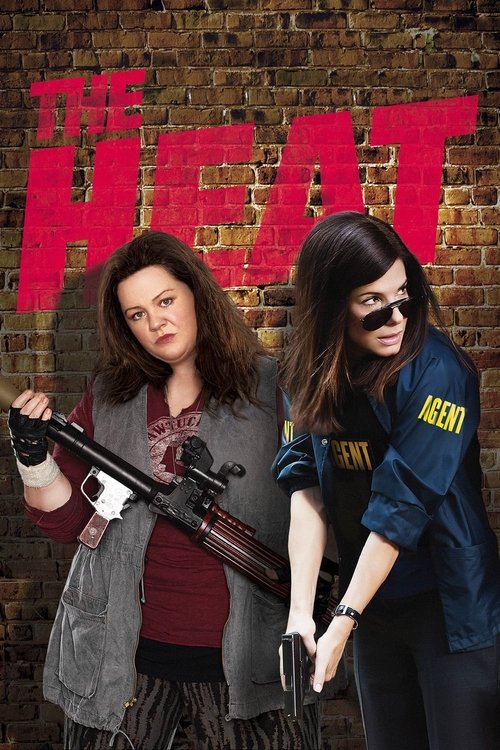
The Heat (2013)
Directed by Paul Feig
No — The Heat is not especially woke, scoring 25 out of 100 on our wokeness meter.
The Heat is a 2013 studio action comedy with a structural agenda: Katie Dippold wrote a buddy-cop script for two women because she was tired of being the girl on the back of the scooter.
Consciousness Markers
The premise is a deliberate gender-flip of the male buddy-cop genre, with screenwriter Katie Dippold explicitly writing it so women could be the ones holding the guns and driving the action rather than being the girl on the back of the scooter.
Two white women headline, but the supporting cast includes Marlon Wayans as a romantic interest and Demián Bichir as a villain, giving modest but unremarkable diversity for a 2013 studio comedy.
Melissa McCarthy's plus-size lead is presented as a capable, desirable action hero without her weight being the punchline, though the film makes no explicit body-positivity statement.
Race is not a thematic concern; minority characters exist naturally in the story without commentary on racial dynamics.
This is a raunchy action comedy that aims to entertain rather than preach; any social point is incidental to the jokes.
No LGBTQ+ characters or themes appear anywhere in the film.
No environmental or climate themes are present.
The villains are drug traffickers, not a critique of wealth or capitalism; no eat-the-rich messaging.
No neurodivergent characters or themes are depicted.
The film is a contemporary crime comedy with no historical revisionism.
Why it received this score
The Heat is a 2013 studio action comedy with a structural agenda: Katie Dippold wrote a buddy-cop script for two women because she was tired of being the girl on the back of the scooter. Paul Feig directs Sandra Bullock and Melissa McCarthy as an FBI agent and a Boston detective whose clashing styles produce the usual genre friction. The feminist gesture is real but contained. It flips Lethal Weapon and Running Scared without turning the film into a sermon. Marlon Wayans appears as a romantic interest and Demián Bichir as the villain, giving the movie a modest multiracial texture. Race is present but unexamined. Queer material, environmental concern, economic anger, neurodivergent arcs, and historical revision are absent.
Melissa McCarthy's lead performance deserves a cautious note. She is a capable, desirable action hero, and her weight is not the punchline. That is a body-image gesture of sorts, though the film never announces it as a thesis. The comedy is raunchy, profane, and committed to jokes. Any social point arrives as a byproduct of casting and character, not as a lecture. The movie wants to entertain first and broaden a genre second. Its racial consciousness is thin, its feminist energy is mostly formal, and its appetite for preaching is nearly nonexistent. It is more notable for who holds the guns than for what it says about the world.
That distinction matters. The Heat is not a moral essay disguised as entertainment. It is entertainment that happens to place women at the center of a male-dominated formula. The achievement is modest and genuine. The film does not demand ideological attention, and it does not reward much of it either. It offers a few progressive ripples, a steady stream of profanity, and a final image of chosen family. A serious classification places it in the low-to-middle tier of social consciousness, with most cultural signals coming from the gender reversal and almost nothing from the other categories. It is a buddy comedy with a slight corrective streak, and it knows better than to overstay its welcome in the pulpit.
Analysis generated by our Consciousness Algorithm


Synopsis
Uptight and straight-laced, FBI Special Agent Sarah Ashburn is a methodical investigator with a reputation for excellence--and hyper-arrogance. Shannon Mullins, one of Boston P.D.'s "finest," is foul-mouthed and has a very short fuse, and uses her gut instinct and street smarts to catch the most elusive criminals. Neither has ever had a partner, or a friend for that matter. When these two wildly incompatible law officers join forces to bring down a ruthless drug lord, they become the last thing anyone expected: buddies.
Questions about The Heat
Is The Heat woke?
No — The Heat is not especially woke, scoring 25 out of 100 on our wokeness meter. That earns it a verdict of Based.
Does The Heat have any woke elements?
2 of the 10 markers register at 30 or above, led by Feminist Agenda (55) and Representation Casting (40). On Feminist Agenda: The premise is a deliberate gender-flip of the male buddy-cop genre, with screenwriter Katie Dippold explicitly writing it so women could be the ones holding the guns and driving the action rather than being the girl on the back of the scooter.
How does The Heat compare to other 2013 movies?
It ranks #43 of the 274 films from 2013 we've scored; their average is 14. The wokest is Belle (76).
How is the Woke Score calculated?
An AI-assisted process researches the film and its reception, scores it 0–100 on ten markers, then combines those into one 0–100 Woke Score. It measures a specific set of 2020s cultural themes, not film quality.