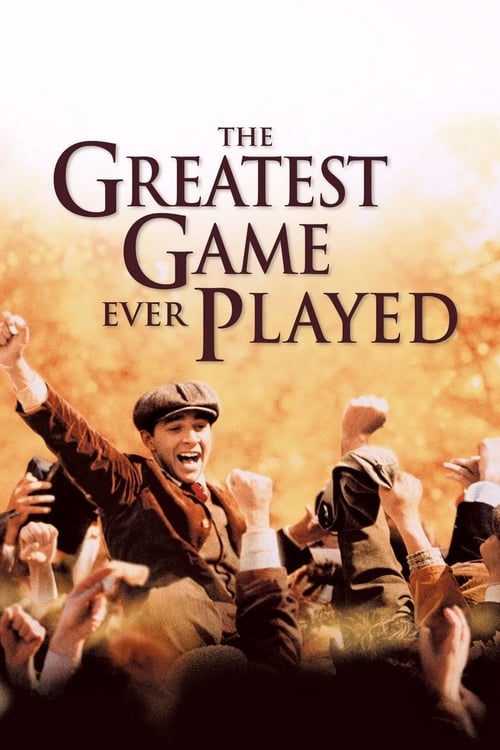
The Greatest Game Ever Played (2005)
Directed by Bill Paxton
No — The Greatest Game Ever Played is not woke, scoring 8 out of 100 on our wokeness meter.
The Greatest Game Ever Played arrives from Walt Disney Pictures with the sober mission of dramatizing the 1913 U.S. Open, in which a working-class amateur named Francis Ouimet out-putted the British professionals who presumed the sport belonged to gentlemen.
Consciousness Markers
The film contrasts Francis's working-class immigrant family against the posh country club elite and the snobbish Lord Northcliffe, but this is a conventional underdog class-friction trope rather than an eat-the-rich polemic.
The cast is overwhelmingly white, but the protagonist's Irish and French-Canadian immigrant working-class background provides a modest ethnic dimension to the underdog framing.
There is mild moralizing about gentlemanliness, class, and earning respect through skill, but the film delivers it through character drama rather than preachy sermonizing.
Francis's mother Mary is briefly supportive of his ambitions and admonishes his father, but the film is entirely centered on male sporting achievement with no feminist agenda.
The film dramatizes the 1913 U.S. Open with a fabricated one-stroke finish and altered weather, but this is standard biopic embellishment rather than ideologically revisionist history.
The film's central tension is class and immigrant status rather than race; there is no engagement with racial identity or systemic racism.
No LGBTQ+ characters, themes, or subtext of any kind appear in this 1913-set golf biopic.
No environmental or climate themes whatsoever; the weather is merely a plot device for the golf tournament.
No body positivity themes; the film does not engage with body image or physical appearance politics.
No neurodivergent characters or themes are present.
Why it received this score
The Greatest Game Ever Played arrives from Walt Disney Pictures with the sober mission of dramatizing the 1913 U.S. Open, in which a working-class amateur named Francis Ouimet out-putted the British professionals who presumed the sport belonged to gentlemen. Bill Paxton directs with a straight bat, and Shia LaBeouf supplies the requisite pluck. The film is adapted from Mark Frost's book and treats its history with the usual biopic looseness, inventing a one-stroke playoff finish and relocating the rain to a more convenient round. This is embellishment, not ideology. The golf itself is shot with real invention, and Roger Ebert was not wrong to admire the ball's-eye views.
On the matter of social consciousness, the ledger is thin. The cast is uniformly white, though the Ouimet family's Irish and French-Canadian immigrant roots give the underdog framing a faint ethnic tint. Race goes unexamined, which is unsurprising for a story about country club membership in 1913, and leaves the racial accounting empty. There is no LGBTQ presence of any kind. No environmental themes intrude, the weather serving purely as a plot device. Body image and neurodivergence are absent. Francis's mother Mary gets a brief moment of support, admonishing her husband, and then the film returns to men hitting balls.
Class friction carries the picture: the posh club elite, the sneering Lord Northcliffe, the caddie who dares to compete. It is the standard underdog arrangement, not a polemic against wealth. The moralizing about gentlemanliness and earning respect through skill is delivered through character, chiefly Vardon's rebuke of Northcliffe, and it lands softly. A pleasant, well-made sports picture with almost nothing on its mind beyond the game.
Analysis generated by our Consciousness Algorithm
Part of


Synopsis
A biopic of 20-year-old Francis Ouimet who defeated his golfing idol and 1900 US Open Champion, Harry Vardon.
Questions about The Greatest Game Ever Played
Is The Greatest Game Ever Played woke?
No — The Greatest Game Ever Played is not woke, scoring 8 out of 100 on our wokeness meter. That earns it a verdict of Ultra Based.
Does The Greatest Game Ever Played have any woke elements?
Very few. None of the 10 markers reaches 30, the level where a marker counts as present; the highest is Eat the Rich at 18.
How does The Greatest Game Ever Played compare to other 2005 movies?
It ranks #90 of the 181 films from 2005 we've scored; their average is 13. The wokest is The Constant Gardener (72).
How is the Woke Score calculated?
An AI-assisted process researches the film and its reception, scores it 0–100 on ten markers, then combines those into one 0–100 Woke Score. It measures a specific set of 2020s cultural themes, not film quality.