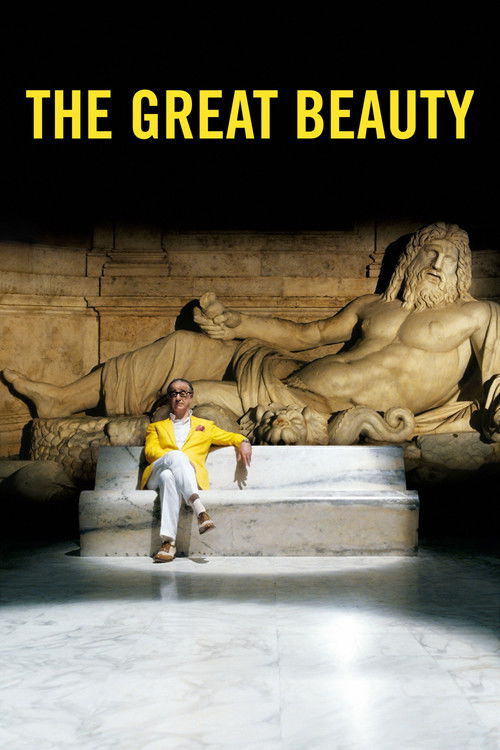
The Great Beauty (2013)
Directed by Paolo Sorrentino
No — The Great Beauty is not woke, scoring 14 out of 100 on our wokeness meter.
Paolo Sorrentino's The Great Beauty arrives bearing an Oscar, a Golden Globe, and a BAFTA, the sort of haul that implies a film has said something profound about the human condition.
Consciousness Markers
The film satirizes the vapid Roman elite and 'radical chic' bourgeoisie of the Berlusconi era, but as existential critique rather than economic argument.
The film is a lyrical, impressionistic mood piece rather than a preachy one, though it carries a melancholic moral about spiritual emptiness.
The cast is almost entirely white Italian actors; a dwarf editor and a stripper appear as characters but not as deliberate diversity casting.
Viola's son Andrea is depicted with serious mental illness, but this is tragic characterization rather than neurodivergence advocacy.
Women are largely framed as objects of desire, strippers, or objects of satire; the film's gaze is a male midlife one with no feminist critique.
A foreign maid and an African missionary appear incidentally, but the film engages no racial consciousness.
A dwarf character and a stripper exist in the story, but the film makes no body-positivity statement.
No LGBTQ+ characters, themes, or subtext of any kind.
No environmental or climate themes whatsoever.
No historical revisionism; the film is a contemporary meditation on Rome.
Why it received this score
Paolo Sorrentino's The Great Beauty arrives bearing an Oscar, a Golden Globe, and a BAFTA, the sort of haul that implies a film has said something profound about the human condition. It has. It says that Rome is very old and that its wealthy inhabitants are very tired, and it says so for two and a half hours, gorgeously. Jep Gambardella has attended every party in the city and enjoyed none of them, and the camera lingers on his fatigue as though fatigue itself were an architectural feature.
The film's contempt for the Berlusconi-era elite is genuine. Jep drifts through a gallery of radical chic novelists, gourmet cardinals, and toy-magnate friends, and Sorrentino skewers them with real venom. The venom is existential, not economic. Nobody here proposes redistribution. The complaint is spiritual emptiness, and the enemy is vulgarity, not capital. A stripper and a dwarf editor populate the margins, though they exist as characters, not as statements, and the film asks nothing of them beyond their presence. The women are framed through the nostalgia of a 65-year-old man, and no corrective lens is offered. A mentally ill son serves as a vessel for tragedy, not for advocacy.
What the film declines to do is equally instructive. There is no environmental lament, no queer subtext, no reckoning with race, no rewriting of the historical record. Rome simply is what it is, which is ancient and indifferent. The closing note of hope, struck at the wreck of the Costa Concordia, carries a faint moral about beauty and mortality. It is a wistful sigh, not a sermon, and the melancholy is earned honestly. Whether that constitutes a great beauty is a question the Academy settled some years ago, and we are left, as ever, to admire the drapes.
Analysis generated by our Consciousness Algorithm


Synopsis
Jep Gambardella has seduced his way through the lavish nightlife of Rome for decades, but after his 65th birthday and a shock from the past, Jep looks past the nightclubs and parties to find a timeless landscape of absurd, exquisite beauty.
Questions about The Great Beauty
Is The Great Beauty woke?
No — The Great Beauty is not woke, scoring 14 out of 100 on our wokeness meter. That earns it a verdict of Ultra Based.
Does The Great Beauty have any woke elements?
1 of the 10 markers register at 30 or above, led by Eat the Rich (35). On Eat the Rich: The film satirizes the vapid Roman elite and 'radical chic' bourgeoisie of the Berlusconi era, but as existential critique rather than economic argument.
How does The Great Beauty compare to other 2013 movies?
It ranks #91 of the 274 films from 2013 we've scored; their average is 14. The wokest is Belle (76).
How is the Woke Score calculated?
An AI-assisted process researches the film and its reception, scores it 0–100 on ten markers, then combines those into one 0–100 Woke Score. It measures a specific set of 2020s cultural themes, not film quality.