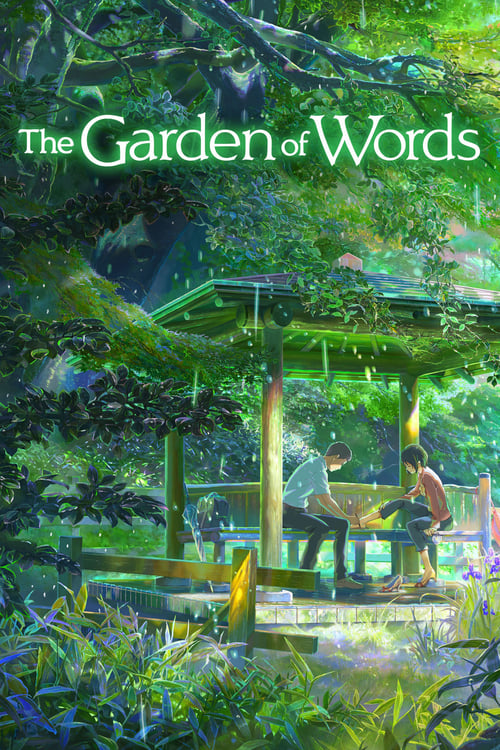
The Garden of Words (2013)
Directed by Makoto Shinkai
No — The Garden of Words is not woke, scoring 5 out of 100 on our wokeness meter.
Makoto Shinkai's The Garden of Words runs forty-six minutes and spends most of them on rain.
Consciousness Markers
Themes of loneliness and uneven maturity are conveyed poetically and subtly, with minimal preachy messaging.
Yukari is a female teacher retreating from workplace bullying, but the story frames this as personal loneliness and healing rather than a feminist statement or agenda.
A wholly Japanese production with Japanese characters and cast; no conscious diversity-casting agenda is present.
No LGBTQ+ characters or themes appear in the film.
The film is culturally Japanese with no racial-justice framing; race is not a subject.
Rain is used as an aesthetic and emotional motif, not as a climate-change message.
No economic or class critique is present; the story is intimate and apolitical.
Shoes serve as a metaphor for life and walking, but no body-positive messaging is present.
No neurodivergent characters or themes are depicted.
The film engages with classical Japanese poetry and tradition respectfully rather than revising history.
Why it received this score
Makoto Shinkai's The Garden of Words runs forty-six minutes and spends most of them on rain. A fifteen-year-old boy who wants to make shoes skips his morning classes to sketch in Shinjuku Gyoen. A twenty-seven-year-old woman skips work for reasons she declines to share. They meet on wet mornings, exchange almost nothing about themselves, and recite classical poetry at each other with the gravity of people who have read the Man'yōshū and intend to prove it.
The film's social consciousness is thin, and thin on purpose. Yukari is a teacher driven from her classroom by student gossip and bullying, a real grievance that the screenplay treats as private melancholy and a decent excuse to sit in a park. It never becomes an argument about anything larger. No economic critique intrudes. No climate sermon arrives with the weather. Race is not a subject, because the film is entirely and unremarkably Japanese. There is no body-positive messaging, no neurodivergent arc, no rewriting of the past. The past is quoted reverently, in tanka, and then left alone.
Where the film leans toward instruction, it does so at a whisper. Shinkai has said he wanted to comfort lonely people without insisting that loneliness be cured, and the result is a lesson delivered softly, mostly through shoes and rainfall. He wants us to understand that adults are not as mature as they appear, and he demonstrates it with a boy and a woman who both behave badly. It is a thesis, absorbed through imagery instead of announced from a lectern. The tally is low. That is not a failure. This is storytelling from before the current taxonomy, executed with an unfashionable amount of restraint. We classify it, we file it, we move on. The rain continues.
Analysis generated by our Consciousness Algorithm

Synopsis
Takao, who is training to become a shoemaker, skipped school and is sketching shoes in a Japanese-style garden. He meets a mysterious woman, Yukino, who is older than him. Then, without arranging the times, the two start to see each other again and again, but only on rainy days. They deepen their relationship and open up to each other. But the end of the rainy season soon approaches.
Questions about The Garden of Words
Is The Garden of Words woke?
No — The Garden of Words is not woke, scoring 5 out of 100 on our wokeness meter. That earns it a verdict of Ultra Based.
Does The Garden of Words have any woke elements?
Very few. None of the 10 markers reaches 30, the level where a marker counts as present; the highest is Lecture Energy at 10.
How does The Garden of Words compare to other 2013 movies?
It ranks #197 of the 274 films from 2013 we've scored; their average is 14. The wokest is Belle (76).
How is the Woke Score calculated?
An AI-assisted process researches the film and its reception, scores it 0–100 on ten markers, then combines those into one 0–100 Woke Score. It measures a specific set of 2020s cultural themes, not film quality.