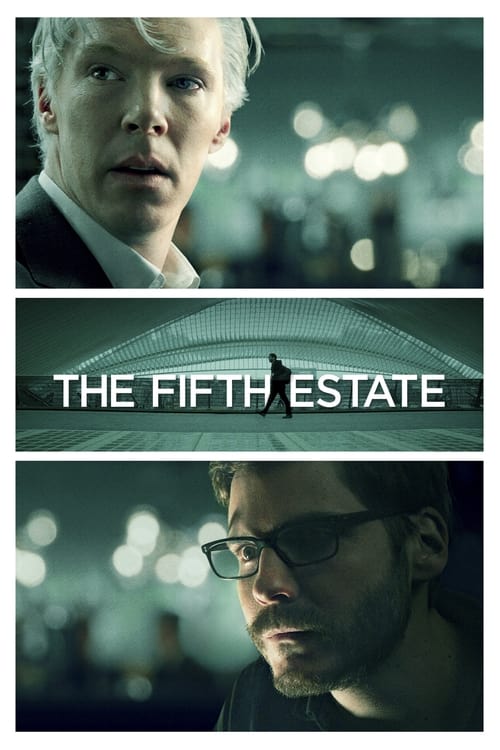
The Fifth Estate (2013)
Directed by Bill Condon
No — The Fifth Estate is not woke, scoring 19 out of 100 on our wokeness meter.
The Fifth Estate arrives with the solemnity of a film that believes it is documenting the birth of a new century, and settles for being a two-hander about two men who stopped returning each other's calls.
Consciousness Markers
WikiLeaks' early targets include a corrupt Swiss bank and institutional secrecy, giving the film a transparency-versus-power streak, but it is ultimately more ambivalent about Assange than ideologically anti-capitalist.
The screenplay periodically sermonizes about press freedom, source protection, and the ethics of leaking, with characters delivering speeches on the responsibility of journalism.
An international ensemble (Anthony Mackie, Alicia Vikander, Daniel Brühl, Carice van Houten) reflects the real-world cast of characters rather than a deliberate diversity mandate; Mackie's composite journalist is the only notable non-white principal.
Laura Linney and Alicia Vikander play competent professionals, but the women function largely as supporting moral compasses to the two men's central conflict; no feminist thesis is advanced.
Anthony Mackie's presence adds diversity to the newsroom, but race is never a subject of the film's commentary or narrative.
The film dramatizes recent events and was accused by Assange and WikiLeaks of fabricating and distorting the record, though it does not recast history through a modern progressive ideological frame.
Chelsea Manning's leak is central to the plot, but the film refers to her by her pre-transition name and engages with no LGBTQ+ themes whatsoever.
No environmental or climate themes appear anywhere in the film.
No body-positivity themes or messaging are present.
Assange is portrayed as eccentric and abrasive, but the film never frames this through a neurodivergence lens.
Why it received this score
The Fifth Estate arrives with the solemnity of a film that believes it is documenting the birth of a new century, and settles for being a two-hander about two men who stopped returning each other's calls. Bill Condon directs the rise and rupture of WikiLeaks through the friendship of Julian Assange and Daniel Domscheit-Berg, with Benedict Cumberbatch buried under wigs, false teeth and blue contact lenses. The early targets include a corrupt Swiss bank and a Cayman Islands branch engaged in illegal activity, which lends the proceedings a transparency-versus-power streak. The film is more interested in Assange's hair dye than in the structures he exposed.
The ensemble is international because the real story was, and Anthony Mackie, Alicia Vikander, Daniel Brühl and Carice van Houten fill the newsroom without anyone making a speech about it. Race is never a subject of the film's argument. Laura Linney and Vikander play capable professionals, though their function is to be right at the men and then step aside. Chelsea Manning's leak drives the plot, and the screenplay uses her pre-transition name without a flicker of curiosity about what that might mean. Assange's abrasiveness is presented as a character flaw, not as anything the film wishes to name.
Where the film does raise its voice, it is on behalf of journalism: source protection, redaction, the ethics of the leak, delivered in speeches by people standing in rooms. That is the sermonizing, earnest enough to be respectable and repetitive enough to be tiring. There is no environmental thread, no body-positivity thread, no neurodivergent framing, and the historical record is bent for melodrama rather than remade into modern ideology. WikiLeaks called the whole thing a fabrication. The film is guilty of a milder crime. It is dull, and Cumberbatch is the only reason to keep watching.
Analysis generated by our Consciousness Algorithm


Synopsis
A look at the relationship between WikiLeaks founder Julian Assange and his early supporter and eventual colleague Daniel Domscheit-Berg, and how the website's growth and influence led to an irreparable rift between the two friends.
Questions about The Fifth Estate
Is The Fifth Estate woke?
No — The Fifth Estate is not woke, scoring 19 out of 100 on our wokeness meter. That earns it a verdict of Ultra Based.
Does The Fifth Estate have any woke elements?
2 of the 10 markers register at 30 or above, led by Eat the Rich (35) and Lecture Energy (30). On Eat the Rich: WikiLeaks' early targets include a corrupt Swiss bank and institutional secrecy, giving the film a transparency-versus-power streak, but it is ultimately more ambivalent about Assange than ideologically anti-capitalist.
How does The Fifth Estate compare to other 2013 movies?
It ranks #63 of the 274 films from 2013 we've scored; their average is 14. The wokest is Belle (76).
How is the Woke Score calculated?
An AI-assisted process researches the film and its reception, scores it 0–100 on ten markers, then combines those into one 0–100 Woke Score. It measures a specific set of 2020s cultural themes, not film quality.