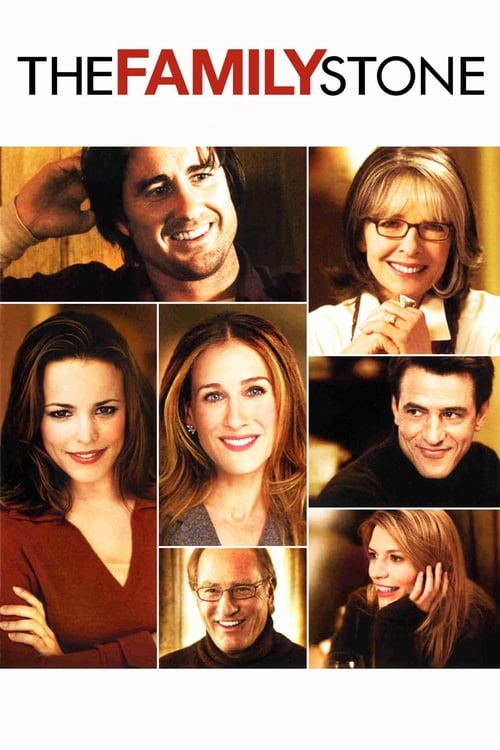
The Family Stone (2005)
Directed by Thomas Bezucha
No — The Family Stone is not woke, scoring 19 out of 100 on our wokeness meter.
The Family Stone arrives in 2005 as a Christmas comedy of hostile in-laws, a fish-out-of-water picture in which an uptight businesswoman named Meredith is dragged to a bohemian New England home and picked apart by a family that mistakes its own rudeness for authenticity.
Consciousness Markers
Thad's gay partner Patrick is a full member of the family, and the couple's plan to adopt a child anchors a Christmas-dinner debate about nature versus nurture and sexual orientation.
The ensemble includes a deaf character (Thad) played by deaf actor Tyrone Giordano and a Black actor (Brian J. White) in a romantic role, giving the 2005 film a modestly diverse cast, though none of this is foregrounded as a statement.
The dinner-table debate over sexual orientation and adoption carries a faint didactic charge, but it is dramatized as family friction rather than delivered as a sermon.
Meredith is a career-driven businesswoman and Sybil a matriarch with agency, but the film's concerns are domestic and romantic rather than a feminist thesis.
An interracial pairing (Amy and Brad) exists naturally in the story with no commentary on race whatsoever.
No environmental or climate themes appear in the film.
Meredith's corporate conservatism is a personality contrast, not a critique of capitalism or wealth.
No body-positivity themes are present.
Deafness is depicted but is not framed as neurodivergence, and no other neurodivergent themes appear.
The film is a contemporary fictional family comedy-drama with no historical revisionism.
Why it received this score
The Family Stone arrives in 2005 as a Christmas comedy of hostile in-laws, a fish-out-of-water picture in which an uptight businesswoman named Meredith is dragged to a bohemian New England home and picked apart by a family that mistakes its own rudeness for authenticity. The film is pleasant, occasionally sharp, and convinced that a dying mother and a botched proposal amount to emotional depth. We have seen this house before. We know exactly where the mistletoe hangs.
What distinguishes the picture, mildly, is its furniture. Thad, one of the Stone sons, is deaf and gay, played by the deaf actor Tyrone Giordano, and his partner Patrick sits at the dinner table as a full member of the clan. Their plan to adopt a child triggers a debate about nature against nurture, staged as family friction instead of a sermon. A Black actor, Brian J. White, appears as Amy's love interest, and nobody remarks on it. These are gestures of a certain liberal decency, not a thesis, and the film never asks them to carry weight.
The picture has no interest in capital, climate, or the body, and its feminism amounts to a woman with a job and a mother with opinions. Its historical sense is nil. What remains is a mild, well-acted domestic comedy that treats its own tolerance as settled and asks nothing further of anyone. It is the cultural equivalent of a polite Christmas card, signed by the whole family, meaning very little.
Analysis generated by our Consciousness Algorithm


Synopsis
An uptight, conservative businesswoman accompanies her boyfriend to his eccentric and outgoing family's annual Christmas celebration and finds that she's a fish out of water in their free-spirited way of life.
Questions about The Family Stone
Is The Family Stone woke?
No — The Family Stone is not woke, scoring 19 out of 100 on our wokeness meter. That earns it a verdict of Ultra Based.
Does The Family Stone have any woke elements?
2 of the 10 markers register at 30 or above, led by LGBTQ+ Themes (45) and Representation Casting (35). On LGBTQ+ Themes: Thad's gay partner Patrick is a full member of the family, and the couple's plan to adopt a child anchors a Christmas-dinner debate about nature versus nurture and sexual orientation.
How does The Family Stone compare to other 2005 movies?
It ranks #38 of the 181 films from 2005 we've scored; their average is 13. The wokest is The Constant Gardener (72).
How is the Woke Score calculated?
An AI-assisted process researches the film and its reception, scores it 0–100 on ten markers, then combines those into one 0–100 Woke Score. It measures a specific set of 2020s cultural themes, not film quality.