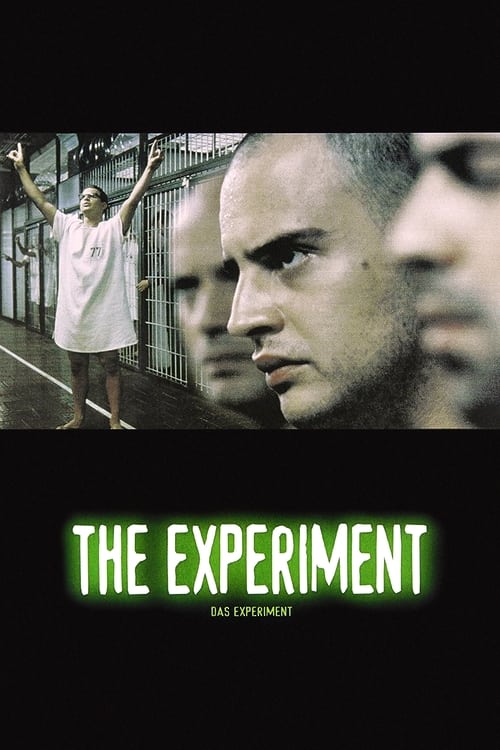
The Experiment (2001)
Directed by Oliver Hirschbiegel
No — The Experiment is not woke, scoring 0 out of 100 on our wokeness meter.
The Experiment, Oliver Hirschbiegel's 2001 adaptation of Mario Giordano's novel Black Box, arrives with a premise borrowed from the Stanford prison experiment and a temperament borrowed from the European art house's long love affair with humiliation.
Consciousness Markers
Cast is uniformly white German; no deliberate diversity casting or minority-led roles.
No LGBTQ+ characters, themes, or subtext.
Female characters exist (scientist, girlfriend) but the film offers no feminist critique or agenda.
No engagement with race, racism, or racial identity.
No environmental or climate themes.
Critiques authoritarianism and scientific ethics, not capitalism or wealth inequality.
No body positivity themes; nudity and humiliation are used for degradation.
A character's mental breakdown is plot-driven, not framed as neurodivergence.
Fictionalized adaptation of a psychological study, not a revisionist historical narrative.
The film shows rather than lectures; no preachy social justice monologues.
Why it received this score
The Experiment, Oliver Hirschbiegel's 2001 adaptation of Mario Giordano's novel Black Box, arrives with a premise borrowed from the Stanford prison experiment and a temperament borrowed from the European art house's long love affair with humiliation. Twenty volunteers, a simulated prison, a professor who will not stop the study until the violence peaks. The machinery is efficient. Moritz Bleibtreu plays Tarek, a journalist with a camera hidden in his glasses, and the film tracks his descent from provocateur to captive with the patience of a documentary and the cruelty of a fable. It is a well-made film about a bad idea, and it knows it.
The film contains none of the modern cultural signaling that a contemporary retelling would supply. The cast is uniformly white and German, and no effort is made to correct this. The women, a scientist and a girlfriend, are present without being argued about. Race never enters the frame. Neither does climate, nor wealth inequality, nor any sustained critique of capital, though a media baron lurks at the edges. The nudity and the shaved heads serve degradation, not affirmation. A guard's collapse into madness is a plot mechanism, not a portrait of a mind. The film's relationship to history is fictional throughout: it adapts a novel that adapts a study, which is not the same as rewriting the record.
The result is a film that lectures no one. It shows a room full of men discovering what authority does to them and lets the audience do the arithmetic. Roger Ebert admired it while finding the outcome foreordained. That is a fair verdict. The film is grim, controlled, and free of sermons, which in the current climate reads almost as an artifact from another era. A sommelier would call it austere. I would call it austere as well, and leave it there.
Analysis generated by our Consciousness Algorithm
Synopsis
20 volunteers agree to take part in a seemingly well-paid experiment advertised by the university. It is supposed to be about aggressive behavior in an artificial prison situation. A journalist senses a story behind the ad and smuggles himself in among the test subjects. They are randomly divided into prisoners and guards. What seems like a game at the beginning soon turns into bloody seriousness.
Questions about The Experiment
Is The Experiment woke?
No — The Experiment is not woke, scoring 0 out of 100 on our wokeness meter. That earns it a verdict of Ultra Based.
Does The Experiment have any woke elements?
No. All 10 markers score zero.
How does The Experiment compare to other 2001 movies?
It ranks #128 of the 148 films from 2001 we've scored; their average is 12. The wokest is Monster's Ball (60).
How is the Woke Score calculated?
An AI-assisted process researches the film and its reception, scores it 0–100 on ten markers, then combines those into one 0–100 Woke Score. It measures a specific set of 2020s cultural themes, not film quality.