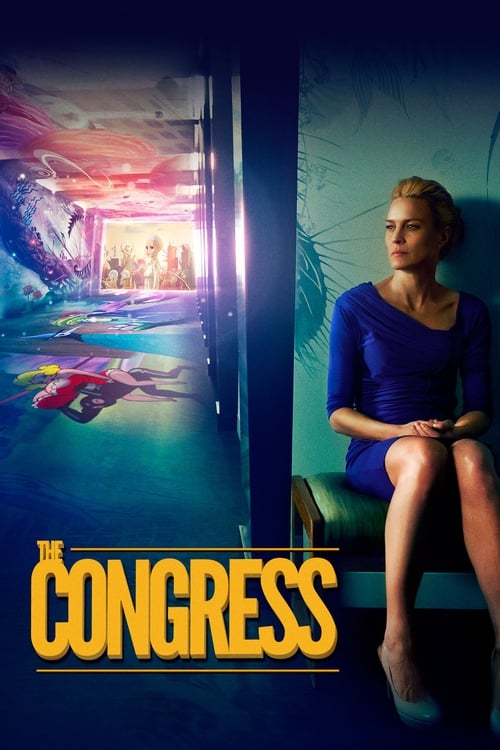
The Congress (2013)
Directed by Ari Folman
Partly — The Congress is somewhat woke, scoring 59 out of 100 on our wokeness meter.
Ari Folman's The Congress opens as a live-action drama about Robin Wright, an aging actress who sells a digital clone of herself to a studio.
Consciousness Markers
The entire plot is a scathing allegory against corporate greed, the commodification of human likeness, and the exploitation of talent by large studios.
As a high-concept sci-fi allegory, the film delivers heavy, didactic commentary on technology, corporate power, and the nature of reality.
The central conflict involves an aging woman fighting corporate exploitation and the loss of her physical autonomy, providing a strong critique of industry control over female labor.
The film features a predominantly white cast and focuses on the aging experience of a white actress, offering minimal representation of diverse groups.
The protagonist experiences severe mental health crises and hallucinations, but this is framed as a consequence of the simulation rather than an exploration of a specific neurodivergent condition.
There are no discernible LGBTQ+ themes or representation within the provided summary or plot description.
Race is not a thematic element or a point of social commentary in the narrative.
The film's focus is on technological and societal collapse, not ecological or climate change issues.
The narrative focuses on the decline of the physical body and the replacement of the physical self with a digital clone, rather than celebrating diverse body types.
The film is speculative fiction and does not challenge established historical narratives.
Why it received this score
Ari Folman's The Congress opens as a live-action drama about Robin Wright, an aging actress who sells a digital clone of herself to a studio. It then becomes an animated hallucination. The film treats this premise with the gravity of a shareholder meeting. Wright's character is a woman whose physical autonomy is negotiated away by men in suits, which gives the film a feminist spine. The critique is not subtle. It is, however, coherent. The film has no interest in racial consciousness, climate, or LGBTQ+ themes. Its gaze stays fixed on the entertainment industry and the people it consumes.
The anti-capitalist argument is the main event. Miramount Studios is a hungry machine, and the film spends its second half lecturing us about the commodification of human likeness. The animated world is a colorful distraction from the real horror, which is a contract. Folman's screenplay is heavy-handed, but the heaviness is the point. The film wants us to feel the weight of a signature. It is preachy in the manner of a late-night panel discussion, yet it earns some of that preaching through Robin Wright's committed performance. She plays a version of herself with enough weariness to suggest she has read the contract and understands the cost.
The film's prescience about artificial intelligence and actor likeness has only grown. When the studios proposed scanning actors for a day's pay, The Congress looked less like science fiction and more like a training video. It is a somber, ambitious work that won a European Film Award for animated feature. It does not celebrate diverse bodies or explore neurodivergence. It simply warns that a person can be turned into a product. That warning is delivered with a straight face. The film is not subtle. It is not wrong.
Analysis generated by our Consciousness Algorithm


Synopsis
An aging, out-of-work actress accepts one last job, though the consequences of her decision affect her in ways she didn't consider.
Questions about The Congress
Is The Congress woke?
Partly — The Congress is somewhat woke, scoring 59 out of 100 on our wokeness meter. That earns it a verdict of Woke-Adjacent.
What makes The Congress woke?
3 of the 10 markers register at 30 or above, led by Eat the Rich (90), Lecture Energy (75) and Feminist Agenda (65). On Eat the Rich: The entire plot is a scathing allegory against corporate greed, the commodification of human likeness, and the exploitation of talent by large studios.
How does The Congress compare to other 2013 movies?
It ranks #13 of the 274 films from 2013 we've scored; their average is 14. The wokest is Belle (76).
How is the Woke Score calculated?
An AI-assisted process researches the film and its reception, scores it 0–100 on ten markers, then combines those into one 0–100 Woke Score. It measures a specific set of 2020s cultural themes, not film quality.