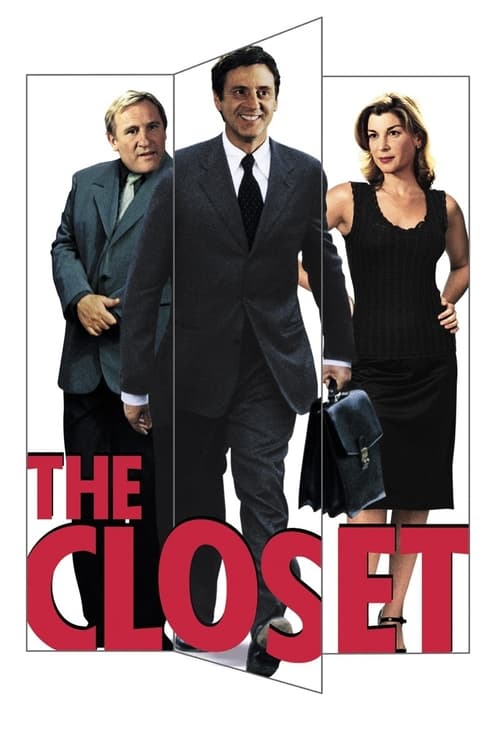
The Closet (2001)
Directed by Francis Veber
No — The Closet is not woke, scoring 13 out of 100 on our wokeness meter.
Francis Veber's The Closet arrives from 2001, that liminal era when a French farce could still build its entire engine on a man pretending to be gay and expect the audience to simply enjoy the ride.
Consciousness Markers
The entire plot hinges on a man faking homosexuality, with gay pride parades, homophobia, and discrimination as central mechanics, though it is deployed as farcical plot fuel rather than advocacy.
The premise mildly satirizes corporate cynicism — a condom factory keeps a worker only to dodge discrimination lawsuits and court gay consumers — but it is a workplace farce, not an eat-the-rich polemic.
Mlle Bertrand exists largely as the romantic reward for the protagonist; no feminist themes or gender critique are present.
The cast is an entirely white ensemble of French character actors; no deliberate diverse or inclusive casting is present.
No engagement with race or racial politics whatsoever.
No environmental or climate themes.
No body positivity themes.
No neurodivergence themes; Santini's breakdown is played for farce, not as neurodivergent representation.
No historical revisionism; it is a contemporary fictional comedy.
The film is a light French farce that, if anything, mocks political correctness rather than preaching it.
Why it received this score
Francis Veber's The Closet arrives from 2001, that liminal era when a French farce could still build its entire engine on a man pretending to be gay and expect the audience to simply enjoy the ride. François Pignon, a bland accountant at a condom factory, faces dismissal until his neighbor proposes a scheme: leak photographs suggesting he is homosexual, and the company, terrified of a discrimination suit and covetous of the gay consumer dollar, will be forced to keep him. The plot then detonates in the expected directions. Colleagues find him suddenly exotic. A homophobic personnel director is ordered to befriend him and develops an obsession. A gay pride float is involved. It is brisk, it is well acted, and it treats its subject as a whoopee cushion rather than a cause.
What complicates any tidy classification is the film's evident contempt for the very sensitivities it exploits. The targets here are corporate cowardice and the panic that political correctness can generate, not the marginalized. The condom factory keeps a suspected gay man on payroll to court a market and dodge a lawsuit, which is a modest jab at institutional cynicism but hardly a class war. The gay material functions as plot fuel, a mechanism for humiliation and reversal, never as advocacy. Mlle Bertrand, the chief accountant, exists chiefly to be won in the final reel, which is how comedies of this vintage tended to close.
The supporting players are uniformly white, the concerns uniformly domestic, and the moral uniformly pragmatic: a milquetoast learns to push his way back into the photograph. There is no sermon, no climate anxiety, no reckoning with history, no body politics, no neurodivergent reading to extract. It simply wants to make us laugh at a man's invented identity and the havoc it wreaks. For a certain kind of viewer, that is either refreshing or disqualifying. The film, blissfully unaware of the question, declines to care.
Analysis generated by our Consciousness Algorithm
Synopsis
A man spreads the rumor of his fake homosexuality with the aid of his neighbor, to prevent his imminent firing at his work.
Questions about The Closet
Is The Closet woke?
No — The Closet is not woke, scoring 13 out of 100 on our wokeness meter. That earns it a verdict of Ultra Based.
Does The Closet have any woke elements?
1 of the 10 markers register at 30 or above, led by LGBTQ+ Themes (45). On LGBTQ+ Themes: The entire plot hinges on a man faking homosexuality, with gay pride parades, homophobia, and discrimination as central mechanics, though it is deployed as farcical plot fuel rather than advocacy.
How does The Closet compare to other 2001 movies?
It ranks #49 of the 148 films from 2001 we've scored; their average is 12. The wokest is Monster's Ball (60).
How is the Woke Score calculated?
An AI-assisted process researches the film and its reception, scores it 0–100 on ten markers, then combines those into one 0–100 Woke Score. It measures a specific set of 2020s cultural themes, not film quality.