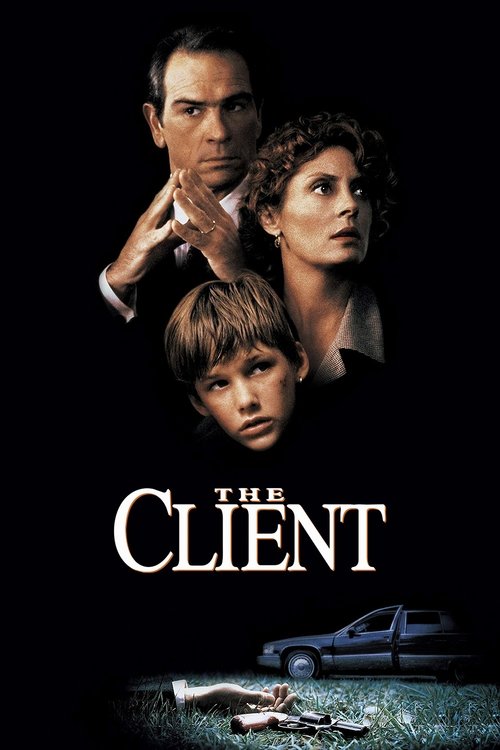
The Client (1994)
Directed by Joel Schumacher
No — The Client is not woke, scoring 7 out of 100 on our wokeness meter.
The Client arrives from 1994, a year when a John Grisham paperback could be trusted to produce a sturdy film adaptation and little else.
Consciousness Markers
Susan Sarandon's Reggie Love is a capable, central female attorney with her own arc, but this is conventional strong-woman characterization rather than an articulated feminist thesis.
A predominantly white cast anchors this 1994 Grisham adaptation, with Ossie Davis appearing in a supporting judicial role. Casting reflects standard period conventions rather than any deliberate representational agenda.
A brisk legal thriller that delivers suspense rather than moral instruction; any social critique is incidental.
Racial identity plays no thematic role; the lone Black character is a judge with no commentary attached.
The film gently satirizes an ambitious US Attorney chasing headlines and political office, but this is individual corruption, not a structural anti-capitalist critique.
No LGBTQ+ characters, themes, or subtext appear anywhere in the film.
No environmental themes or messaging of any kind.
Body image is not addressed in any form.
Ricky's catatonia is trauma-induced from witnessing a suicide, not a depiction of neurodivergence.
A fiction procedural with no revisionist historical claims.
Why it received this score
The Client arrives from 1994, a year when a John Grisham paperback could be trusted to produce a sturdy film adaptation and little else. Joel Schumacher directs with a journeyman's confidence, keeping the machinery of the legal thriller oiled and moving. A boy witnesses a mob lawyer's suicide, the FBI and the Mafia both come calling, and a Memphis attorney named Reggie Love steps in to broker a deal. It is efficient, well acted, and entirely content to be a procedural.
Susan Sarandon's Reggie is the film's most interesting piece of business. She is competent, flawed, a recovering alcoholic with a client she cannot quite protect, and the role earned her an Academy Award nomination. We should be careful about what that amounts to. Strong women in 1990s thrillers were a casting habit, not a thesis, and nothing here argues a position on gender beyond the observation that a woman can be good at her job. Tommy Lee Jones plays the United States Attorney as a preening media animal, and the film enjoys watching him enjoy himself. The satire stops at the individual. No structural indictment of the justice system's incentives follows, and the movie seems untroubled by the omission.
On the matter of casting, the film reflects its period without comment. Ossie Davis appears as a judge, a pleasant piece of business and nothing more. Race, sexuality, body image, climate, and neurology are simply absent from the frame. A child's catatonia is trauma, not a condition to be explored or celebrated. The rest is a brisk, competent entertainment that wishes to thrill and never to instruct. There is something restful in that.
Analysis generated by our Consciousness Algorithm
Part of


Synopsis
A street-wise kid, Mark Sway, sees the suicide of Jerome Clifford, a prominent Louisiana lawyer, whose current client is Barry 'The Blade' Muldano, a Mafia hit-man. Before Jerome shoots himself, he tells Mark where the body of a Senator is buried. Clifford shoots himself and Mark is found at the scene, and both the FBI and the Mafia quickly realize that Mark probably knows more than he says.
Questions about The Client
Is The Client woke?
No — The Client is not woke, scoring 7 out of 100 on our wokeness meter. That earns it a verdict of Ultra Based.
Does The Client have any woke elements?
Very few. None of the 10 markers reaches 30, the level where a marker counts as present; the highest is Feminist Agenda at 18.
How does The Client compare to other 1994 movies?
It ranks #40 of the 86 films from 1994 we've scored; their average is 10. The wokest is On Deadly Ground (75).
How is the Woke Score calculated?
An AI-assisted process researches the film and its reception, scores it 0–100 on ten markers, then combines those into one 0–100 Woke Score. It measures a specific set of 2020s cultural themes, not film quality.