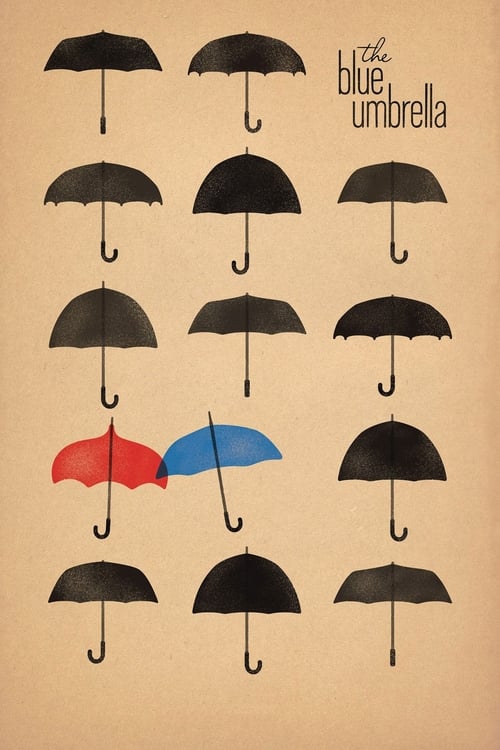
The Blue Umbrella (2013)
Directed by Saschka Unseld
No — The Blue Umbrella is not woke, scoring 0 out of 100 on our wokeness meter.
There is a moment early in The Blue Umbrella when a city street acquires a face, and then several more, and we understand that Pixar's technical department has been let out for recess.
Consciousness Markers
The cast is essentially all anthropomorphic street objects and umbrellas; there is no human casting to diversify.
A wordless boy-umbrella-meets-girl-umbrella romance carries no LGBTQ+ themes.
A six-minute rain romance between two umbrellas has no gendered politics or feminist statement.
No racial themes or commentary appear; the principals are objects.
Celebrates rain as beauty, not as a climate-crisis warning; the film is a 'love declaration to the rain.'
A gentle urban romance with no economic critique whatsoever.
No body-diversity or body-positivity messaging; the umbrellas are unremarkable in shape.
No neurodivergent characterization or theme present.
An original whimsical short with no historical subject matter to revise.
Wordless, dialogue-free ten-minute Pixar short relying on music and imagery; nothing is lectured.
Why it received this score
There is a moment early in The Blue Umbrella when a city street acquires a face, and then several more, and we understand that Pixar's technical department has been let out for recess. Saschka Unseld's six-minute short, released in 2013 in front of Monsters University, follows a blue umbrella and a red umbrella through a rainstorm that behaves like a matchmaker. Drain pipes gurgle. Awnings whistle. Mailboxes and construction signs and gutters conspire, with the quiet efficiency of a heist crew, to reunite two objects whose owners have walked in different directions. It is wordless, scored by Jon Brion, and rendered with global illumination so persuasive that the wet pavement looks damp enough to ruin a pair of shoes.
The film has no interest in argument. It has no dialogue to lecture with and no thesis to advance. The romance is between two umbrellas, which spares us any gendered politics, and the cast is composed of street furniture, which spares us a casting conversation. Rain here is not a symptom of anything. It is weather, and it is beautiful, and the director has called the short a love declaration to the rain, a position that climate-minded viewers may find retrograde but which the film states without apology. Two umbrellas fall in love in the rain. That is the entire proposition.
What remains is craft. Pareidolia is deployed deliberately, faces coaxed out of concrete and glass, and the result is a small, generous piece of filmmaking that asks nothing of its audience except six minutes and a willingness to feel something about a bent umbrella in traffic. Our classification apparatus finds nothing to detain it. No grievance, no sermon, no agenda. Only rain, and two umbrellas, and a city that briefly cares.
Analysis generated by our Consciousness Algorithm
Part of

Synopsis
It is just another evening commute until the rain starts to fall, and the city comes alive to the sound of dripping rain pipes, whistling awnings and gurgling gutters.
Questions about The Blue Umbrella
Is The Blue Umbrella woke?
No — The Blue Umbrella is not woke, scoring 0 out of 100 on our wokeness meter. That earns it a verdict of Ultra Based.
Does The Blue Umbrella have any woke elements?
No. All 10 markers score zero.
How does The Blue Umbrella compare to other 2013 movies?
It ranks #249 of the 274 films from 2013 we've scored; their average is 14. The wokest is Belle (76).
How is the Woke Score calculated?
An AI-assisted process researches the film and its reception, scores it 0–100 on ten markers, then combines those into one 0–100 Woke Score. It measures a specific set of 2020s cultural themes, not film quality.