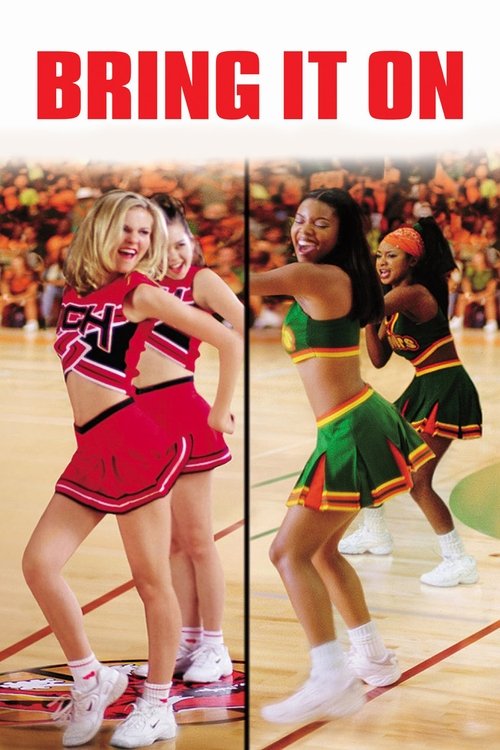
Bring It On (2000)
Directed by Peyton Reed
Yes — Bring It On is woke, scoring 60 out of 100 on our wokeness meter.
Bring It On arrives in 2000, which is to say before the culture had assembled a vocabulary for what the film was already doing.
Consciousness Markers
The central conflict is cultural appropriation: the white Toros have stolen routines from the underfunded Black/Latina East Compton Clovers, and the film explicitly addresses racial and economic inequality. It is one of the film's most discussed themes.
The film prominently features a Black rival squad led by Gabrielle Union and a gay male cheerleader, with a multiracial ensemble that was notably diverse for a 2000 teen comedy. However, the lead remains a white protagonist and the diversity is largely integrated into the plot rather than a modern casting mandate.
The story centers on female athletes, female leadership, and a rivalry between women, with Torrance's arc about accountability and respect rather than male approval. It has been retroactively praised for intersectional feminist undertones, but it is not an explicitly feminist polemic.
The Clovers' lack of school funding and the Toros' access to resources highlight economic disparity, and a corporate sponsorship is offered and refused. But the film does not mount a systemic anti-capitalist critique.
A gay male cheerleader, Les, appears as an accepted member of the Toros, and the film treats his sexuality without crisis. The element is minor and not a central theme.
The film gestures at serious issues of appropriation and inequality, but it delivers them through satire and teen comedy rather than direct preaching. Its didacticism is light.
No environmental or climate-change themes appear in the film.
Cheerleading body standards and a punitive diet are briefly depicted, but the film does not promote body positivity as a theme.
No neurodivergent characters or themes are present.
The film is a contemporary teen comedy with no historical revisionism.
Why it received this score
Bring It On arrives in 2000, which is to say before the culture had assembled a vocabulary for what the film was already doing. The plot concerns a San Diego cheerleading squad that has won five consecutive national titles on routines lifted, wholesale, from an underfunded Black and Latina squad in East Compton. The theft is not a subplot. It is the engine. Torrance Shipman inherits the crown, discovers the provenance, and spends the rest of the running time negotiating a debt she did not personally incur. The film names the crime, lets the wronged party take the trophy, and declines to hand victory back to its white protagonist. That is a more rigorous moral accounting than most of its contemporaries attempted.
The ensemble is unusually mixed for its moment, and the rival captain, played by Gabrielle Union with a composure the screenplay does not deserve, is granted dignity, ambition and the last word. A gay male cheerleader exists among the Toros without crisis or comment, which in 2000 passed for quiet radicalism. The squad is led by women, argues about leadership with women, and measures success without reference to male approval. The gulf between the two schools is stated plainly, and a corporate sponsorship is offered and refused, though the film stops well short of indicting the system that produced the gulf.
Where the film holds back is in its delivery. Serious matters surface through jokes, montages and a choreographer named Sparky, and the sermon never arrives. A punitive team diet is shown and left unexamined. There is no environmental thread, no neurodivergent character, no rewriting of history. The result is a comedy that gestures at inequality with one hand while keeping the other firmly on the pom-pom.
Analysis generated by our Consciousness Algorithm
Part of


Synopsis
The Toro cheerleading squad from Rancho Carne High School in San Diego has got spirit, spunk, sass and a killer routine that's sure to land them the national championship trophy for the sixth year in a row. But for newly-elected team captain Torrance, the Toros' road to total cheer glory takes a shady turn when she discovers that their perfectly-choreographed routines were in fact stolen.
Questions about Bring It On
Is Bring It On woke?
Yes — Bring It On is woke, scoring 60 out of 100 on our wokeness meter. That earns it a verdict of Woke.
What makes Bring It On woke?
4 of the 10 markers register at 30 or above, led by Racial Consciousness (80), Representation Casting (65) and Feminist Agenda (50). On Racial Consciousness: The central conflict is cultural appropriation: the white Toros have stolen routines from the underfunded Black/Latina East Compton Clovers, and the film explicitly addresses racial and economic inequality.
How does Bring It On compare to other 2000 movies?
It ranks #2 of the 125 films from 2000 we've scored; their average is 13. The wokest is But I'm a Cheerleader (72).
Is Bring It On the most woke Bring It On movie?
Yes. It scores highest of the 4 Bring It On films we've scored.