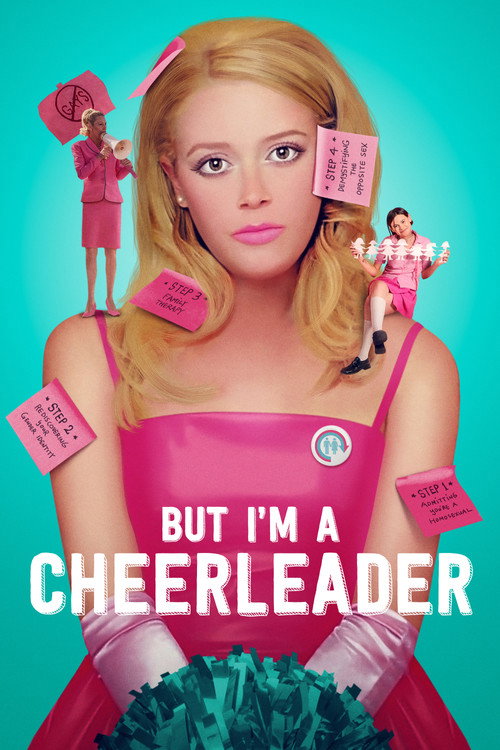
But I'm a Cheerleader (2000)
Directed by Jamie Babbit
Yes — But I'm a Cheerleader is woke, scoring 72 out of 100 on our wokeness meter.
But I'm a Cheerleader is a vibrant assault on the status quo, a saturated blast of primary colors designed to interrogate the boundaries of acceptable behavior.
Consciousness Markers
The entire premise is a lesbian cheerleader sent to conversion therapy who embraces her sexuality; the film is a landmark of queer cinema with gay, lesbian, bisexual, and transgender characters and a central sapphic romance.
Babbit made a conscious effort to cast performers of color in supporting roles, with Mike, Dolph, and Andre written as African American, Asian, and Hispanic respectively, and RuPaul headlining out of drag. The ensemble is deliberately diverse across race and sexuality.
Directed by a woman (Jamie Babbit) and built to explore the social construction of gender roles and heteronormativity from a femme perspective, deliberately countering the butch-centered lesbian films of its era.
The screenwriter aimed to anger audiences and provoke discussion about conversion therapy, and the film carries a clear message about its harms, though it delivers this through broad comedy rather than direct preaching.
Racial consciousness is present mainly in the production's casting philosophy rather than the narrative itself; the story does not engage racial themes directly.
The film satirizes the artificiality of the American dream of femininity and the consumerist trappings of the conversion camp, but its critique targets conformity and the religious right rather than wealth or class.
No environmental or climate themes appear in the film.
No body positivity themes are present.
No neurodivergence themes are present.
The film is a contemporary satire, not a reworking of historical events.
Why it received this score
But I'm a Cheerleader is a vibrant assault on the status quo, a saturated blast of primary colors designed to interrogate the boundaries of acceptable behavior. Directed by Jamie Babbit, the film operates with an almost aggressive level of social consciousness. The premise, centered on a young woman navigating the pressures of heteronormativity, is a foundational text for queer cinema. The production team made a clear effort to diversify the supporting roles, ensuring that the representation of identity was far broader than the standard fare of its era. The central romance, which is nearly flawless in its commitment to its progressive sensibilities, gives the narrative a powerful emotional anchor. This attention to cultural awareness is the film's greatest strength.
We find the satire of the conversion camp to be both heavy-handed and surprisingly effective. The film is not subtle in its critique of the artificiality of the American dream, nor is it afraid to confront the ugly reality of forced gender roles. However, this clear message sometimes borders on sermonizing. While the film excels at examining the constructed nature of femininity and identity, it remains superficial when addressing broader societal issues. We see no deep engagement with climate concerns or complex anti-capitalist themes. Racial consciousness, for instance, exists only in the production's deliberate casting choices, not within the script's thematic structure.
The film successfully elevates its message through high-concept comedy and aesthetic design. It is a fascinating artifact that managed to exist at the intersection of niche progressive sensibilities and mainstream accessibility. It is a necessary viewing for anyone studying the evolution of modern social commentary. The film is a highly stylized exercise in defiance, proving that cultural statements do not always require narrative complexity, only a willingness to be loud.
Analysis generated by our Consciousness Algorithm


Synopsis
Megan is an all-American girl. A cheerleader. She has a boyfriend. But Megan doesn't like kissing her boyfriend very much. And she's pretty touchy with her cheerleader friends. Her conservative parents worry that she must be a lesbian and send her off to "sexual redirection" school, where she must, with other lesbians and gays learn how to be straight.
Questions about But I'm a Cheerleader
Is But I'm a Cheerleader woke?
Yes — But I'm a Cheerleader is woke, scoring 72 out of 100 on our wokeness meter. That earns it a verdict of Woke.
What makes But I'm a Cheerleader woke?
4 of the 10 markers register at 30 or above, led by LGBTQ+ Themes (98), Feminist Agenda (72) and Representation Casting (72). On LGBTQ+ Themes: The entire premise is a lesbian cheerleader sent to conversion therapy who embraces her sexuality; the film is a landmark of queer cinema with gay, lesbian, bisexual, and transgender characters and a central sapphic romance.
How does But I'm a Cheerleader compare to other 2000 movies?
It is the wokest of the 125 films from 2000 we've scored; their average is 13.
How is the Woke Score calculated?
An AI-assisted process researches the film and its reception, scores it 0–100 on ten markers, then combines those into one 0–100 Woke Score. It measures a specific set of 2020s cultural themes, not film quality.