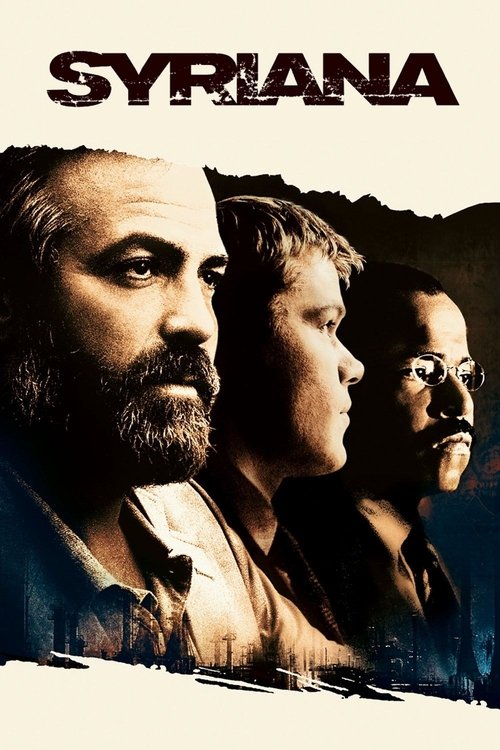
Syriana (2005)
Directed by Stephen Gaghan
Partly — Syriana is somewhat woke, scoring 45 out of 100 on our wokeness meter.
Syriana arrives with the grim confidence of a film that has done its homework and intends to show it.
Consciousness Markers
A sustained indictment of oil conglomerates, corporate bribery, and the revolving door between business and government, with the merger storyline explicitly sacrificing individuals to protect corporate power.
The ensemble prominently features Middle Eastern actors (Alexander Siddig, Amr Waked, Kayvan Novak, Mazhar Munir) in substantive roles, and the film deliberately centers Arab and South Asian perspectives, though this casting serves the geopolitical narrative rather than a modern representation agenda.
The film is densely didactic about oil geopolitics, CIA malfeasance, and US foreign policy, delivering its thesis through intricate plotting and dialogue that frequently verges on exposition.
The film humanizes Arab and Pakistani migrant characters and critiques Western exploitation of the Middle East, but its lens is geopolitical and anti-imperialist rather than a modern racial-justice framework.
Oil dependency is the film's central subject, but the concern is strategic and economic, not environmental; climate change is never invoked.
No LGBTQ+ characters, themes, or subtext appear anywhere in the film.
Women appear only in peripheral roles (Amanda Peet as Woodman's wife); the film has no feminist themes or gender critique.
No body-positivity themes or messaging are present.
No neurodivergent characters or themes are depicted.
The film is a fictionalized thriller loosely inspired by real events and a memoir, not a revisionist rewriting of history for ideological ends.
Why it received this score
Syriana arrives with the grim confidence of a film that has done its homework and intends to show it. Stephen Gaghan's screenplay, loosely tethered to Robert Baer's memoir, braids four storylines through Geneva, Washington, the Persian Gulf and the Kazakh oil fields, and it casts its Arab and South Asian characters with real weight: Alexander Siddig's reform-minded prince, Amr Waked's laid-off migrant worker, Mazhar Munir's Wasim, a boy who studies Arabic to improve his job prospects and ends up in a madrasa that hands him a missile. The film takes those perspectives seriously. It also treats them as raw material for a geopolitical argument, which is a different thing from a representation program, and the difference is visible on screen.
Where the film leans hardest is on its corporate indictment. The Connex-Killen merger is a machine that eats people: a Texas oilman offered up as a body, a mentor handed to the Justice Department as a second body, a prince killed by a Predator drone so an antitrust inquiry can be closed and a chief executive can collect his industry award. Gaghan's anger at the revolving door between business and government is sustained and specific. His method of expressing it is less subtle. Characters explain the oil economy to each other in conference rooms, and the plotting sometimes doubles as a briefing document.
Oil dependency is the film's obsession, though the concern is strategic and economic. The environment never enters the room. Neither do questions of gender, sexuality, disability or body image, which is a description and not a complaint. This is a 2005 anti-imperialist thriller with a long memory and a heavy hand, and it belongs to an older tradition of political cinema. It lectures. It also lands a few punches. The sommelier notes a tannic vintage, best decanted with patience and a map of the Persian Gulf.
THEMATIC TAGS: oscar_winner, book_adaptation, true_story
Analysis generated by our Consciousness Algorithm
Part of


Synopsis
The Middle Eastern oil industry is the backdrop of this tense drama, which weaves together numerous story lines. Bennett Holiday is an American lawyer in charge of facilitating a dubious merger of oil companies, while Bryan Woodman, a Switzerland-based energy analyst, experiences both personal tragedy and opportunity during a visit with Arabian royalty. Meanwhile, veteran CIA agent Bob Barnes uncovers an assassination plot with unsettling origins.
Questions about Syriana
Is Syriana woke?
Partly — Syriana is somewhat woke, scoring 45 out of 100 on our wokeness meter. That earns it a verdict of Woke-Adjacent.
What makes Syriana woke?
4 of the 10 markers register at 30 or above, led by Eat the Rich (75), Lecture Energy (45) and Representation Casting (45). On Eat the Rich: A sustained indictment of oil conglomerates, corporate bribery, and the revolving door between business and government, with the merger storyline explicitly sacrificing individuals to protect corporate power.
How does Syriana compare to other 2005 movies?
It ranks #11 of the 181 films from 2005 we've scored; their average is 13. The wokest is The Constant Gardener (72).
How is the Woke Score calculated?
An AI-assisted process researches the film and its reception, scores it 0–100 on ten markers, then combines those into one 0–100 Woke Score. It measures a specific set of 2020s cultural themes, not film quality.