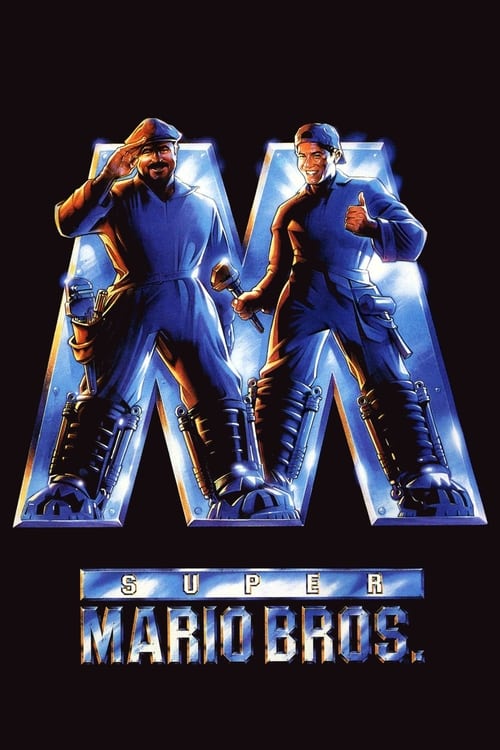
Super Mario Bros. (1993)
Directed by Annabel Jankel
No — Super Mario Bros. is not woke, scoring 12 out of 100 on our wokeness meter.
Super Mario Bros. (1993) is a strange artifact from a moment when video game adaptations were not a genre but a dare.
Consciousness Markers
John Leguizamo (Colombian-American) was cast as Luigi, and the rewrite introduced Big Bertha as a black woman, giving the otherwise white cast a modest degree of diversity for 1993.
The British writing team was explicitly hired to deliver a 'more adult and feminist tone,' expanding Princess Daisy and Lena's roles, though Daisy remains largely a rescue object in the finished film.
The plumbers are squeezed by mafioso developer Scapelli's construction company and Koopa rules a dystopian police state, offering mild anti-corporate and anti-authoritarian shading without any coherent economic critique.
Conceived as a subversive, dark comedy in the Ghostbusters mold, the film is far more interested in weirdness than in preaching any message.
The film engages no racial themes; the only trace is the incidental casting of a black actress as the nightclub bouncer.
Co-director Morton mused about a dinosaur society that 'holds fossil fuels sacred,' a faint satirical ecological note that never becomes an actual environmental message.
No LGBTQ+ characters, themes, or subtext appear anywhere in the film.
No body-positivity themes or messaging are present.
No neurodivergent characters or themes are depicted.
The film invents a dinosaur parallel universe but makes no revisionist claims about real history.
Why it received this score
Super Mario Bros. (1993) is a strange artifact from a moment when video game adaptations were not a genre but a dare. Annabel Jankel and Rocky Morton turn Brooklyn plumbers into dimensional travelers, sending them to Dinohattan, a dystopian parallel world of evolved dinosaurs. The film's social awareness is modest and mostly incidental. John Leguizamo, Colombian-American, plays Luigi, and Big Bertha appears as a black woman, small gestures of representation in an otherwise pale cast. These choices register without comment. The film does not pause to congratulate itself. It is the first American feature-length live-action film based on a video game, though that historical distinction does not make it more culturally advanced.
Feminist ambitions are documented but uneven. British writers were brought in to deliver a more adult and feminist tone, expanding Princess Daisy and Lena. Daisy remains largely a rescue object, kissed goodbye and left to rule a dinosaur city. Racial consciousness is absent; a black actress as nightclub bouncer is casting, not theme. Climate concern flickers in the directors' talk of a dinosaur society that holds fossil fuels sacred, yet the finished film never turns that into an environmental sermon. Anti-capitalist shading exists: a mafioso developer squeezes the plumbers, and Koopa runs a police state. The critique is atmospheric, not coherent.
The film has no LGBTQ content, no body-positivity message, no neurodivergent characters, and no revisionist claims about real history. Its lecture energy is low. It was conceived as a subversive dark comedy in the Ghostbusters mold, and it prefers weirdness to preaching. The result is a financial failure turned cult curiosity, a movie that devolves its villain into a Tyrannosaurus rex and then primeval slime. For all its mess, it does not scold. It simply happens, which may be its most old-fashioned quality. Nintendo did not license another Mario film for three decades, and perhaps that says enough.
Analysis generated by our Consciousness Algorithm
Synopsis
Mario and Luigi, plumbers from Brooklyn, find themselves in an alternate universe where evolved dinosaurs live in hi-tech squalor. They're the only hope to save our universe from invasion by the dino dictator, Koopa.
Questions about Super Mario Bros.
Is Super Mario Bros. woke?
No — Super Mario Bros. is not woke, scoring 12 out of 100 on our wokeness meter. That earns it a verdict of Ultra Based.
Does Super Mario Bros. have any woke elements?
Very few. None of the 10 markers reaches 30, the level where a marker counts as present; the highest is Representation Casting at 25.
How does Super Mario Bros. compare to other 1993 movies?
It ranks #29 of the 97 films from 1993 we've scored; their average is 11. The wokest is Bound by Honor (60).
How is the Woke Score calculated?
An AI-assisted process researches the film and its reception, scores it 0–100 on ten markers, then combines those into one 0–100 Woke Score. It measures a specific set of 2020s cultural themes, not film quality.