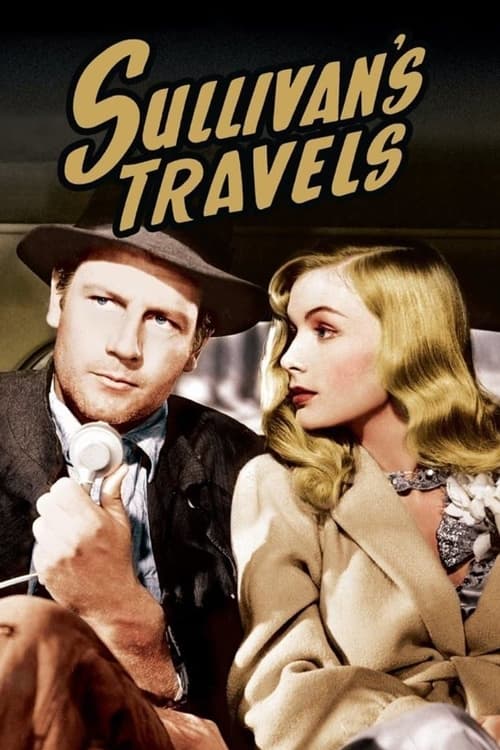
Sullivan's Travels (1941)
Directed by Preston Sturges
No — Sullivan's Travels is not woke, scoring 17 out of 100 on our wokeness meter.
Preston Sturges made a film about a man who wants to make a film about suffering, and the joke lands squarely on him.
Consciousness Markers
The Southern Black church sequence, in which prisoners and congregants share a Disney cartoon, was singled out by NAACP secretary Walter White for its dignified, non-menial portrayal of African-Americans — a genuinely progressive gesture for its era, though not framed as modern racial consciousness.
The film satirizes the Hollywood studio system and the idle rich, and Sullivan's tax-motivated marriage is a cynical jab at wealth, but the ultimate message celebrates escapist comedy rather than indicting capital.
The film carries a social message about poverty and the value of laughter, but Sturges explicitly wrote it as a rebuke to the 'preaching' of message comedies, so the moralizing is deliberately undercut by farce.
The principal cast is entirely white, with the notable exception of the Black congregation in the church sequence, who are treated with unusual dignity for 1941 but remain peripheral. No modern diverse-casting intent is present.
Veronica Lake's character is spirited and self-directed, shoving Sullivan into his own pool and insisting on joining his journey, but she functions as a romantic companion rather than a vehicle for any feminist argument.
No LGBTQ+ characters, themes, or subtext. The Girl's cross-dressing disguise is a screwball gag, not a queer statement.
No environmental or climate themes whatsoever.
No body-positivity themes; the film's physical comedy and casting reflect standard 1941 norms.
Sullivan's amnesia is a plot device for mistaken identity, not a depiction of neurodivergence.
Not a historical film and makes no revisionist claims about past events.
Why it received this score
Preston Sturges made a film about a man who wants to make a film about suffering, and the joke lands squarely on him. Sullivan, a director of profitable comedies, dons a hobo's rags to know trouble firsthand, dragging a studio entourage and later a struggling actress (Veronica Lake) along for the ride. The satire aims at Hollywood's appetite for solemnity, and it is a sharp one. The studio wants another comedy. Sullivan wants poverty, or at least the appearance of it, and the film is honest enough to find the whole enterprise ridiculous.
The social content here is real but belongs to its moment. The Southern church sequence, where prisoners and Black congregants share a Disney cartoon, drew a letter of thanks from the NAACP's Walter White, who praised the dignified treatment of Negroes in an era that rarely offered any. That is a genuine gesture, and it earns its place. It is not the racial consciousness of a later age, and it does not pretend to be. Lake's character is lively and stubborn, shoving her wealthy deceiver into his own pool, but she is a companion, not a cause. The idle rich take their lumps, and Sullivan's tax-driven marriage is a cynical touch, though the film's heart lies with the worth of laughter, not the indictment of capital.
Sturges wrote the thing as a rebuke to message comedies, and the moralizing is deflated by farce at every turn. The chain gang, the amnesia, the mistaken corpse: all machinery for a punchline about the value of making people laugh. A worthy film, a humane one, and almost entirely innocent of the cultural markers that would come to define a later era's cinema. Its convictions are old-fashioned, its charity is genuine, and its conscience is entirely its own.
Analysis generated by our Consciousness Algorithm
Part of


Synopsis
Successful movie director John L. Sullivan, convinced he won't be able to film his ambitious masterpiece until he has suffered, dons a hobo disguise and sets off on a journey, aiming to "know trouble" first-hand. When all he finds is a train ride back to Hollywood and a beautiful blonde companion, he redoubles his efforts, managing to land himself in more trouble than he bargained for when he loses his memory and ends up a prisoner on a chain gang.
Questions about Sullivan's Travels
Is Sullivan's Travels woke?
No — Sullivan's Travels is not woke, scoring 17 out of 100 on our wokeness meter. That earns it a verdict of Ultra Based.
Does Sullivan's Travels have any woke elements?
1 of the 10 markers register at 30 or above, led by Racial Consciousness (35). On Racial Consciousness: The Southern Black church sequence, in which prisoners and congregants share a Disney cartoon, was singled out by NAACP secretary Walter White for its dignified, non-menial portrayal of African-Americans — a genuinely progressive gesture for its era, though not framed as modern racial consciousness.
How does Sullivan's Travels compare to other 1941 movies?
It is the wokest of the 6 films from 1941 we've scored; their average is 4.
How is the Woke Score calculated?
An AI-assisted process researches the film and its reception, scores it 0–100 on ten markers, then combines those into one 0–100 Woke Score. It measures a specific set of 2020s cultural themes, not film quality.