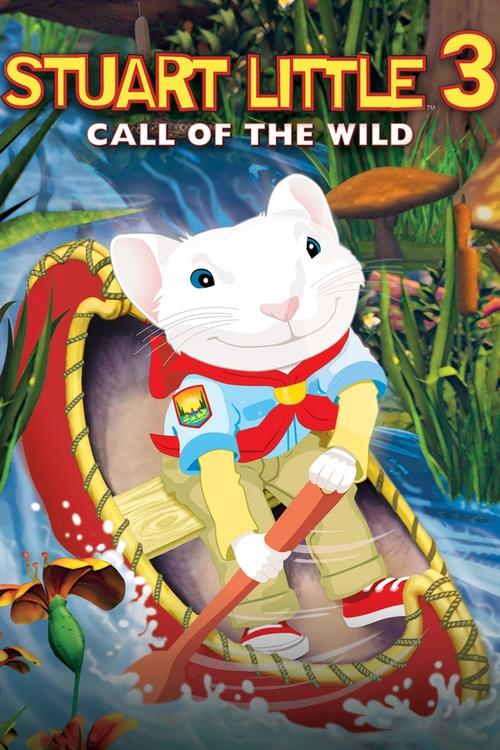
Stuart Little 3: Call of the Wild (2005)
Directed by Audu Paden
No — Stuart Little 3: Call of the Wild is not woke, scoring 5 out of 100 on our wokeness meter.
Stuart Little 3: Call of the Wild arrives as the third and final entry in a trilogy that began with a mouse of unusual ambition and ends with a direct-to-video animated feature that nobody involved seems to have enjoyed making.
Consciousness Markers
Wayne Brady voices a main character, but the film is otherwise not built around inclusive casting and the characters are non-human.
Mild children's-film moralizing about perseverance, friendship, and belonging, but no modern social-justice lecturing.
No LGBTQ+ characters, themes, or subtext.
Female characters appear, including Eleanor and Brooke, but there is no feminist agenda or gender commentary.
No racial themes, commentary, or consciousness.
The forest setting is backdrop only; no environmental or climate messaging.
No economic critique or anti-capitalist themes.
Stuart's small size drives a perseverance plot, but it is not framed as body positivity or body-image commentary.
No neurodivergent characters or themes.
No historical revisionism; the film is not a historical narrative.
Why it received this score
Stuart Little 3: Call of the Wild arrives as the third and final entry in a trilogy that began with a mouse of unusual ambition and ends with a direct-to-video animated feature that nobody involved seems to have enjoyed making. The live-action hybrid charm of the earlier films is gone, replaced by flat computer animation and a plot about a lakeside vacation, a Lake Scout troop, and a cougar known as the Beast who abducts the family cat. Michael J. Fox, Geena Davis, and Hugh Laurie return to voice their roles with the weary professionalism of actors fulfilling a contract. The film grossed eleven million dollars in DVD sales, which is the most interesting thing about it.
The narrative concerns perseverance and belonging, delivered with the gentle sermonizing that children's entertainment has always favored. Stuart is small, the Scouts are tall, and the lesson is that effort matters more than stature. This is not body positivity, nor is it a meditation on difference in any modern sense. It is the oldest story in the book, told without commentary. Wayne Brady voices Reeko the skunk, a casting decision that constitutes the film's entire engagement with inclusive representation. The forest is a backdrop, not a cause. Nobody lectures about carbon or capital.
This is a cultural artifact of almost zero yield. The film has no gender politics, no racial consciousness, no queer subtext, and no interest in the neurodivergent experience of a mouse who talks to cats. It moralizes mildly about friendship and honesty, which is as close as it comes to a message. For the sommelier of social consciousness, this is a thin vintage, pleasant enough for a seven-year-old, and entirely without aftertaste.
Analysis generated by our Consciousness Algorithm
Part of


Synopsis
With school out for the summer, The Littles are vacationing in a cabin by the lake, and Stuart is so excited he could burst! But when Snowbell the cat is captured by a mean-spirited creature known simply as the Beast, it's up to Stuart and a skunk named Reeko to rescue him and a few other friends.
Questions about Stuart Little 3: Call of the Wild
Is Stuart Little 3: Call of the Wild woke?
No — Stuart Little 3: Call of the Wild is not woke, scoring 5 out of 100 on our wokeness meter. That earns it a verdict of Ultra Based.
Does Stuart Little 3: Call of the Wild have any woke elements?
Very few. None of the 10 markers reaches 30, the level where a marker counts as present; the highest is Lecture Energy at 10.
How does Stuart Little 3: Call of the Wild compare to other 2005 movies?
It ranks #126 of the 181 films from 2005 we've scored; their average is 13. The wokest is The Constant Gardener (72).
Is Stuart Little 3: Call of the Wild the most woke Stuart Little movie?
Yes. It scores highest of the 3 Stuart Little films we've scored.