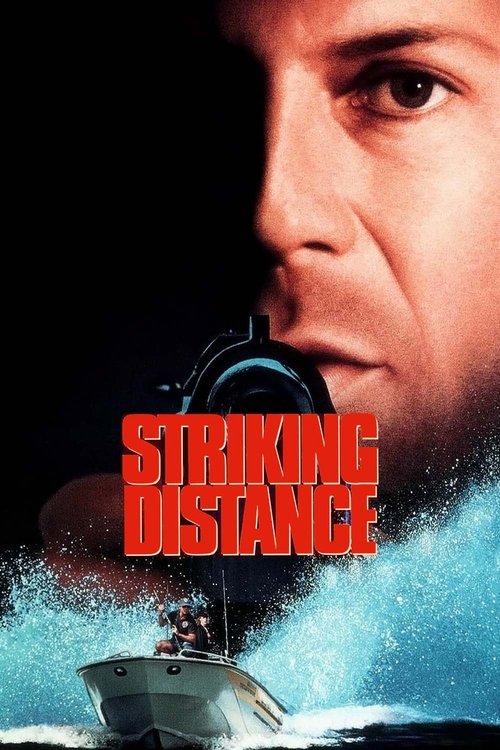
Striking Distance (1993)
Directed by Rowdy Herrington
No — Striking Distance is not woke, scoring 6 out of 100 on our wokeness meter.
"Striking Distance" arrives from 1993 with the weary confidence of a film that was rewritten by its own star and reshot until the seams showed.
Consciousness Markers
The cast includes Andre Braugher and a river rescue coworker named Kim Lee, but these are incidental presences in a predominantly white 1993 Pittsburgh cop thriller with no commentary on their inclusion.
Sarah Jessica Parker's Jo Christman is revealed to be an undercover state investigator, giving her a measure of professional agency, but the film is a standard male-led genre thriller with the love interest also functioning as a target.
No LGBTQ+ characters, themes, or subtext of any kind appear in the film.
The film engages no racial themes, commentary, or dynamics whatsoever.
The river patrol setting is atmospheric backdrop only; there is no environmental or climate messaging.
The film concerns police corruption and a serial killer, not economic critique or class warfare.
No body positivity themes; female victims are framed conventionally and the reshot love scenes emphasize conventional attractiveness.
No neurodivergent characters or themes are present or explored.
A fictional crime thriller with no historical subject matter to revise.
The film is a rote procedural thriller that lectures no one; it has no social or moral thesis to preach.
Why it received this score
"Striking Distance" arrives from 1993 with the weary confidence of a film that was rewritten by its own star and reshot until the seams showed. Bruce Willis plays Tom Hardy, a Pittsburgh homicide detective demoted to river patrol after telling a reporter that the Polish Hill Strangler might be a cop. The river is atmospheric furniture. It carries bodies and boats and nothing resembling an environmental thesis, a conclusion reached after patient review of every barge.
The cast includes Andre Braugher and a river rescue colleague named Kim Lee, both of whom occupy the frame without the film pausing to remark upon them. That is the full extent of the picture's demographic curiosity. Sarah Jessica Parker's Jo Christman turns out to be an undercover state investigator named Emily Harper, which grants her a badge and a measure of professional standing before the plot reassigns her to the role of woman tied to a chair. This is not a film with a thesis. It has a serial killer, a corrupt uncle, and a taser.
We are dealing with a procedural that lectures no one, critiques no economy, and revises no history. The love scenes were reshot to be sexier, according to contemporary reporting, which reveals more about Columbia's marketing department than about any cultural program. Roger Ebert listed the clichés individually, which sounds exhausting, and he was right to be tired. The film opened at number one and then evaporated. It stands as a curious artifact: a star vehicle that treats its star as an auteur, a Pittsburgh postcard with a body count. We classify it without enthusiasm and without objection.
Analysis generated by our Consciousness Algorithm


Synopsis
Demoted Pittsburgh cop Tom Hardy works river patrol while a serial killer targets women from his past, forcing him to conduct an unauthorized investigation to prove his innocence and expose a dirty cop.
Questions about Striking Distance
Is Striking Distance woke?
No — Striking Distance is not woke, scoring 6 out of 100 on our wokeness meter. That earns it a verdict of Ultra Based.
Does Striking Distance have any woke elements?
Very few. None of the 10 markers reaches 30, the level where a marker counts as present; the highest is Representation Casting at 15.
How does Striking Distance compare to other 1993 movies?
It ranks #48 of the 97 films from 1993 we've scored; their average is 11. The wokest is Bound by Honor (60).
How is the Woke Score calculated?
An AI-assisted process researches the film and its reception, scores it 0–100 on ten markers, then combines those into one 0–100 Woke Score. It measures a specific set of 2020s cultural themes, not film quality.