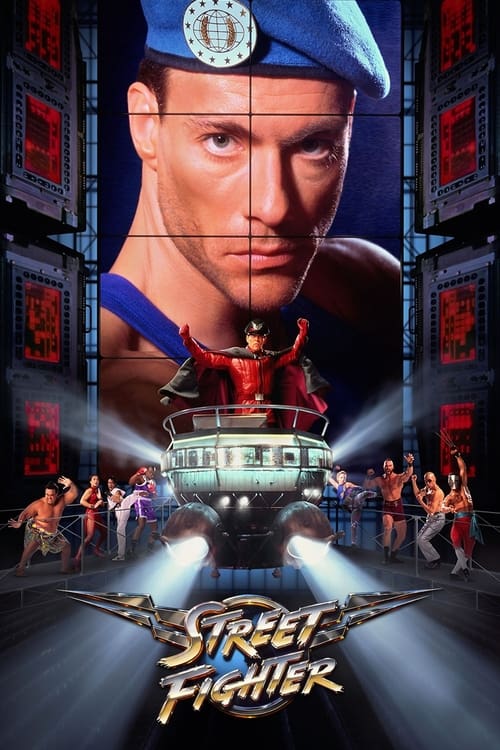
Street Fighter (1994)
Directed by Steven E. de Souza
No — Street Fighter is not woke, scoring 10 out of 100 on our wokeness meter.
The 1994 Street Fighter arrives as a curiosity for our ledger, a Capcom-financed adaptation in which a Belgian martial artist is paid roughly a quarter of the budget to play a United States colonel, and the remaining roles go to whoever was affordable and, in one instance, whoever the Australian Actors' Guild demanded.
Consciousness Markers
The cast is notably international, with actors of various ethnicities playing characters from the video game, but this reflects source-material fidelity and availability rather than a modern inclusive-casting agenda.
Cammy and Chun-Li are capable female characters in action roles, but the film offers no feminist critique or agenda.
No LGBTQ+ characters, themes, or subtext.
The conflict is geopolitical and fictional, with no engagement with racial identity or systemic racism.
No environmental or climate themes.
Bison is a dictator and drug lord, not a capitalist villain, and the film contains no anti-capitalist critique.
No body-positivity themes or messaging.
No neurodivergent characters or themes.
The film is a fictional video-game adaptation, not a historical revision.
The film is campy action entertainment and does not lecture the audience on social issues.
Why it received this score
The 1994 Street Fighter arrives as a curiosity for our ledger, a Capcom-financed adaptation in which a Belgian martial artist is paid roughly a quarter of the budget to play a United States colonel, and the remaining roles go to whoever was affordable and, in one instance, whoever the Australian Actors' Guild demanded. The resulting ensemble is unusually multinational: Thai, Indian, Chinese, Japanese and African American performers fill out the Allied Nations and the warlord's court. We record this as representation of a sort, though it flows from fidelity to the arcade cabinet and from a depleted casting account, not from any contemporary inclusion initiative. The film's politics begin and end at the roster screen.
Two women appear in combat roles. Cammy White, played by Kylie Minogue, holds a bazooka with a Heidi braid and a mean expression, and Chun-Li, a reporter avenging her father, fights Bison in his quarters. Both are competent. Neither is offered as a thesis. There is no critique of the military hierarchy, no reckoning with the warlord's gendered violence, no speech. Elsewhere the ledger is bare. Bison is a dictator and a drug kingpin, a tyrant of the old model, so the film's economics stay quiet. The climate does not appear. No character is written as neurodivergent. No body is celebrated. History is not revised, because there is no history here, only Shadaloo.
The film is a campy, overstuffed action picture that lectures nobody, which is its own modest virtue. Raul Julia, visibly ill, plays Bison with Shakespearean relish, and the finished work is dedicated to his memory. We find no sermon in it, no lesson, no instruction. For a genre that now arrives with homework attached, that absence registers as almost restful.
Analysis generated by our Consciousness Algorithm


Synopsis
Colonel William F. Guile leads an international Allied Nations strike force to free relief workers held hostage by the megalomaniacal dictator General M. Bison in the war-torn region of Shadaloo.
Questions about Street Fighter
Is Street Fighter woke?
No — Street Fighter is not woke, scoring 10 out of 100 on our wokeness meter. That earns it a verdict of Ultra Based.
Does Street Fighter have any woke elements?
Very few. None of the 10 markers reaches 30, the level where a marker counts as present; the highest is Representation Casting at 20.
How does Street Fighter compare to other 1994 movies?
It ranks #22 of the 86 films from 1994 we've scored; their average is 10. The wokest is On Deadly Ground (75).
How is the Woke Score calculated?
An AI-assisted process researches the film and its reception, scores it 0–100 on ten markers, then combines those into one 0–100 Woke Score. It measures a specific set of 2020s cultural themes, not film quality.